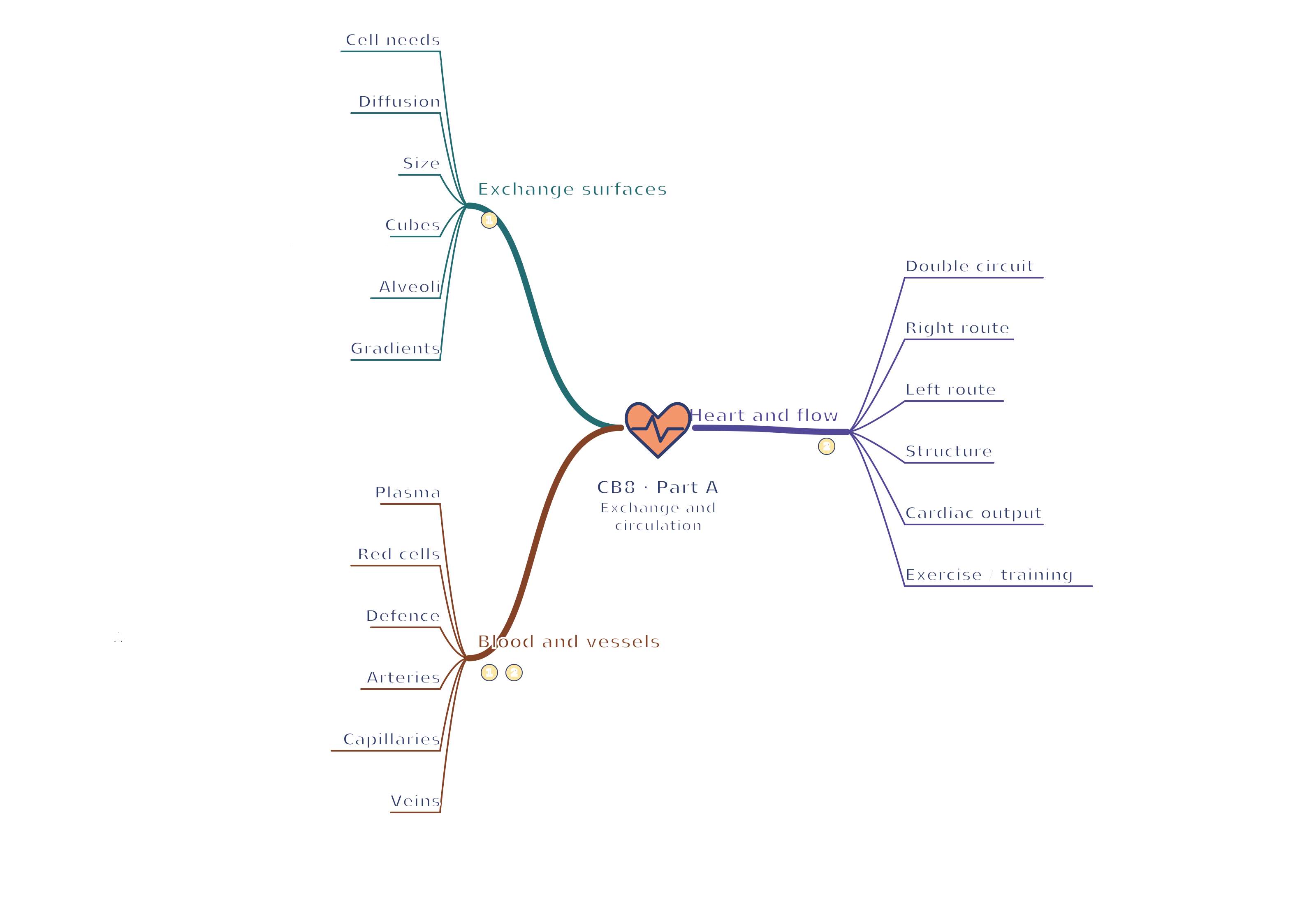
Back to revision notes Open full-size SVG Print mind map Part A · Exchange and circulation Exchange and transport in animals mind map Use your browser’s Print command for A4 landscape, or choose A3 in its paper settings. The SVG remains sharp when enlarged. A text version follows the map.
Read the mind map as text Exchange surfaces Cell needs: Deliver nutrients / O₂; remove CO₂ and liver-made ureaDiffusion: Large area, short distance, steep gradient → faster exchangeSize: Larger organisms: lower SA:V and longer transport distancesCubes: SA = 6l²; V = l³; 1, 2, 3 cm → 6:1, 3:1, 2:1Alveoli: Large moist surface; two one-cell-thick wallsGradients: O₂ → blood; CO₂ → air; ventilation and blood flow maintainBlood and vessels Plasma: Carries cells, dissolved nutrients, wastes, hormones and heatRed cells: Haemoglobin carries O₂; biconcave, no nucleusDefence: White cells: immunity; platelet fragments: clottingArteries: Away from heart; thick elastic muscle; pulse is pressure waveCapillaries: Thin walls, extensive networks; exchange with tissuesVeins: Towards heart; lower pressure, wider lumen; many have valvesHeart and flow Double circuit: Body → right heart → lungs → left heart → bodyRight route: Vena cava → right atrium → right ventricle → pulmonary artery → lungsLeft route: Pulmonary veins → left atrium → left ventricle → aorta → bodyStructure: Valves; septum; thicker left ventricle; coronary supplyCardiac output: Stroke volume × heart rate; 70 × 75 = 5,250 cm³/minExercise / training: Immediate demand raises output; training may raise stroke volumeConnections Exchange surfaces → Blood and vessels: Gas exchange loads oxygen into circulating blood. Blood and vessels → Heart and flow: The pump drives blood through vessels to tissues.