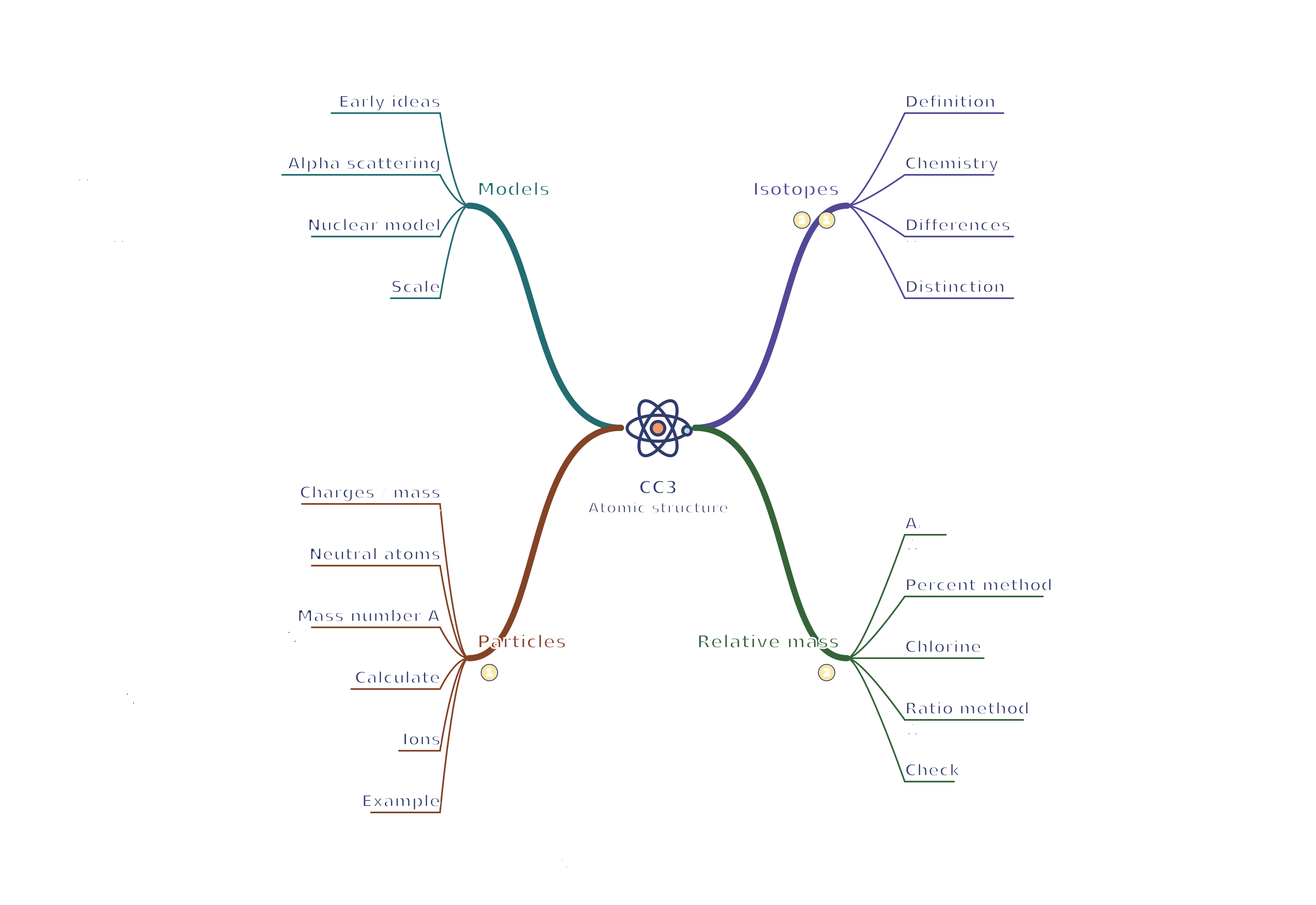
Back to revision notes Open full-size SVG Print mind map CC3 Atomic structure mind map Use your browser’s Print command for A4 landscape, or choose A3 in its paper settings. The SVG remains sharp when enlarged. A text version follows the map.
Read the mind map as text Models Early ideas: Dalton spheres → Thomson electron / plum puddingAlpha scattering: Mostly passes through; rare strong deflectionsNuclear model: Mostly empty; tiny dense positive nucleusScale: Atom ≈ 10⁻¹⁰ m; nucleus much smaller; drawings not to scaleParticles Charges / mass: Proton +1 / 1; neutron 0 / 1; electron −1 / tiny massNeutral atoms: Electrons = protons; atomic number Z = protonsMass number A: Protons + neutrons; ²³₁₁Na: 11 p, 12 n, 11 eCalculate: Neutrons = A − Z; neutral electrons = ZIons: Lose electrons: positive; gain: negative; protons unchangedExample: 13 protons + 14 neutrons → aluminium-27Isotopes Definition: Same element / protons; different neutrons / mass numbersChemistry: Same electron arrangement → very similar reactionsDifferences: Mass affects physical properties; not all are radioactiveDistinction: Isotopes differ in neutrons; ions differ in electronsRelative mass Aᵣ: Weighted mean relative to ¹²C standard; no unitPercent method: Σ(isotope mass × percentage) ÷ 100Chlorine: 75% ³⁵Cl + 25% ³⁷Cl → Aᵣ = 35.5Ratio method: Weighted total ÷ total abundance; 3:1 → divide by 4Check: Between isotope masses; nearer more abundant isotopeConnections Particles → Isotopes: Neutron number distinguishes isotopes of one element. Isotopes → Relative mass: Isotope abundances determine the weighted mean.