Use your browser’s Print command for A4 landscape, or choose A3 in its paper settings. The SVG remains sharp when enlarged. A text version follows the map.
Read the mind map as text
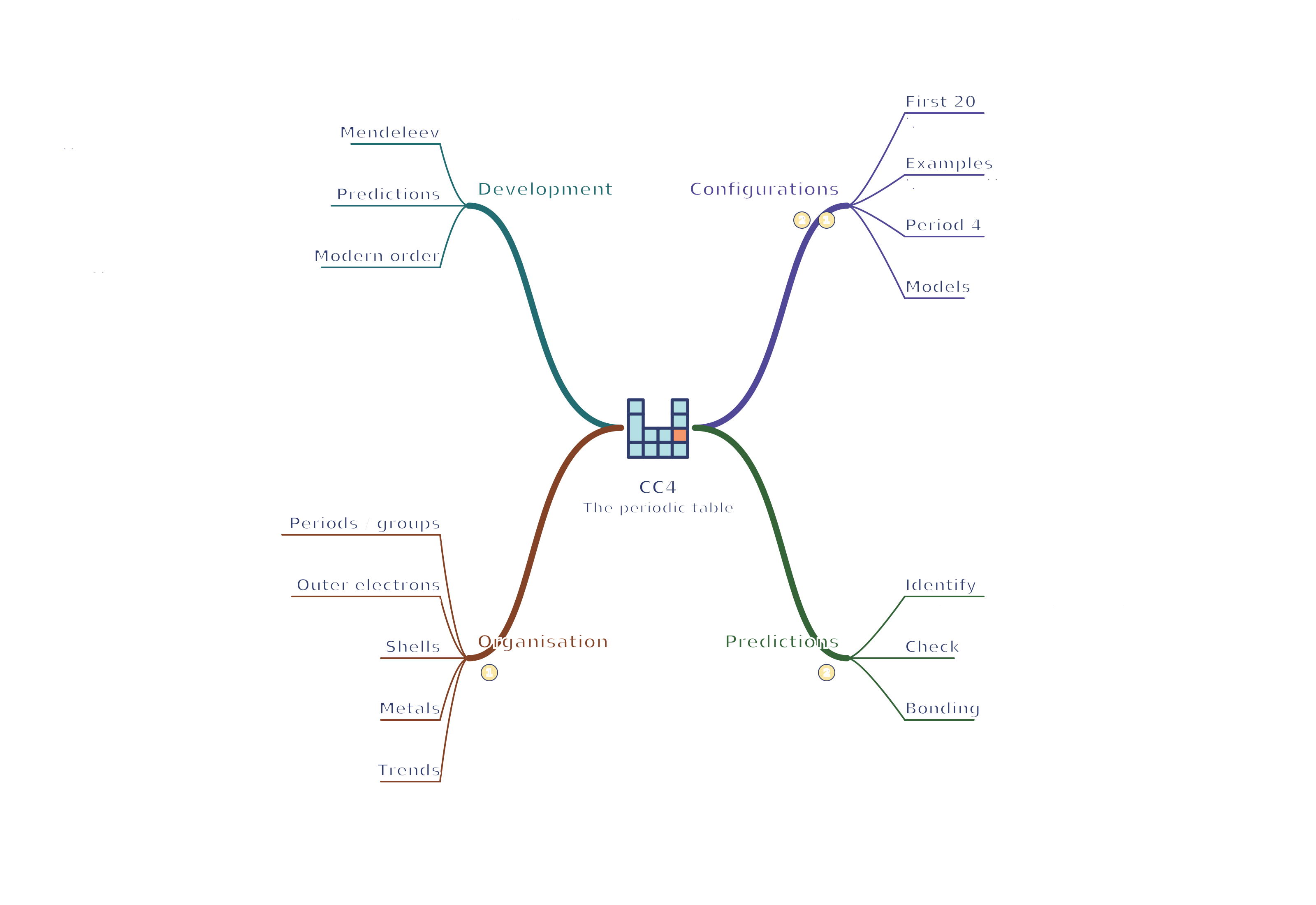
Development
Mendeleev: Mass order with chemical groupings; sometimes reversed order
Predictions: Gaps for undiscovered elements; matching discoveries supported model
Modern order: Moseley evidence → atomic / proton number
Organisation
Periods / groups: Rows / columns; proton number increases across period
Outer electrons: Same main group → similar chemistry; groups 1–7 give count
Shells: Period number = occupied shells in simple model
Metals: Left / centre; conduct and lose electrons; H is non-metal
Trends: Similar does not mean identical; reactivity trends vary
Configurations
First 20: Neutral count = Z; fill 2, 8, 8 then fourth shell
Examples: Na: 2,8,1; Mg: 2,8,2; Cl: 2,8,7
Period 4: K: 2,8,8,1; Ca: 2,8,8,2
Models: Shell drawings count electrons; not actual paths / scale
Predictions
Identify: 2,8,3 → Al, period 3, group 3; sum electrons gives Z
Check: Use total, occupied shells and outer count together
Bonding: Group 1 commonly loses one; group 7 gains / shares one
Connections
Organisation → Configurations: Shells and outer electrons locate elements in the table.
Configurations → Predictions: Electron configuration helps predict ion formation.