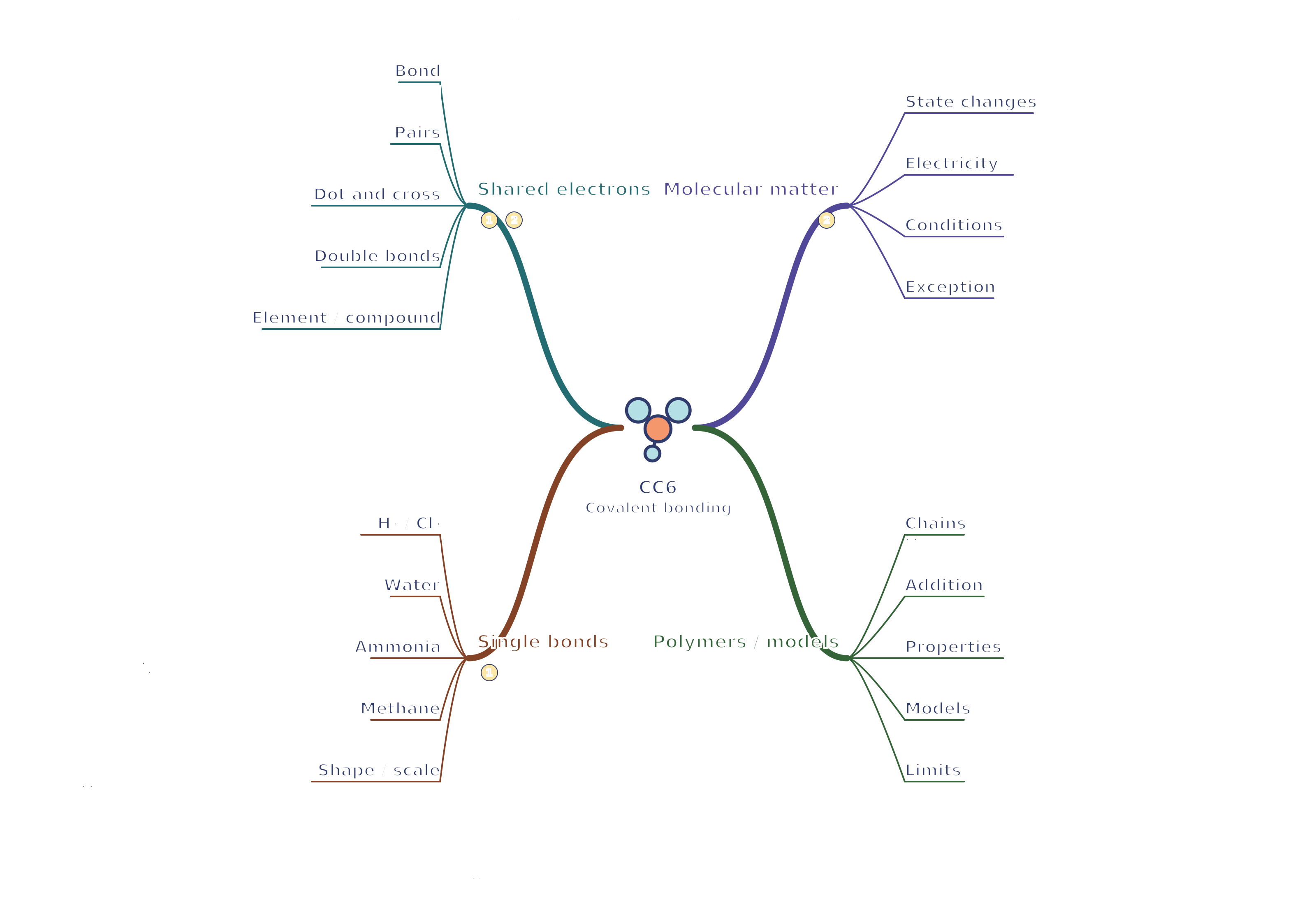
Back to revision notes Open full-size SVG Print mind map CC6 Covalent bonding mind map Use your browser’s Print command for A4 landscape, or choose A3 in its paper settings. The SVG remains sharp when enlarged. A text version follows the map.
Read the mind map as text Shared electrons Bond: Shared electron pair attracted to both nucleiPairs: Single / double / triple bonds share 1 / 2 / 3 pairsDot and cross: Count shared and lone pairs; symbols distinguish originDouble bonds: O₂: O=O; CO₂: O=C=O, four shared pairs totalElement / compound: O₂ contains one element; CO₂ contains twoSingle bonds H₂ / Cl₂: One shared pair; Cl has three lone pairs per atomWater: Two O–H bonds; oxygen has two lone pairsAmmonia: Three N–H bonds; nitrogen has one lone pairMethane: Four C–H bonds; no lone pairs on carbonShape / scale: Molecules not necessarily flat; HCl shares one pair; tiny scaleMolecular matter State changes: Overcome weak intermolecular forces, not covalent bondsElectricity: Usually no mobile ions / electrons; neutral motion ≠ currentConditions: Solubility varies; HCl ionises in water and conductsException: Giant covalent networks differ from small moleculesPolymers / models Chains: Monomers chemically link into polymer moleculesAddition: Ethene → poly(ethene); C=C becomes C–C linksProperties: Strong chain bonds; between-chain attractions matterModels: Ball / stick shows bonds; space filling shows occupied spaceLimits: Dot / cross counts electrons, not real shape or bond lengthConnections Shared electrons → Single bonds: Shared pairs build the bonds in molecules. Shared electrons → Molecular matter: Strong bonds within molecules differ from forces between them.