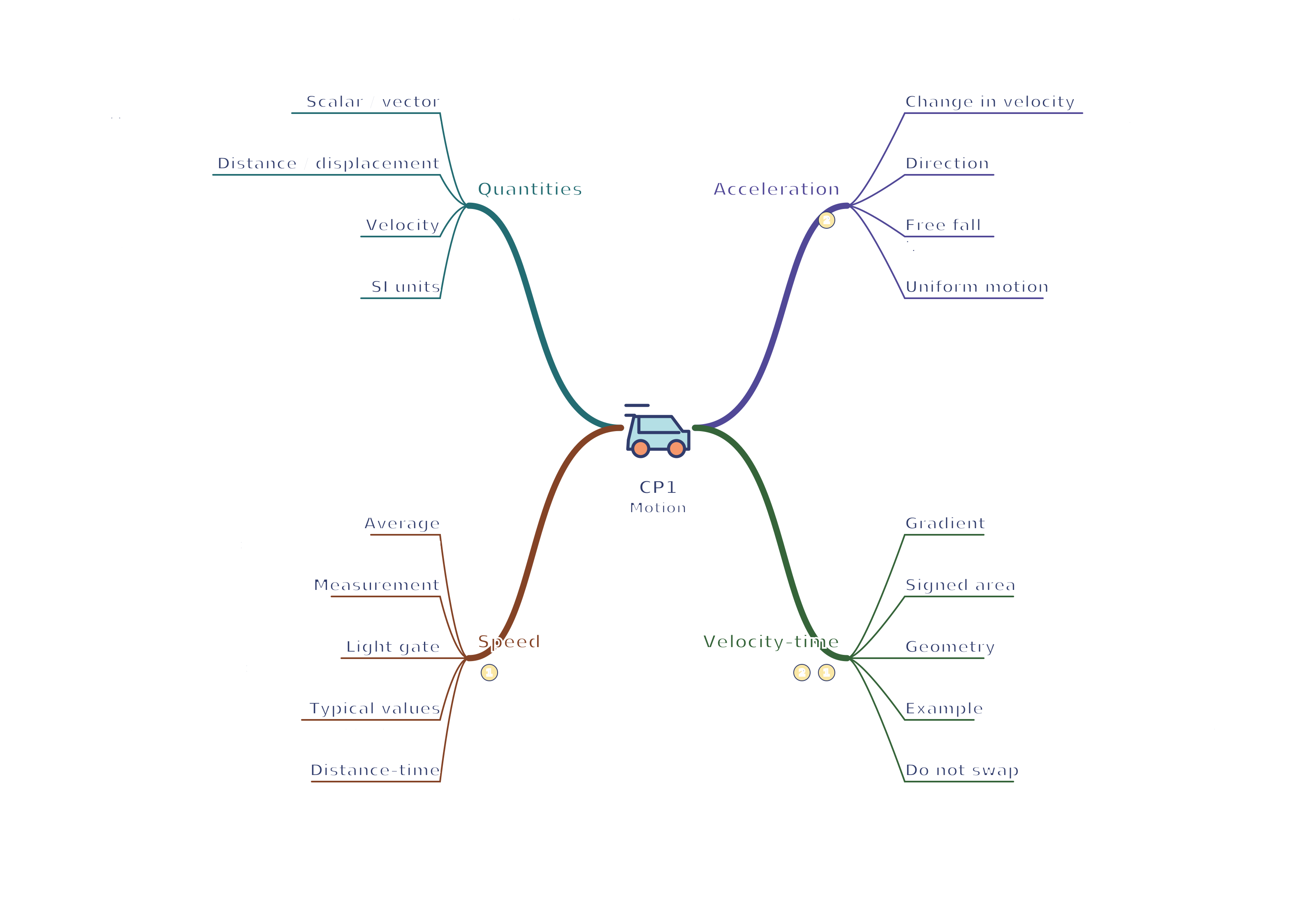
Use your browser’s Print command for A4 landscape, or choose A3 in its paper settings. The SVG remains sharp when enlarged. A text version follows the map.
Read the mind map as text
Quantities
Scalar / vector: Magnitude only / magnitude with direction
Distance / displacement: Path length / straight change with direction; lap ends at start
Velocity: Speed with direction; east and west differ
SI units: m, s, m/s, m/s²; convert km / hours and prefixes first
Speed
Average: Total distance ÷ total time; velocity uses displacement
Measurement: Known distance / time; repeat; reduce relative timing error
Light gate: Card length ÷ beam interruption time
Typical values: Speeds vary; sound in air ≈330–340 m/s
Distance–time: Gradient = speed; horizontal rest; steeper means faster
Acceleration
Change in velocity: a = (v − u)/t; 4 → 16 m/s in 3 s gives 4 m/s²
Direction: Changing direction accelerates even at constant speed
Free fall: Near Earth g ≈10 m/s², neglecting air resistance
Uniform motion: v² − u² = 2ax; from rest, 2 × 2 × 25 → v = 10 m/s
Velocity–time
Gradient: Acceleration; horizontal means constant velocity
Signed area: Displacement; below-axis area is negative
Geometry: Rectangles vt; triangles ½ × base × height
Example: 0 → 12 m/s in 4 s: 24 m displacement, 3 m/s² acceleration
Do not swap: Distance–time gradient is speed; velocity–time area is displacement
Connections
Speed → Velocity–time: Graph axes determine what a gradient measures.