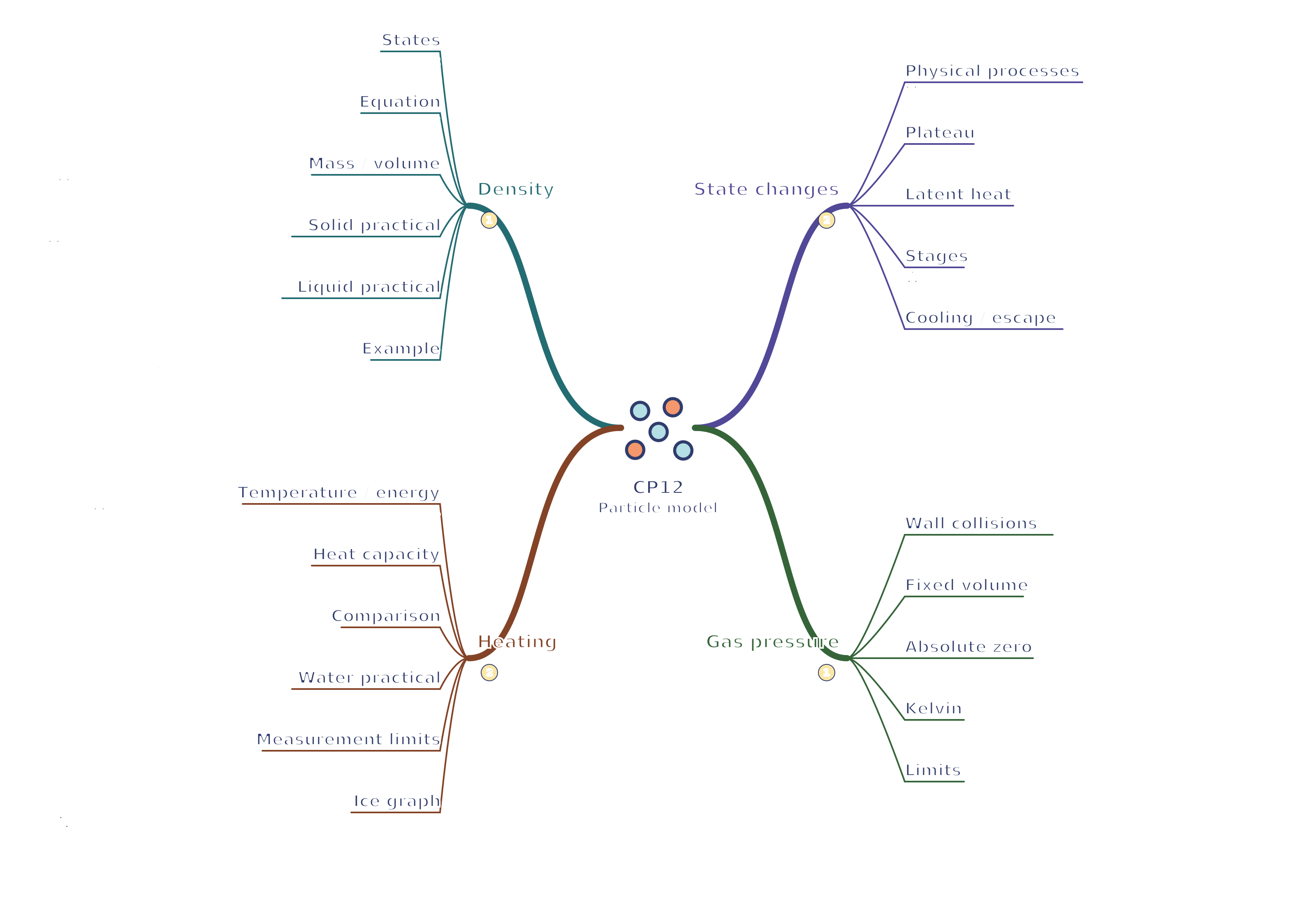
Back to revision notes Open full-size SVG Print mind map CP12 Particle model mind map Use your browser’s Print command for A4 landscape, or choose A3 in its paper settings. The SVG remains sharp when enlarged. A text version follows the map.
Read the mind map as text Density States: Solid fixed / close; liquid flows / close; gas spaced / compressibleEquation: ρ = m/V; kg/m³ or g/cm³; 1 g/cm³ = 1,000 kg/m³Mass / volume: Mass conserved; expansion lowers density; ice is less dense than waterSolid practical: Mass by balance; regular dimensions / submerged displacementLiquid practical: Subtract container mass; measure volume at eye level; repeatExample: 54 g ÷ 20 cm³ = 2.7 g/cm³ = 2,700 kg/m³Heating Temperature / energy: Mean kinetic energy / total particle kinetic + potential energyHeat capacity: c in J/(kg K); ΔQ = mcΔθ; 1 °C change = 1 K changeComparison: 0.5 × 4,200 × 10 = 21,000 J; greater c needs more energyWater practical: Insulate / lid; measure m, Δθ and E = VIt; c = E/(mΔθ)Measurement limits: Stir, immersed low-voltage heater; heat loss can overestimate cIce graph: Near 0 °C while pure ice melts; afterwards water warmsState changes Physical processes: Melt / freeze; vaporise / condense; sublime / depositPlateau: Pure sample: potential energy changes, temperature constantLatent heat: L in J/kg; Q = mL; fusion / vaporisation differStages: Warming: mcΔθ; state change: mL; add separate energiesCooling / escape: Freeze / condense release energy; evaporation only at surfaceGas pressure Wall collisions: Pressure Pa = force/area; particles strike wallsFixed volume: Higher T → faster particles → more frequent / stronger impactsAbsolute zero: Ideal extrapolation ≈−273 °C = 0 K; real gases condenseKelvin: T = θ + 273; 20 °C ≈293 K; differences do not need +273Limits: Finite particles, attractions and phase changes limit simple modelConnections Density → Gas pressure: Particle motion and spacing explain state and pressure. Heating → State changes: Heating changes temperature or causes a state change.