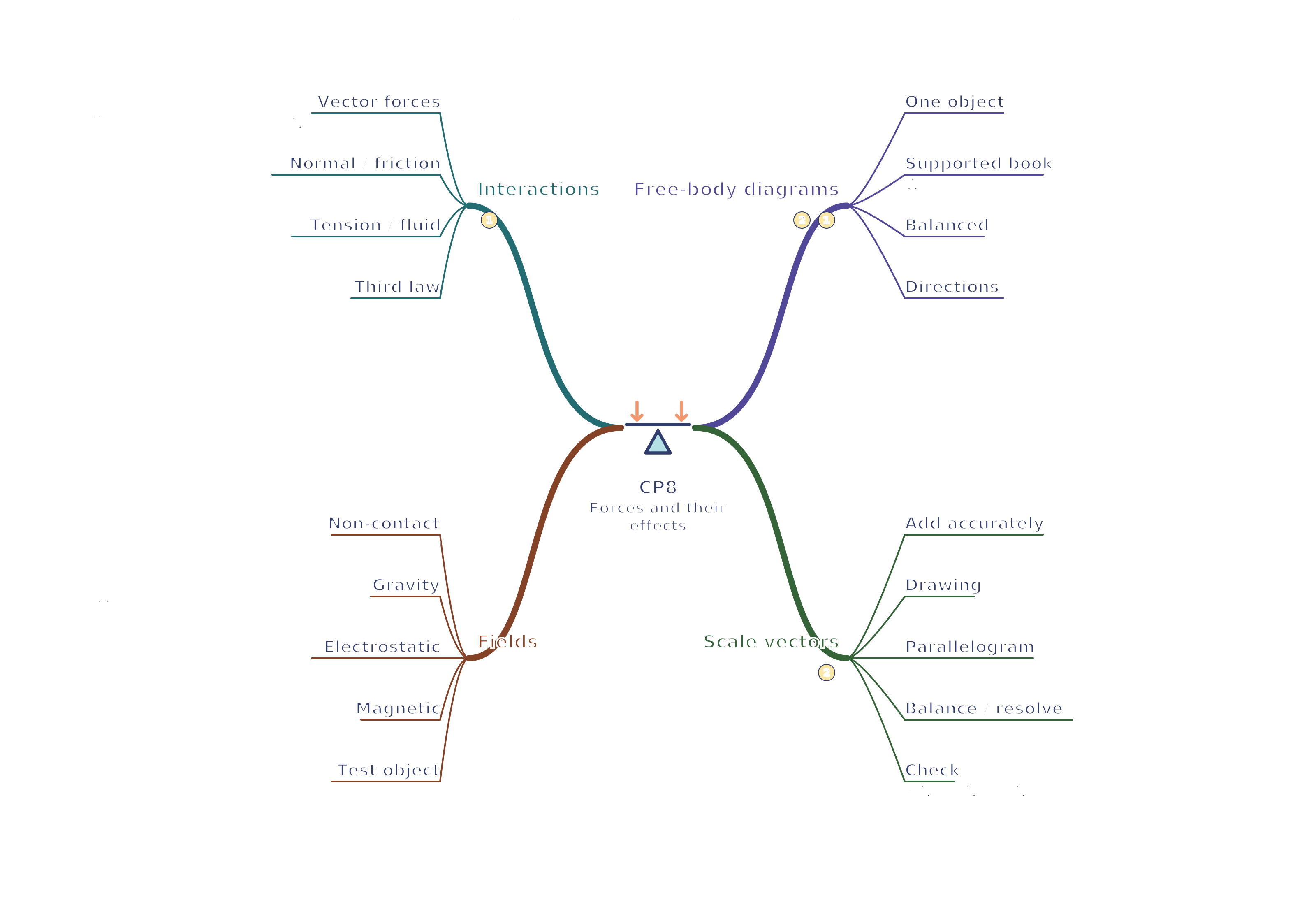
Back to revision notes Open full-size SVG Print mind map CP8 Forces and their effects mind map Use your browser’s Print command for A4 landscape, or choose A3 in its paper settings. The SVG remains sharp when enlarged. A text version follows the map.
Read the mind map as text Interactions Vector forces: Magnitude and direction, N; contact requires touchingNormal / friction: Support ⟂ surface; friction opposes relative slidingTension / fluid: String pulls; drag opposes relative motion; upthrust upwardThird law: Equal opposite forces on different objects; acceleration may differFields Non-contact: Region where suitable object experiences force; not a stringGravity: Masses attract; weight is gravitational forceElectrostatic: Like charges repel; unlike attractMagnetic: Like poles repel; unlike attract; not all metals magneticTest object: Field exists without it; force needs a suitable objectFree-body diagrams One object: Label force arrows; length shows size, arrow shows directionSupported book: Weight / normal balance on book; not a third-law pairBalanced: Zero resultant → no acceleration; constant-velocity carDirections: Equal perpendicular forces do not cancel; resolve angled tensionScale vectors Add accurately: Scalars lack direction; add / subtract collinear forcesDrawing: Scale lengths / angles; head-to-tail without rotating arrowsParallelogram: Common origin; diagonal gives resultant; measure directionBalance / resolve: Equilibrant opposes resultant; rectangle sides are componentsCheck: 3 N ⟂ 4 N → 5 N; equilibrium forms closed force polygonConnections Interactions → Free-body diagrams: Free-body diagrams include forces on one object only. Free-body diagrams → Scale vectors: Vector addition checks whether resultant force is zero.