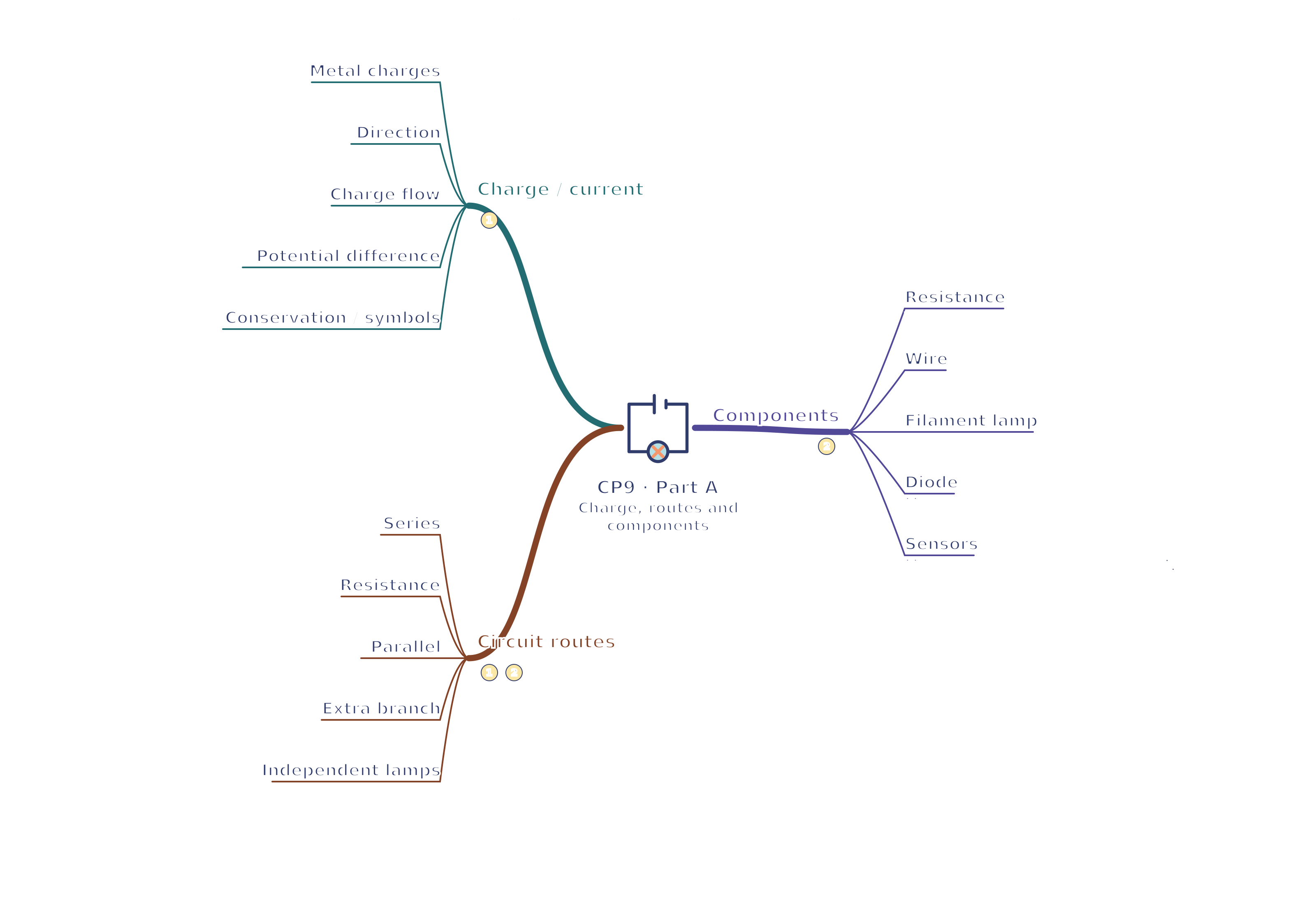
Part A · Charge, routes and components Electricity and circuits mind map
Use your browser’s Print command for A4 landscape, or choose A3 in its paper settings. The SVG remains sharp when enlarged. A text version follows the map.
Read the mind map as text
Charge / current
Metal charges: Delocalised electrons move; complete loop and p.d. required
Direction: Conventional current + → −; metal electrons drift opposite
Charge flow: I = Q/t; Q = It; A, C, s; ammeter in series
Potential difference: V = E/Q; E = QV; voltmeter across component
Conservation / symbols: Current not used up; standard symbols; long cell line +
Circuit routes
Series: One route; same current; component voltages sum to supply
Resistance: Series R values add; at fixed voltage, added R reduces I
Parallel: Current splits / rejoins; each complete branch has supply V
Extra branch: At fixed V, total current rises and total R falls
Independent lamps: One failed branch need not stop other branches
Components
Resistance: V = IR; R = V/I, Ω; ohmic line through origin at fixed T
Wire: Longer / thinner → greater R; heating increases metal R
Filament lamp: Heats as I rises; R rises, so I–V curve bends
Diode: Mainly forward current; normal reverse current very small
Sensors: More light → lower LDR R; hotter NTC thermistor → lower R
Connections
Charge / current → Circuit routes: Charge conservation explains current at junctions.
Circuit routes → Components: Added resistance changes current at fixed supply voltage.