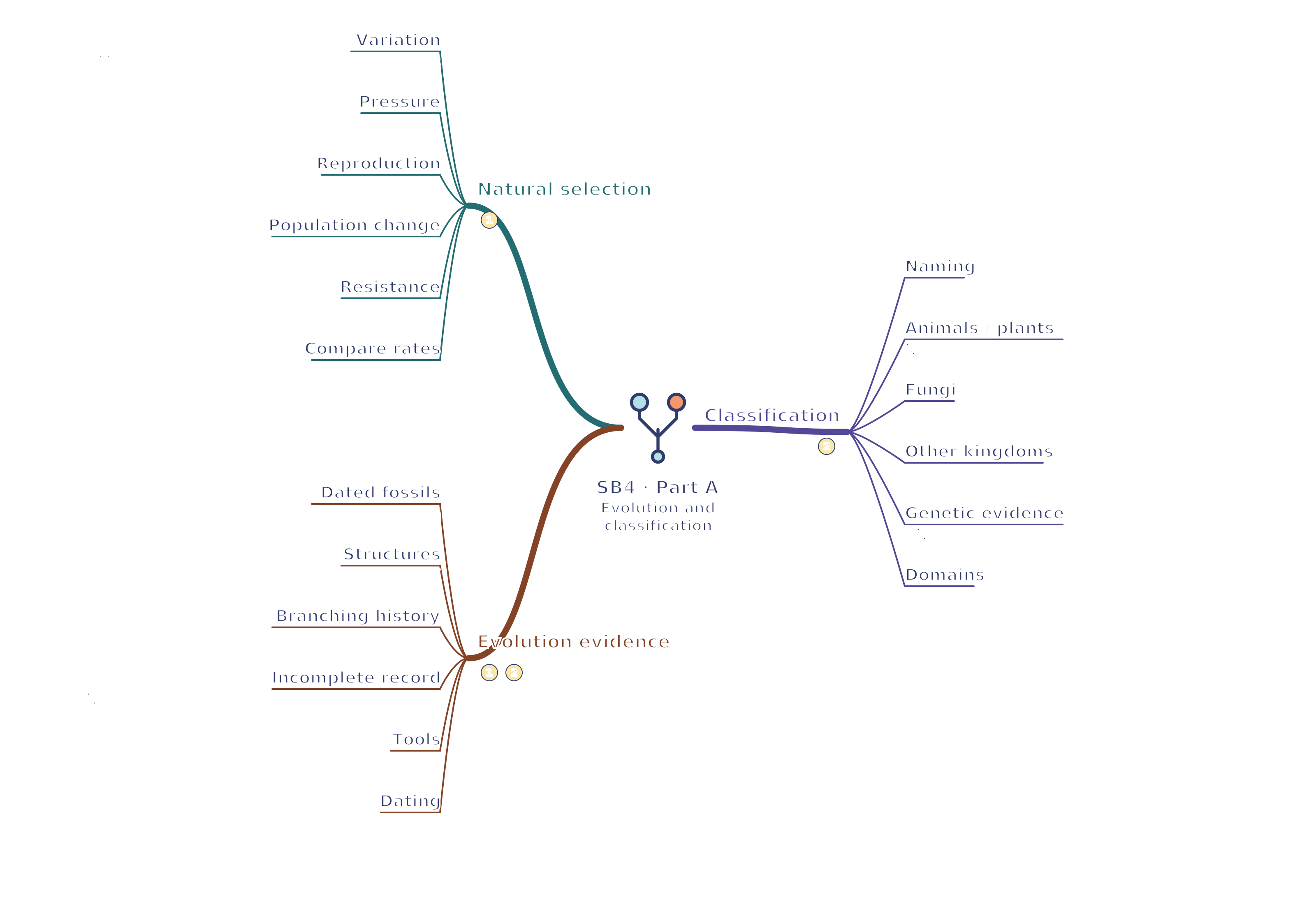
Back to revision notes Open full-size SVG Print mind map Part A · Evolution and classification Natural selection and genetic modification mind map Use your browser’s Print command for A4 landscape, or choose A3 in its paper settings. The SVG remains sharp when enlarged. A text version follows the map.
Read the mind map as text Natural selection Variation: Mutations create alleles; variation precedes selectionPressure: Competition, predators, disease and conditions limit survivalReproduction: Advantageous inherited traits → more surviving offspringPopulation change: Alleles spread over generations; no guaranteed perfectionResistance: Antibiotic / poison selects pre-existing resistant individualsCompare rates: 15 resistant out of 60 = 25%; compare proportionsEvolution evidence Dated fossils: Ardi 4.4, Lucy 3.2, Leakey fossils 1.6 million years agoStructures: Pelvis, limbs, feet and skull inform movement / brain sizeBranching history: Shared ancestors with apes; fossils are not a simple ladderIncomplete record: Not all organisms fossilise; discoveries revise interpretationsTools: Cores / flakes → shaped handaxes suggest skills and planningDating: Undisturbed deeper layers usually older; use context and uncertaintyClassification Naming: Genus species; capital genus, lower-case species, italicsAnimals / plants: No cell wall / cellulose wall; photosynthetic cells have chloroplastsFungi: Chitin walls; absorb nutrients; yeast is unicellularOther kingdoms: Protists: varied, nuclei; prokaryotes: no nucleusGenetic evidence: RNA comparisons distinguish groups once classed togetherDomains: Bacteria / Archaea: no nucleus; Eukarya: nuclei; above kingdomsConnections Natural selection → Evolution evidence: Dated structures provide evidence for population change. Evolution evidence → Classification: Relationships are inferred from structural and genetic evidence.