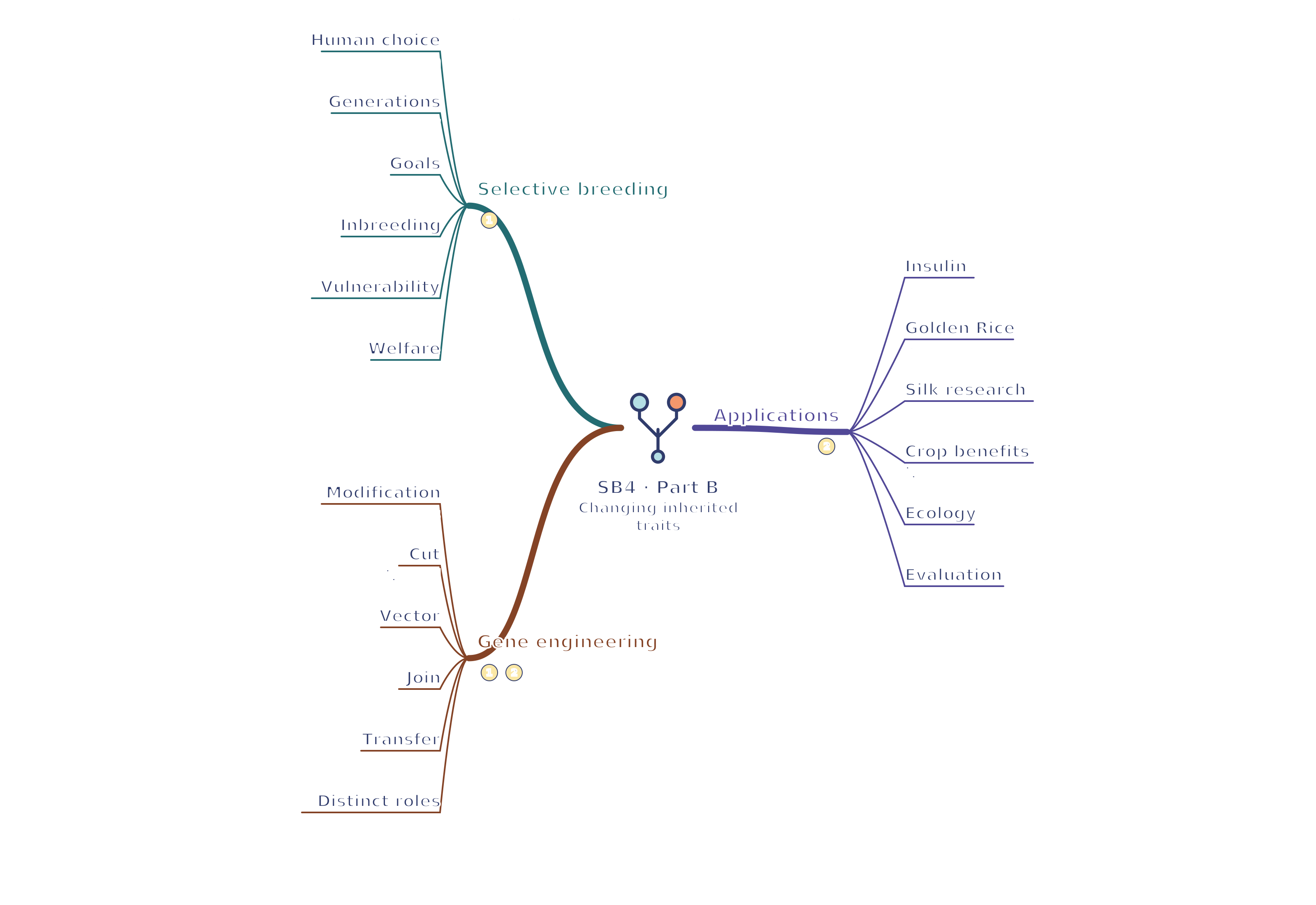
Back to revision notes Open full-size SVG Print mind map Part B · Changing inherited traits Natural selection and genetic modification mind map Use your browser’s Print command for A4 landscape, or choose A3 in its paper settings. The SVG remains sharp when enlarged. A text version follows the map.
Read the mind map as text Selective breeding Human choice: Select inherited traits from existing variationGenerations: Choose parents → breed → select offspring → repeatGoals: Yield, resistance, flavour, growth or milk productionInbreeding: Lower diversity; harmful recessive alleles may pairVulnerability: Similar susceptibility can increase pathogen impactWelfare: Extreme selected traits can harm health and movementGene engineering Modification: Introduce a useful gene; transfer can cross speciesCut: Restriction enzyme cuts gene-containing DNA and plasmidVector: Plasmid carries the gene into the recipientJoin: Complementary sticky ends pair; ligase joins backbonesTransfer: Identify recipients; grow them; collect expressed proteinDistinct roles: Restriction cuts; ligase joins; gene gives protein instructionsApplications Insulin: Engineered bacteria produce human insulin for purificationGolden Rice: Beta-carotene production → vitamin A in the bodySilk research: Engineered goats produce spider-silk proteins in milkCrop benefits: Nutrition, pest resistance and yield depend on trait / contextEcology: Gene spread to compatible relatives; test non-target effectsEvaluation: Evidence: safety, biodiversity, welfare, cost and accessConnections Selective breeding → Gene engineering: Selection uses existing variation; engineering transfers genes. Gene engineering → Applications: Transferred genes provide useful protein instructions.