Back to revision notes Open full-size SVG Print mind map Part A · Hormones and reproduction Animal coordination, control and homeostasis mind map Use your browser’s Print command for A4 landscape, or choose A3 in its paper settings. The SVG remains sharp when enlarged. A text version follows the map.
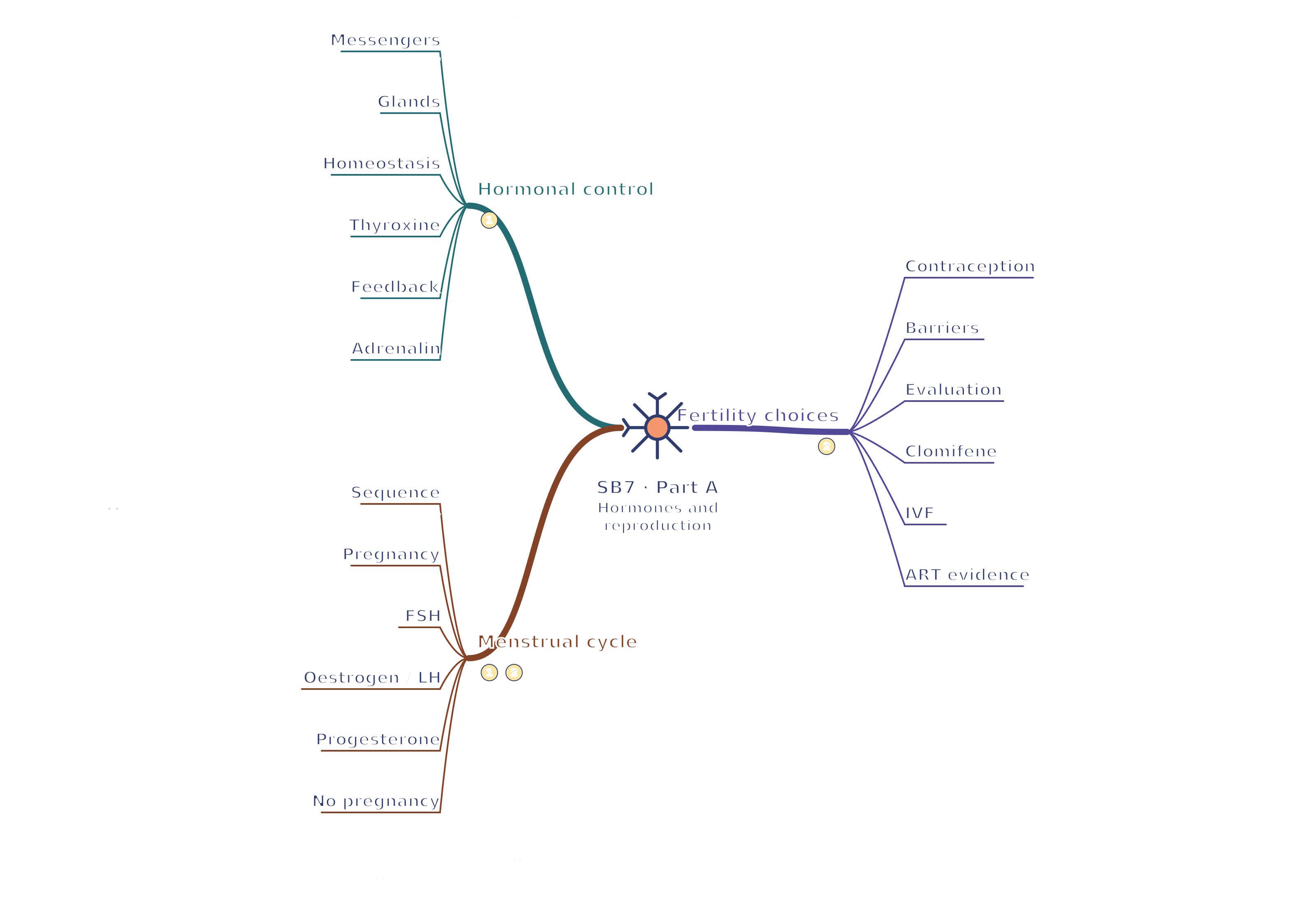
Read the mind map as text Hormonal control Messengers: Blood-borne hormones; suitable receptors; slower than nervesGlands: Pituitary, thyroid, adrenals, pancreas, ovaries and testesHomeostasis: Stable internal conditions; negative feedback opposes changeThyroxine: Low level → hypothalamus TRH → pituitary TSH → thyroidFeedback: Restored thyroxine inhibits TRH / TSH; controls metabolic rateAdrenalin: Fight / flight: more muscle blood flow; glycogen → glucoseMenstrual cycle Sequence: Menstruation → lining repair → ovulation → maintained liningPregnancy: Oviduct: fertilisation; embryo divides, then implants in uterusFSH: Pituitary stimulates follicles and oestrogen productionOestrogen / LH: Repairs lining; inhibits FSH; high oestrogen → LH surgeProgesterone: Corpus luteum maintains lining; inhibits FSH and LHNo pregnancy: Ovarian hormones fall → menstruation; graph timing variesFertility choices Contraception: Combined pill suppresses FSH / LH; progestogen thickens mucusBarriers: Condom blocks semen / reduces STIs; diaphragm covers cervixEvaluation: Use, efficacy, side effects, duration, reversibility, STI protectionClomifene: Reduced oestrogen feedback promotes FSH / LH and ovulationIVF: Stimulate → collect → fertilise in lab → develop → transferART evidence: Variable success; cost / risks; compare age and stated outcomeConnections Hormonal control → Menstrual cycle: Pituitary and ovarian hormones coordinate the cycle. Menstrual cycle → Fertility choices: Hormone interactions can suppress or stimulate ovulation.