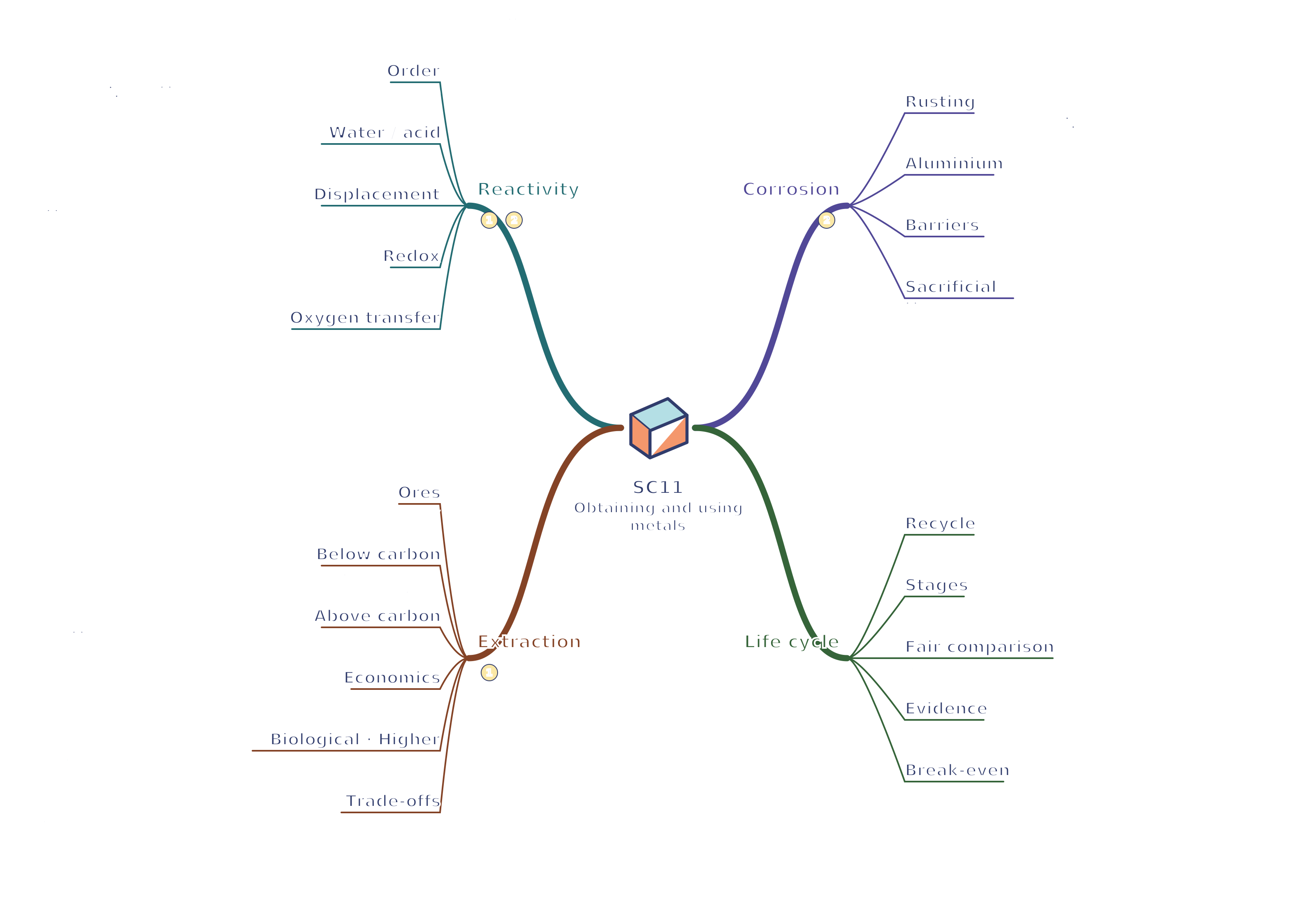
Back to revision notes Open full-size SVG Print mind map SC11 Obtaining and using metals mind map Use your browser’s Print command for A4 landscape, or choose A3 in its paper settings. The SVG remains sharp when enlarged. A text version follows the map.
Read the mind map as text Reactivity Order: K Na Ca Mg Al C Zn Fe H Cu Ag Au; C / H are comparisonsWater / acid: Reactive metals release H₂; oxide coatings affect observationsDisplacement: More reactive metal replaces a less reactive metalRedox: Zn loses e⁻; Cu²⁺ gains e⁻; Zn + Cu²⁺ → Zn²⁺ + CuOxygen transfer: Oxidation gains O; reduction loses O; energetic reactions need careExtraction Ores: Enough metal for worthwhile extraction; gold may be nativeBelow carbon: Reduce oxides with C / CO; Fe₂O₃ + 3CO → 2Fe + 3CO₂Above carbon: Molten electrolysis; alumina in cryolite reduces temperatureEconomics: Energy, costs and impacts matter; low-grade ores consideredBiological · Higher: Bioleaching: soluble compounds; plants → ash in phytoextractionTrade-offs: Biological methods may reduce mining impacts but can be slowCorrosion Rusting: Iron needs oxygen AND water; porous rust does not protectAluminium: Adherent oxide barrier protects despite high reactivityBarriers: Paint / oil exclude air and water; damage may expose ironSacrificial: More reactive metal oxidises instead; must be replacedLife cycle Recycle: Conserve ores / reduce impacts; sorting and remelting still costStages: Raw materials → manufacture → use → disposal / recyclingFair comparison: Same useful service; repeated use can offset initial impactEvidence: Energy, emissions, waste, assumptions; no single complete scoreBreak-even: 100 + uses versus 6 × uses; equal at 20 usesConnections Reactivity → Extraction: Reactivity determines the feasible extraction route. Reactivity → Corrosion: A more reactive metal provides sacrificial protection.