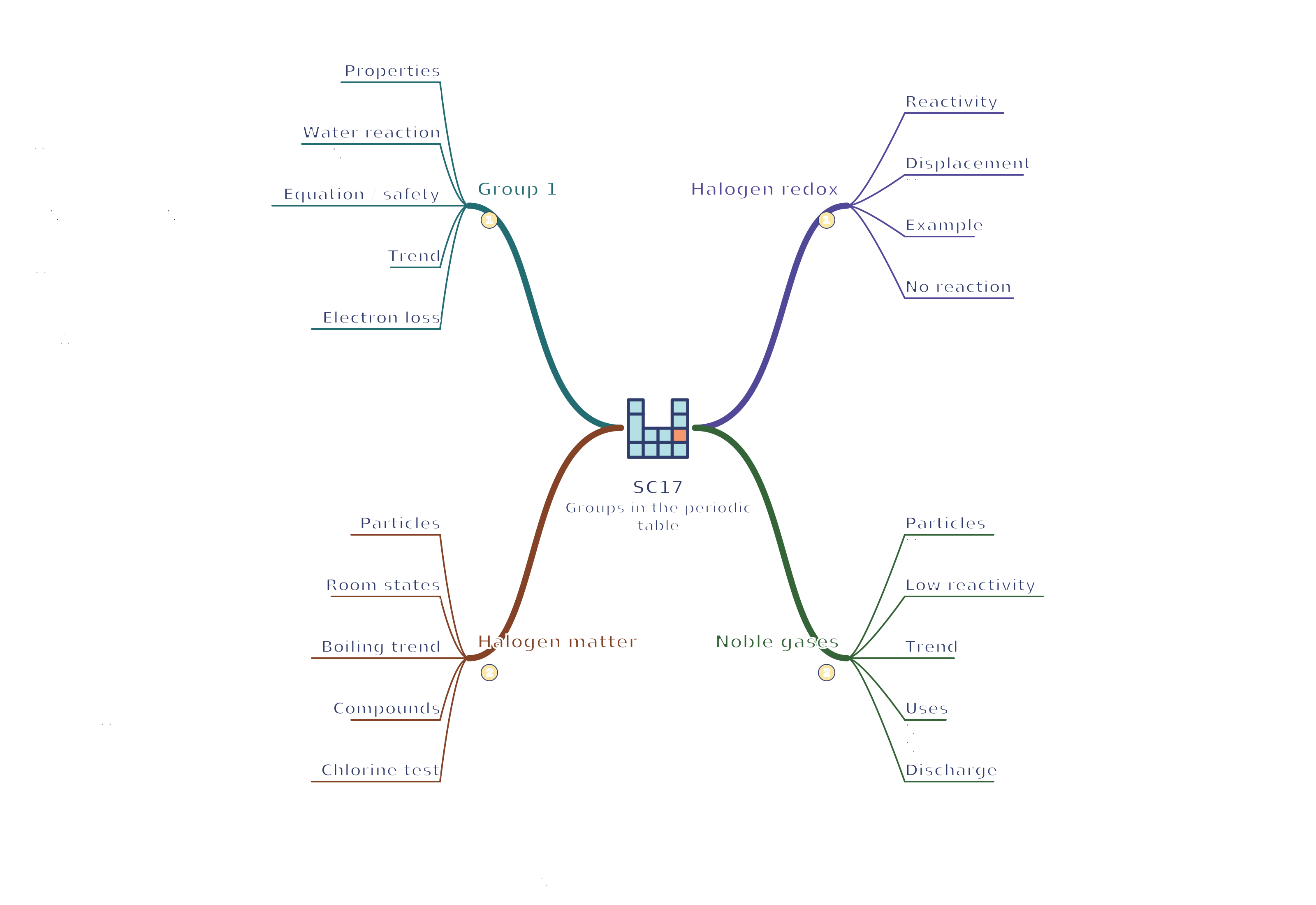
Back to revision notes Open full-size SVG Print mind map SC17 Groups in the periodic table mind map Use your browser’s Print command for A4 landscape, or choose A3 in its paper settings. The SVG remains sharp when enlarged. A text version follows the map.
Read the mind map as text Group 1 Properties: One outer electron; soft conducting metals; form +1 ionsWater reaction: Metal + water → hydroxide + H₂; Li < Na < K vigourEquation / safety: 2Na + 2H₂O → 2NaOH + H₂; teacher demonstrationTrend: More shells down group → more distance / shieldingElectron loss: Weaker effective attraction → easier loss → more reactiveHalogen matter Particles: Seven outer electrons; diatomic non-metals; −1 halidesRoom states: Cl₂ green gas; Br₂ brown liquid; I₂ dark solid / purple vapourBoiling trend: Larger molecules → stronger intermolecular forces down groupCompounds: Metal halides / hydrogen halides; HCl(aq) is hydrochloric acidChlorine test: Bleaches damp litmus; harmful gas needs controlsHalogen redox Reactivity: Decreases down group; shielding weakens attraction for new e⁻Displacement: More reactive halogen replaces less reactive from halideExample: Cl₂ + 2Br⁻ → 2Cl⁻ + Br₂; Cl reduced, Br⁻ oxidisedNo reaction: I₂ cannot displace Cl₂ / Br₂; compare reference coloursNoble gases Particles: Monatomic colourless gases; full outer shells, He has twoLow reactivity: Usually uncombined; not absolutely unable to reactTrend: Larger atoms → stronger attractions → higher boiling pointsUses: Non-flammable He balloons; inert Ar; glowing Ne / Kr dischargeDischarge: Excitation / ionisation gives light; not normal metal conductionConnections Group 1 → Halogen redox: Electron loss versus gain gives opposite reactivity trends. Halogen matter → Noble gases: Particle attractions affect boiling-point trends.