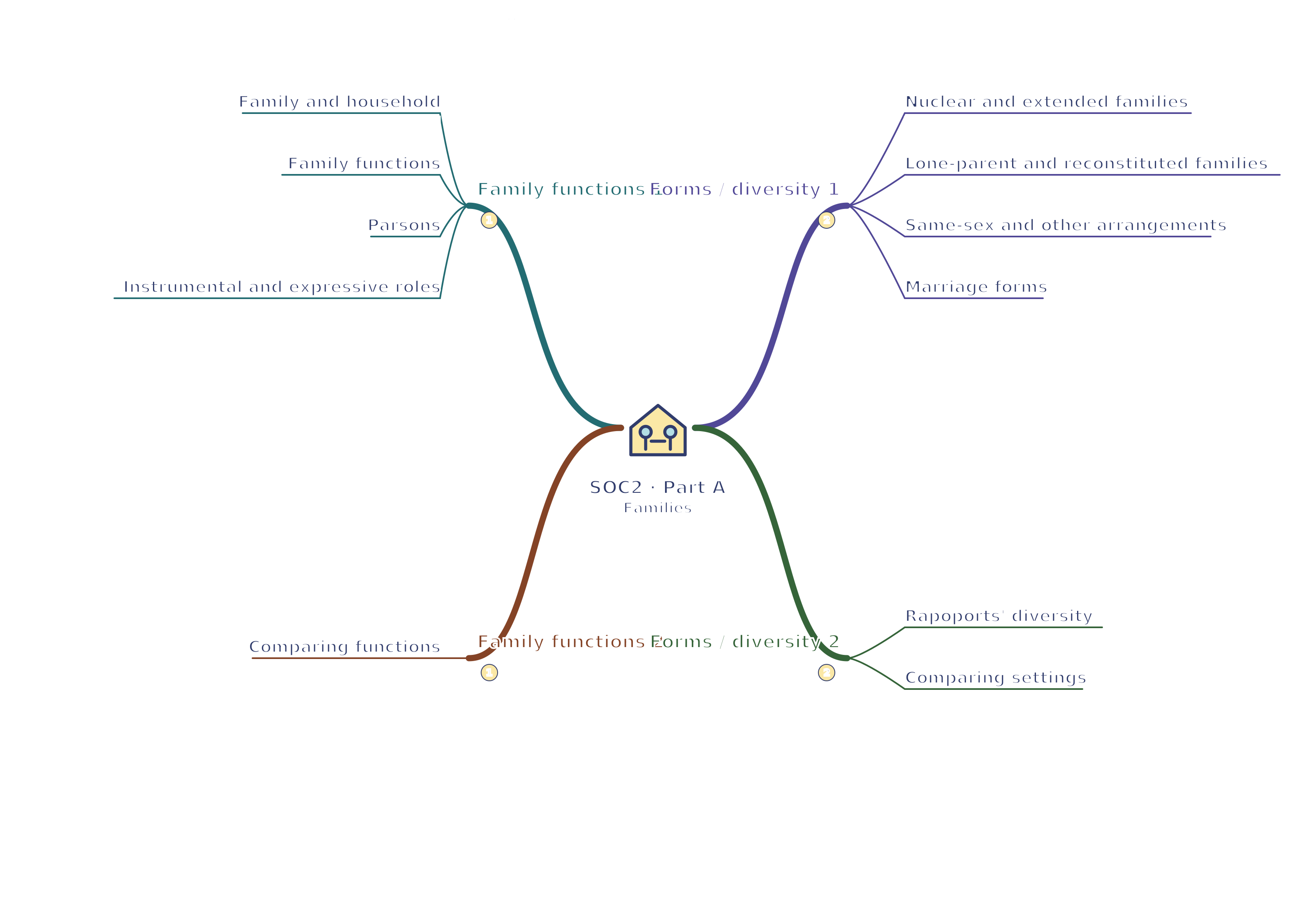
SOC2 · Family functions 1 / Family functions 2 / Forms / diversity 1 / Forms / diversity 2 Families mind map
Use your browser’s Print command for A4 landscape, or choose A3 in its paper settings. The SVG remains sharp when enlarged. A text version follows the map.
Read the mind map as text
Family functions 1
Family and household: Kinship or caring ties differ from shared residence
Family functions: Care, reproduction, resources and learning can be organised together
Parsons: Primary socialisation and adult emotional support were central functions
Instrumental and expressive roles: Parsons linked differentiated roles to family stability
Family functions 2
Comparing functions: A stabilising institution may also reproduce inequality
Forms / diversity 1
Nuclear and extended families: Two-generation arrangements differ from wider kin networks
Lone-parent and reconstituted families: A family can have one resident parent or combine earlier relationships
Same-sex and other arrangements: Partnership and care do not fit one conventional form
Marriage forms: Partner arrangements vary across societies and time
Forms / diversity 2
Rapoports' diversity: Organisation, culture, class, life course and cohort matter
Comparing settings: Industrialisation does not produce one universal family path
Connections
Family functions 1 → Family functions 2: Gendered role specialisation changes how the same family function distributes work.
Forms / diversity 1 → Forms / diversity 2: Family diversity concerns organisation and context as well as household form.