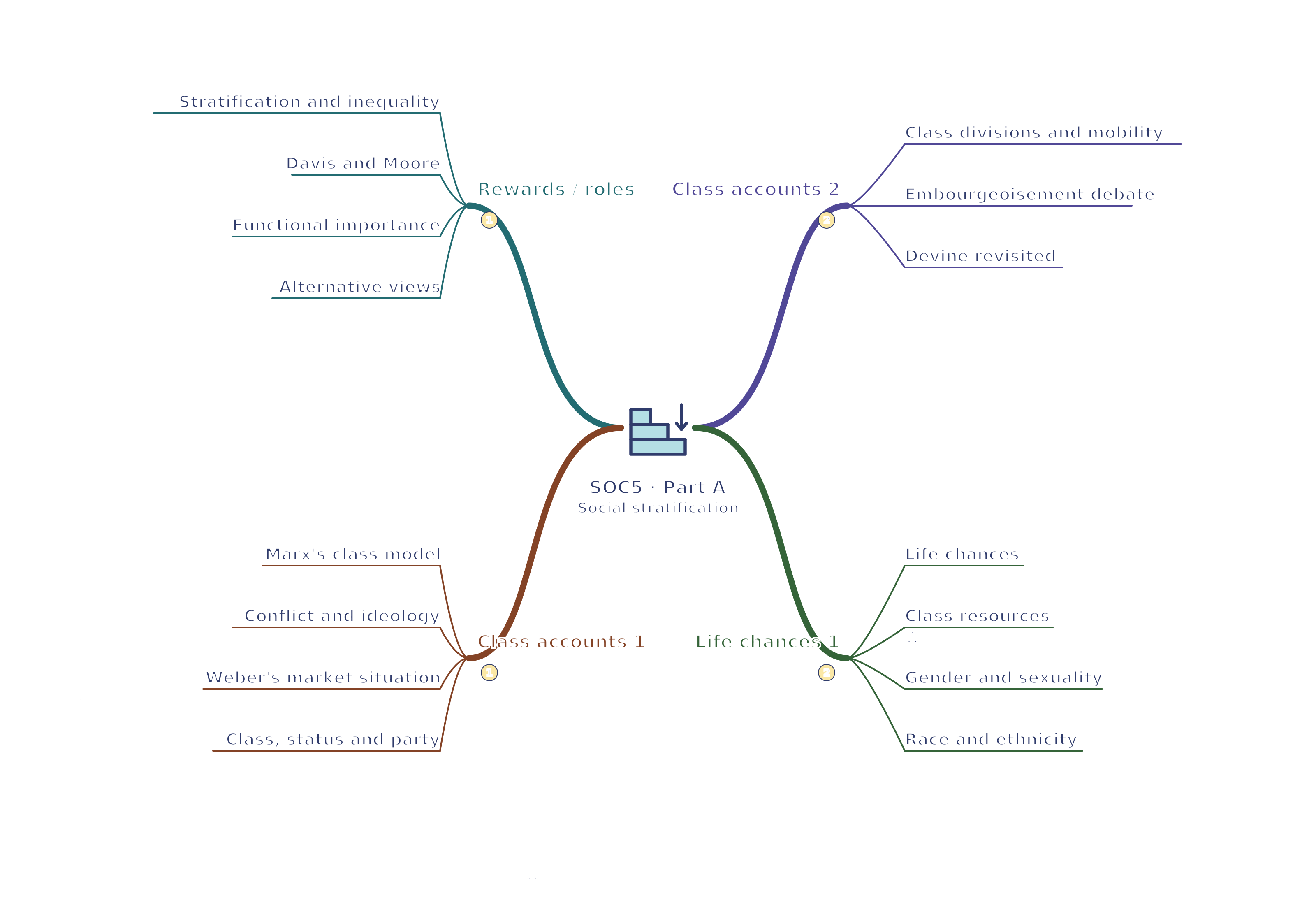
SOC5 · Rewards / roles / Class accounts 1 / Class accounts 2 / Life chances 1 Social stratification mind map
Use your browser’s Print command for A4 landscape, or choose A3 in its paper settings. The SVG remains sharp when enlarged. A text version follows the map.
Read the mind map as text
Rewards / roles
Stratification and inequality: Resources and prestige are distributed in structured layers
Davis and Moore: Unequal rewards were argued to recruit and motivate suitable role holders
Functional importance: High pay is not an independent measure of social necessity
Alternative views: Rewards may reflect unequal power rather than efficient allocation
Class accounts 1
Marx's class model: Ownership separates capitalists from wage workers
Conflict and ideology: Economic advantage can support political and cultural influence
Weber's market situation: Skills and assets affect economic opportunities within classes
Class, status and party: Economic position, esteem and organised influence may overlap
Class accounts 2
Class divisions and mobility: Occupational categories are indicators with limits
Embourgeoisement debate: Higher living standards need not erase working-class identities
Devine revisited: Affluence coexisted with resentment of inherited inequality
Life chances 1
Life chances: Social positions affect probabilities of valued outcomes
Class resources: Wealth, income and networks can compound advantage
Gender and sexuality: Expectations and discrimination can constrain choices and rewards
Race and ethnicity: Racialisation and unequal treatment affect opportunities
Connections
Rewards / roles → Class accounts 1: Reward-based allocation and class-power theories explain unequal resources differently.
Class accounts 2 → Life chances 1: Mobility and affluence do not remove all class-linked constraints on life chances.