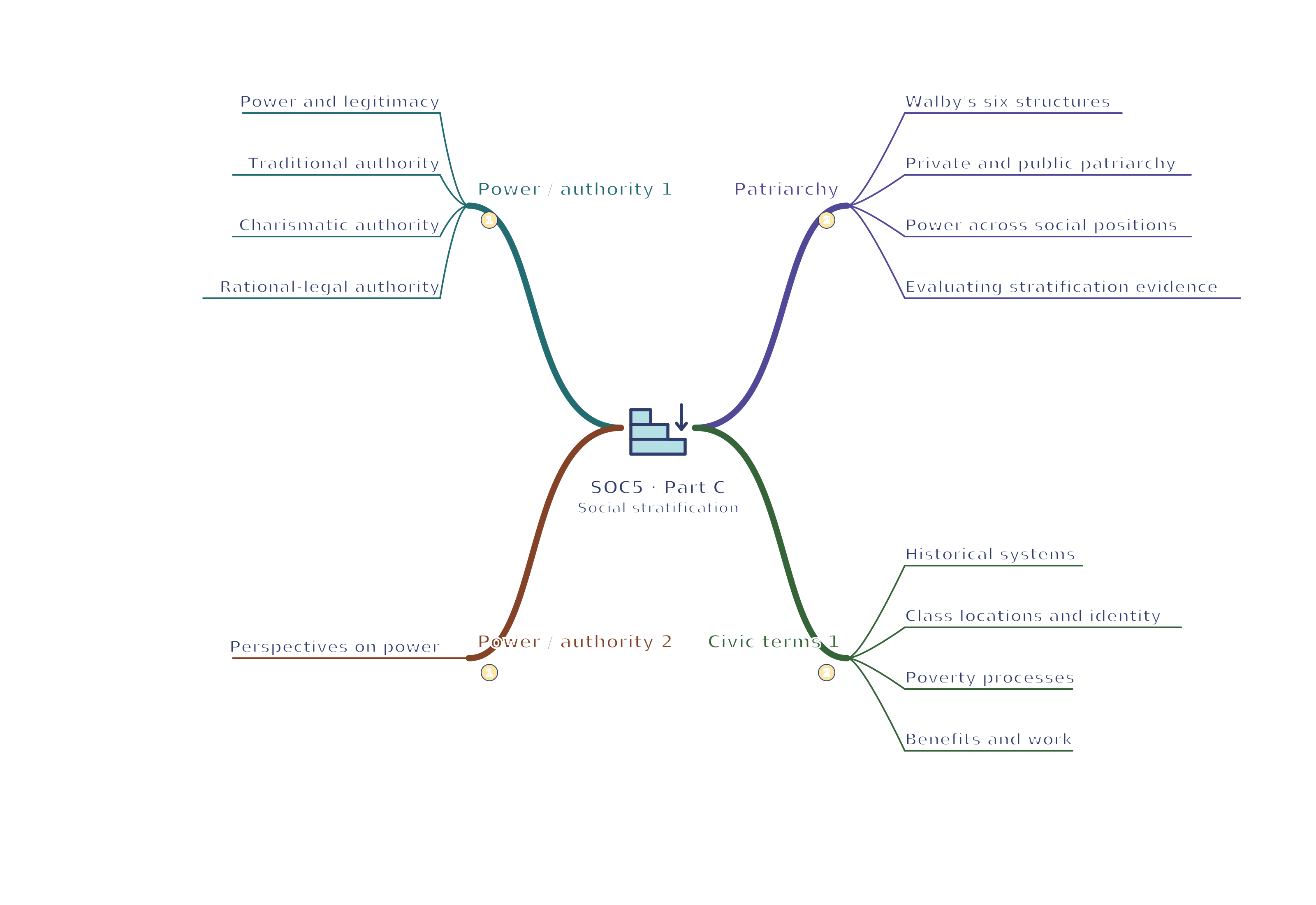
SOC5 · Power / authority 1 / Power / authority 2 / Patriarchy / Civic terms 1 Social stratification mind map
Use your browser’s Print command for A4 landscape, or choose A3 in its paper settings. The SVG remains sharp when enlarged. A text version follows the map.
Read the mind map as text
Power / authority 1
Power and legitimacy: Power can work through resources, force or agenda setting
Traditional authority: Custom and inherited arrangements legitimate obedience
Charismatic authority: Devotion to perceived exceptional qualities legitimates leadership
Rational-legal authority: Impersonal rules legitimate an office rather than an individual
Power / authority 2
Perspectives on power: Pluralism and conflict accounts differ over its distribution
Patriarchy
Walby's six structures: Gendered domination operates through interconnected institutions
Private and public patriarchy: Control can shift from household exclusion to unequal public participation
Power across social positions: Class, age, ethnicity and other inequalities interact with gender
Evaluating stratification evidence: Compare measures and explanations before making a judgement
Civic terms 1
Historical systems: Different systems organise labour, property and inherited status
Class locations and identity: Occupational labels and subjective class are different evidence
Poverty processes: Constraints can reproduce hardship without a fixed culture
Benefits and work: Eligibility and labour conditions affect security
Connections
Power / authority 1 → Power / authority 2: Authority depends on legitimacy while its use can reproduce gendered power.
Patriarchy → Civic terms 1: Historical class vocabulary and welfare categories should describe processes without moral ranking.