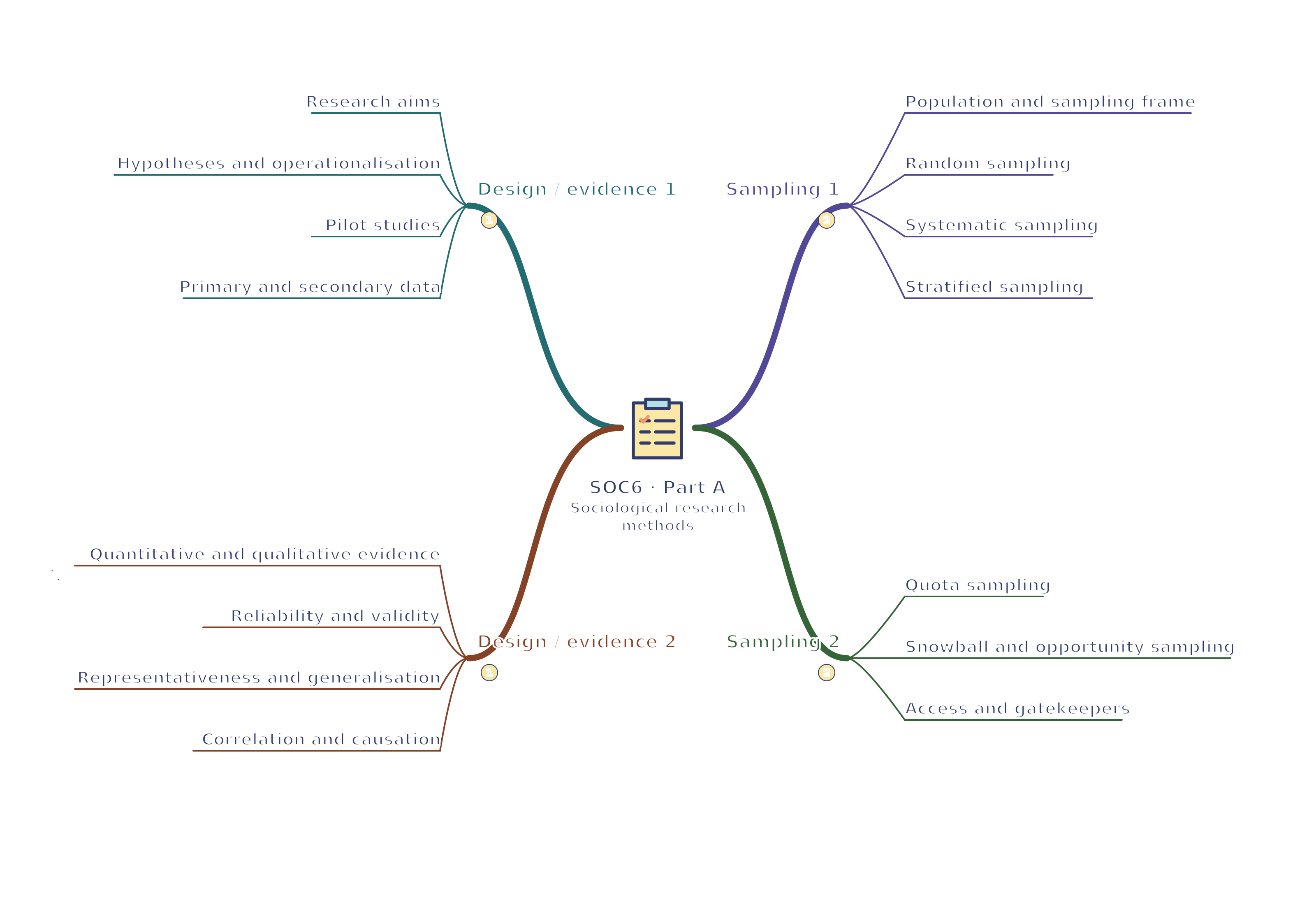
Use your browser’s Print command for A4 landscape, or choose A3 in its paper settings. The SVG remains sharp when enlarged. A text version follows the map.
Read the mind map as text
Design / evidence 1
Research aims: A focused question guides the design and evidence needed
Hypotheses and operationalisation: A testable claim needs clear measurable concepts
Pilot studies: A small trial identifies problems before the main study
Primary and secondary data: Purpose of collection differs from numerical or descriptive form
Design / evidence 2
Quantitative and qualitative evidence: Numbers compare distributions; accounts explore meanings
Reliability and validity: Consistency of measurement differs from measuring the intended concept
Representativeness and generalisation: Population claims need a suitable sample and cautious scope
Correlation and causation: Association does not isolate the cause of a pattern
Sampling 1
Population and sampling frame: The group of interest differs from the list used to select people
Random sampling: Equal selection chances reduce researcher selection bias
Systematic sampling: A fixed interval needs a random start and no problematic pattern
Stratified sampling: Relevant population subgroups are sampled deliberately
Sampling 2
Quota sampling: Targets for categories differ from random selection within them
Snowball and opportunity sampling: Access strategies can distort who is included
Access and gatekeepers: Permission can help access while shaping the evidence obtained
Connections
Design / evidence 1 → Design / evidence 2: A good question needs valid evidence, not merely consistent measurement.
Sampling 1 → Sampling 2: Sampling and gatekeeper access determine whose experiences can inform a conclusion.