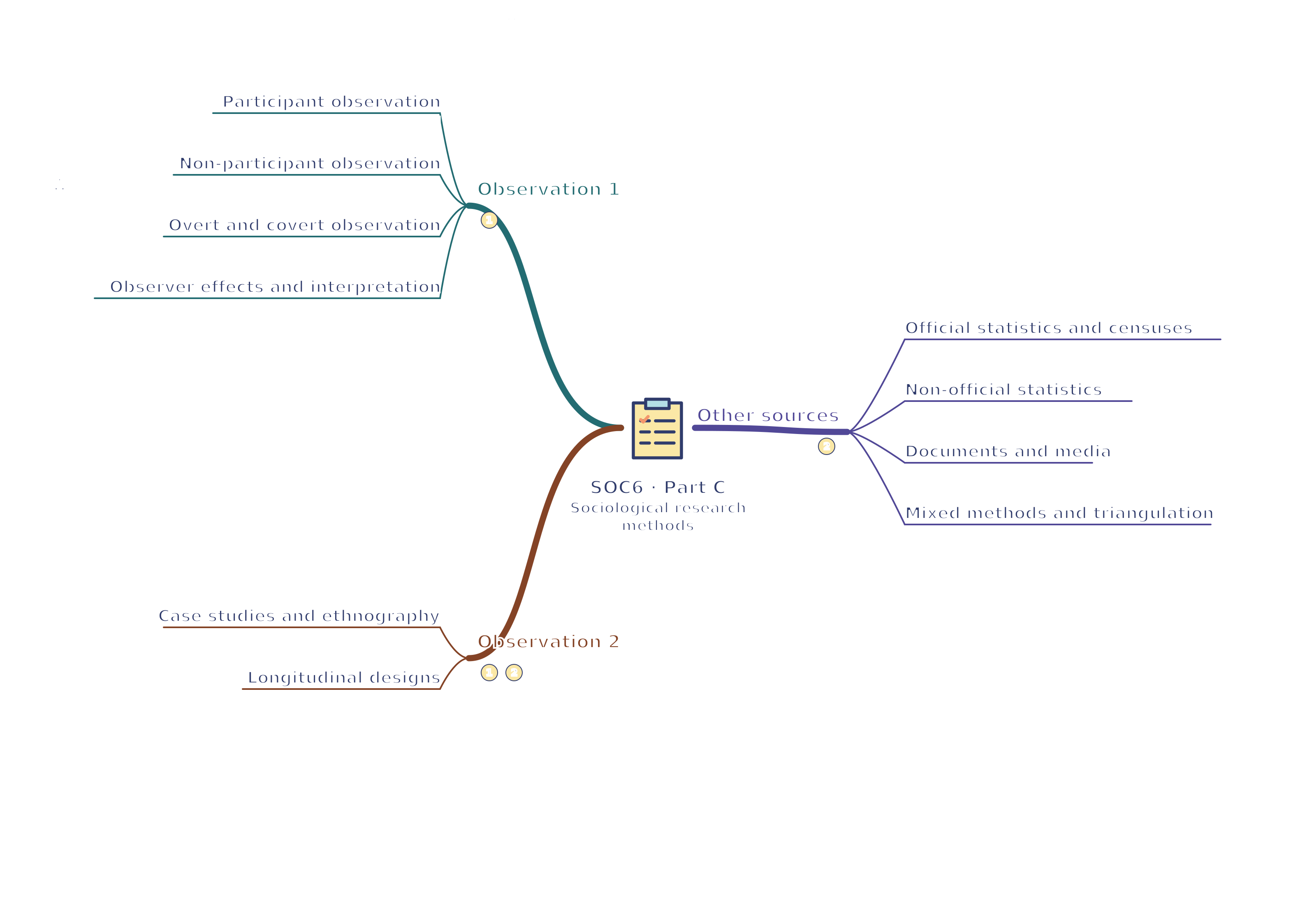
SOC6 · Observation 1 / Observation 2 / Other sources Sociological research methods mind map
Use your browser’s Print command for A4 landscape, or choose A3 in its paper settings. The SVG remains sharp when enlarged. A text version follows the map.
Read the mind map as text
Observation 1
Participant observation: Joining activities gives access to meanings and routines
Non-participant observation: Watching without joining can reduce involvement but miss meanings
Overt and covert observation: Awareness differs from the researcher's level of participation
Observer effects and interpretation: Presence and selective attention can shape findings
Observation 2
Case studies and ethnography: Depth in a setting supports understanding with limited population inference
Longitudinal designs: Following change improves temporal understanding but risks attrition
Other sources
Official statistics and censuses: Systematic public data offer breadth with administrative definitions
Non-official statistics: Other organisations' figures need equally careful scrutiny
Documents and media: Accounts reveal perspectives but may not represent the whole population
Mixed methods and triangulation: Complementary evidence can examine patterns and meanings
Connections
Observation 1 → Observation 2: Observation gains contextual depth but requires scrutiny of influence and scope.
Observation 2 → Other sources: Contextual studies and combined sources illuminate different aspects with remaining limits.