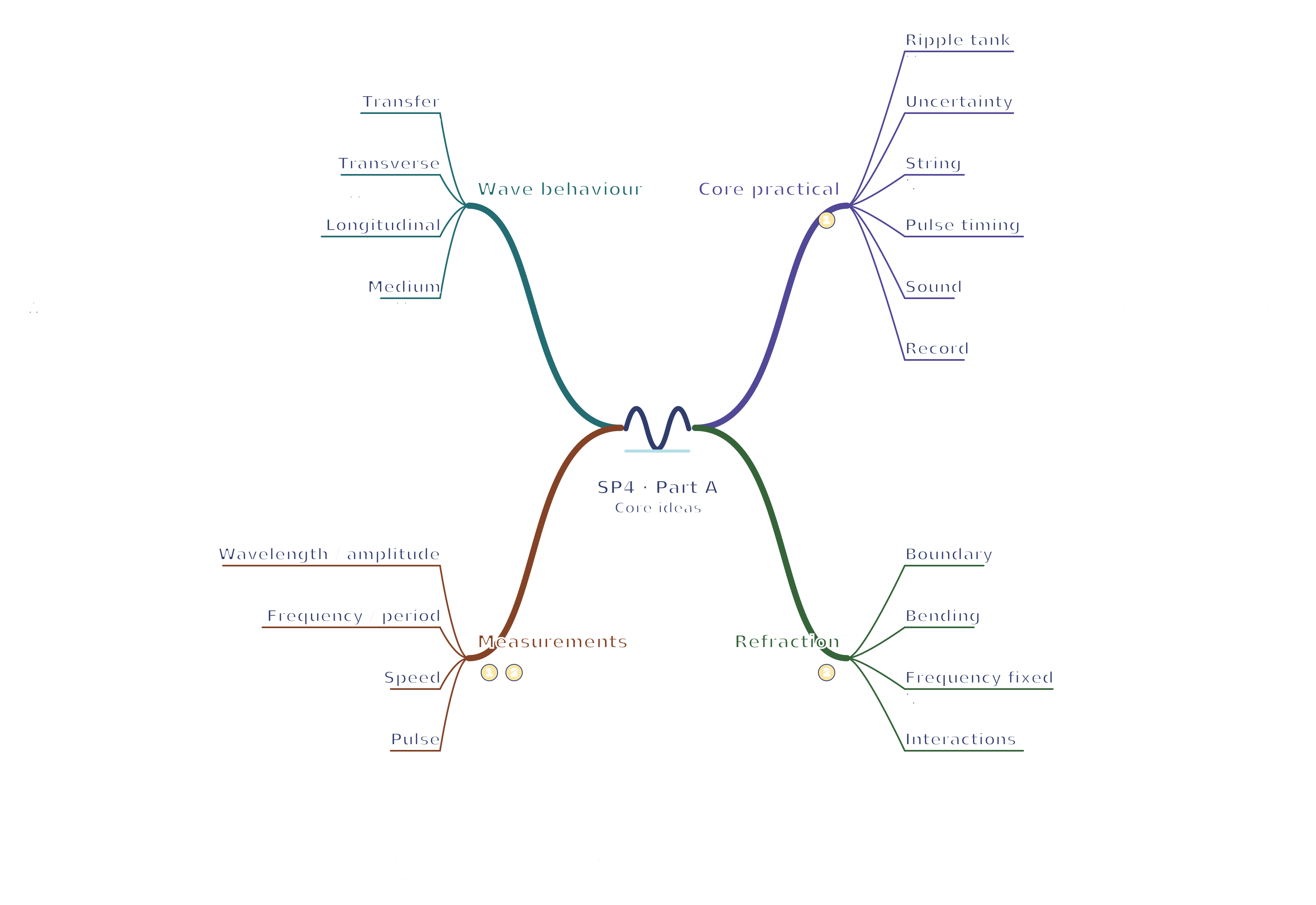
Use your browser’s Print command for A4 landscape, or choose A3 in its paper settings. The SVG remains sharp when enlarged. A text version follows the map.
Read the mind map as text
Wave behaviour
Transfer: Energy and information, no net transfer of matter
Transverse: Vibration perpendicular to energy transfer; string / EM / S waves
Longitudinal: Parallel vibration; compressions / rarefactions; sound / P waves
Medium: Water model simplified; sound needs matter, EM can cross vacuum
Measurements
Wavelength / amplitude: λ: corresponding points; amplitude: maximum from rest
Frequency / period: f: cycles per second, Hz; T = 1/f, seconds
Speed: v = fλ; 4 Hz × 0.5 m = 2 m/s; use metres
Pulse: v = distance/time; not the vibrating-particle speed
Core practical
Ripple tank: Measure multiple λ intervals; frequency from dipper / count
Uncertainty: Even shallow water; repeats, reflections and scale checks
String: Node spacing = ½λ; control tension / length; use generator f
Pulse timing: Known long travel distance; suitable timing resolution
Sound: Two microphones: spacing ÷ delay; echo: 2d ÷ delay
Record: Units, controls, repeats and instrument uncertainty
Refraction
Boundary: Different speed may change direction; normal ⟂ interface
Bending: Slower → towards normal; faster → away
Frequency fixed: Normal incidence stays straight; lower v → shorter λ
Interactions: Reflection, transmission, absorption / refraction depend on material
Connections
Measurements → Core practical: Measured frequency and wavelength give wave speed.
Measurements → Refraction: At fixed frequency, a speed change changes wavelength.