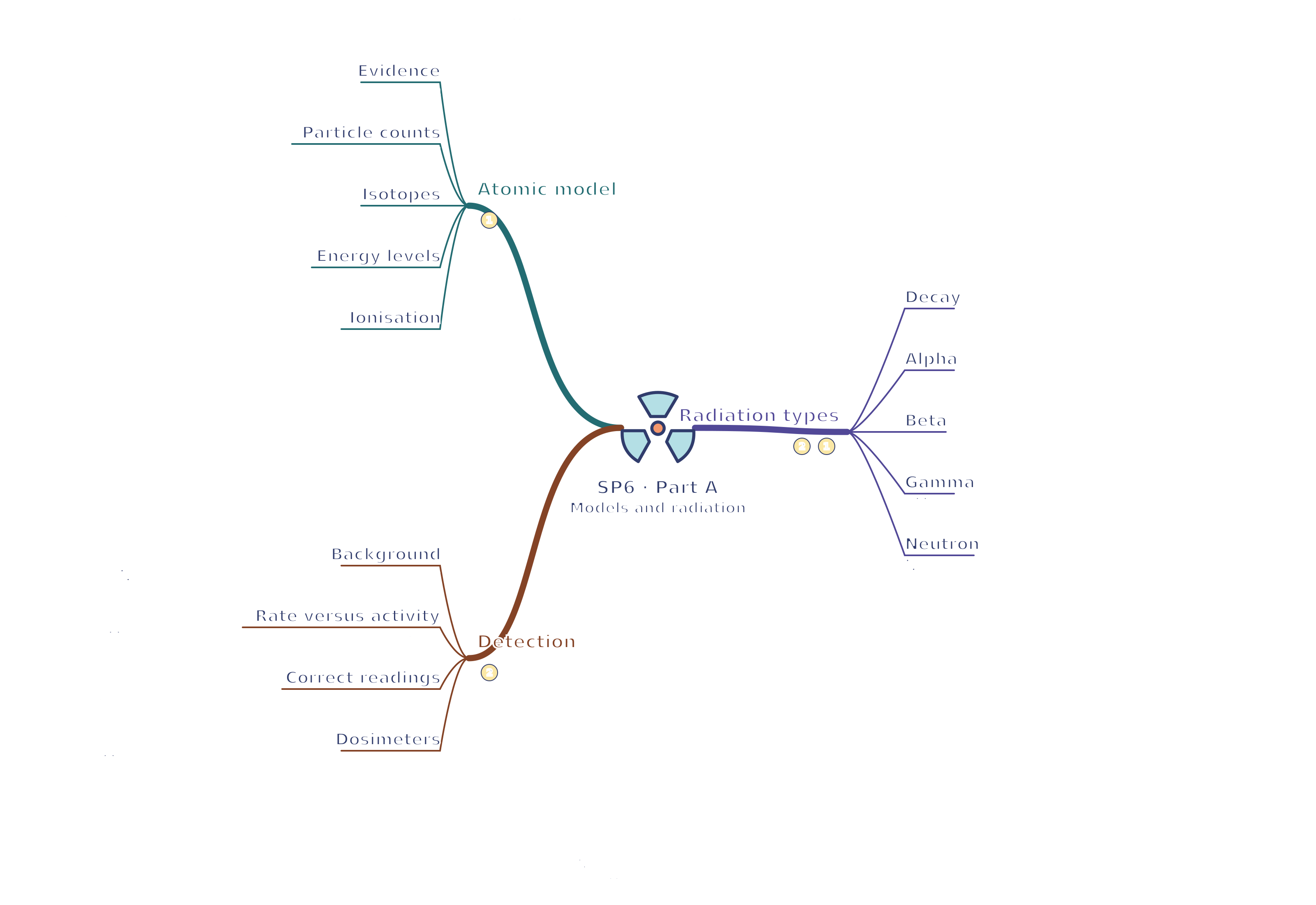
Back to revision notes Open full-size SVG Print mind map Part A · Models and radiation Radioactivity mind map Use your browser’s Print command for A4 landscape, or choose A3 in its paper settings. The SVG remains sharp when enlarged. A text version follows the map.
Read the mind map as text Atomic model Evidence: Plum pudding → scattering → tiny positive nucleus / empty spaceParticle counts: p: +1, n: 0, e: −1; Z = p; A = p + n; n = A − ZIsotopes: Same proton number, different neutron numbersEnergy levels: Absorb to rise; emit to fall; discrete transitions give line spectraIonisation: Electron removed → positive ion; proton count unchangedDetection Background: Natural rocks / radon / cosmic / food plus artificial sourcesRate versus activity: GM counts / time ≠ all decays; activity Bq = decays/sCorrect readings: Subtract measured background rate; control geometry / timeDosimeters: Monitor exposure; do not shield the wearerRadiation types Decay: Spontaneous, random changes of unstable nucleiAlpha: He nucleus; strong ionisation; short range, paper stopsBeta: β⁻ electron / β⁺ positron from nucleus; aluminium shieldingGamma: EM radiation; no A / Z change; lead / concrete reduce intensityNeutron: Neutron emission: A − 1, Z unchangedConnections Atomic model → Radiation types: Nuclear changes emit radiation; electron changes are distinct. Detection → Radiation types: GM counters detect radiation, but not every decay.