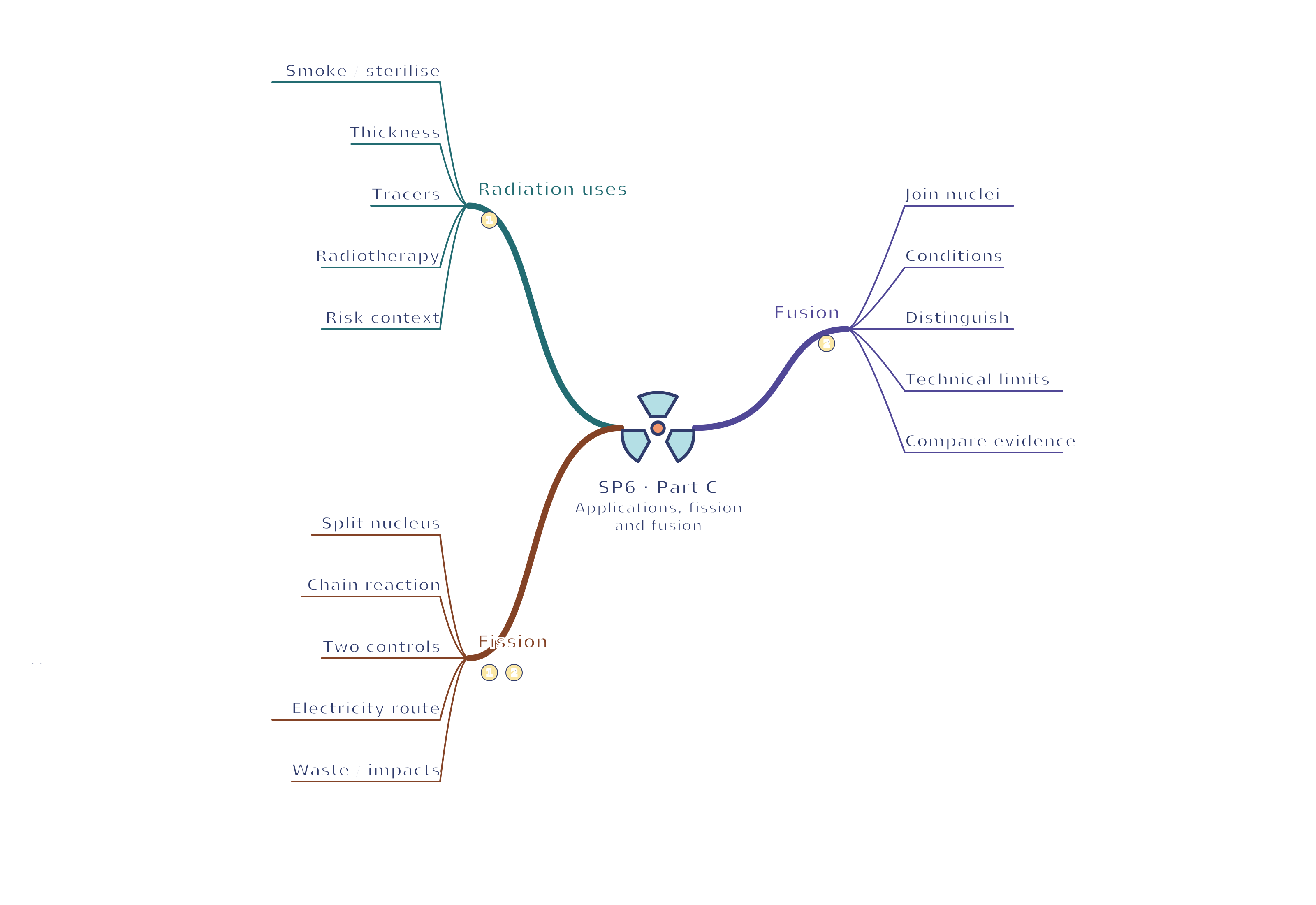
Back to revision notes Open full-size SVG Print mind map Part C · Applications, fission and fusion Radioactivity mind map Use your browser’s Print command for A4 landscape, or choose A3 in its paper settings. The SVG remains sharp when enlarged. A text version follows the map.
Read the mind map as text Radiation uses Smoke / sterilise: Alpha ionises alarm air; gamma irradiation kills microbesThickness: Beta detector count falls for thicker sheet; choose stable sourceTracers: Detectable penetration / suitable half-life; PET uses positronsRadiotherapy: Target tumour externally / internally; limit healthy-tissue doseRisk context: Activity, penetration, route / half-life; short ≠ automatically safeFission Split nucleus: U-235 absorbs neutron → daughters + energy + more neutronsChain reaction: Released neutrons cause further fissions; reactor controls growthTwo controls: Moderator slows neutrons; control rods absorb themElectricity route: Heat coolant → steam → turbine → generatorWaste / impacts: Radioactive waste needs management; evaluate whole-life costsFusion Join nuclei: Light nuclei combine; lower product mass corresponds to energyConditions: Stars: high T overcomes repulsion; pressure / confinement matterDistinguish: Decay, heavy-nucleus fission and light-nucleus fusion differTechnical limits: Hot plasma containment; useful whole-system output must exceed inputCompare evidence: Fuel, waste, safety, readiness, costs; avoid universal claimsConnections Radiation uses → Fission: Radiation hazards also inform fission-product handling and waste control. Fission → Fusion: Both release nuclear energy, but their processes and constraints differ.