 Mr Kidman's Classroom


Revise the key ideas
Fibres and fabric structures
- Fibre yarn fabric — A fibre is a fine strand; fibres can be spun into yarn, and yarn can be woven or knitted into fabric. Some fabrics are formed directly from fibres. Distinguish these stages when explaining a material, since yarn twist and fabric structure affect performance as well as fibre type.
- Cotton and linen — Cotton and linen are plant fibres. Cotton commonly provides absorbent, versatile cloth; linen, made from flax, often feels crisp and creases readily. Fabric weight, finishing and construction affect the actual result, so test the sample rather than relying on a fibre name alone.
- Wool and silk — Wool and silk are animal fibres. Wool's structure can support warmth and felting; silk can provide lustre and fine drape. Individual fabrics vary, and care requirements matter. Check composition and handling guidance before dyeing, heating or washing a sample.
- Manufactured fibres — Polyester is a synthetic polymer fibre; viscose is regenerated cellulose. Their manufacturing routes and properties differ, even though both are manufactured. Polyester often resists creasing and absorbs little water into the fibre, but weave, finish and blends still influence how a cloth behaves.
A polymer is a substance made of very long molecular chains. Polyester is made synthetically; viscose is made by processing cellulose from plants into a new fibre, which is why it is called regenerated.
- Blends and finishes — A blend combines different fibres to adjust properties, appearance or cost. A finish alters a fabric's handle or performance, for example through brushing or coating. Record the actual composition and finish when known; an unknown reclaimed cloth needs tests rather than a guessed care label.
- Woven fabric — Weaving interlaces warp and weft yarns. In plain weave, each weft alternates over and under successive warp yarns, reversing on the next row. Twill creates diagonal effects; longer floats in satin structures can produce smooth lustre but may snag more readily.
A float is a stretch of yarn passing over several crossing yarns before interlacing again. Longer exposed stretches can catch on objects more easily.
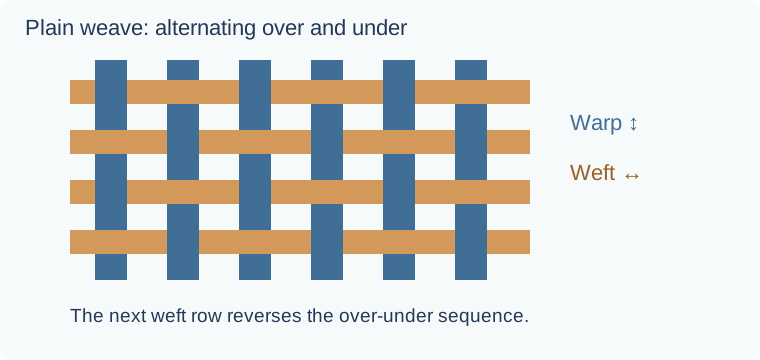
Plain-weave schematic: blue warp runs lengthwise and ochre weft crosses it, alternating over and under. Full-size diagram - Knitted fabric — Knitting forms interlocking loops of yarn. The structure often gives stretch and flexibility even when the fibre itself has limited elasticity. Cut edges can unravel, curl or behave differently from woven fabric, so test edge control and handling for the actual knit.
- Nonwoven and felt — Nonwovens form sheets from fibres joined by mechanical, thermal or chemical methods rather than weaving or knitting. Wool felt can form through moisture, heat and agitation; needle felting entangles fibres mechanically. Use appropriate supervised methods and distinguish the structure from a printed felt-like texture.
Handling and construction
- Grain and bias — The lengthwise grain follows warp in woven fabric; crosswise grain follows weft. True bias runs at about 45 degrees to them and generally allows more give and drape. Mark grain on a pattern and check the actual cloth rather than assuming a distorted cut edge is straight.
- Drape and handle — Drape describes how fabric hangs; handle describes how it feels and responds to touch. Weight, stiffness, thickness, structure and finish all contribute. Compare equal-sized samples over the same support so you can choose a cloth for the intended form or movement.
- Measuring and layout — Measure accurately, mark grain direction and identify seam allowances before cutting. Check the direction of print, nap and stretch, and plan an economical layout. A rotated pattern piece may save cloth but change the finished appearance or behaviour.
Nap is a raised or directional surface, such as velvet’s pile. Turning one piece the other way can change its appearance even when it is cut from the same cloth.
- Seams and allowances — A seam joins fabric pieces; a seam allowance is the material between stitching and cut edge. Match the method and allowance to fabric and purpose. Test strength, bulk and appearance on scraps before joining final pieces, and secure stitch ends appropriately.
- Edge finishes — Woven cut edges can fray, so choose a suitable finish such as a folded hem, binding or an approved machine finish. Consider thickness, curve and visibility. An intentionally raw edge is a design choice requiring control, not an excuse for a failing join.
- Hand and machine stitch — Running stitch can gather or make a visible broken line; backstitch can create a stronger continuous line. A sewing machine needs correct threading, needle and tension for the task. Learn setup under supervision and stop the machine before adjusting fabric near the needle.
- Shaping fabric — Darts remove wedges of fullness to create three-dimensional shape; gathers distribute fullness along an edge; pleats fold cloth in a planned way. Test the amount and position on a toile or sample, since the same pattern behaves differently in stiff and fluid fabric.
A dart usually folds and stitches a wedge-shaped area to take in fullness; it does not necessarily remove a cut-out wedge of fabric. Follow the taught pattern method.
- Support and fastening — Interfacing can strengthen or stabilise selected areas, while a lining forms an inner layer. Fastenings must suit the fabric, function and visual intention. Test iron-on products with the approved temperature and barrier, since heat can mark, melt or distort some materials.
Testing and responsible making
- Toiles and prototypes — A toile is a trial version used to investigate shape, fit or construction. Mark changes on it and transfer useful corrections to the pattern. A full prototype is not always needed; a focused section can test a difficult join or unsupported form more efficiently.
- Material testing — Compare samples for the properties your intention requires, such as drape, seam strength or colour transfer. Keep dimensions and test conditions comparable and record observations. School tests provide evidence for your project, not a certificate that a material meets an industrial safety standard.
- Care repair waste — Plan cleaning, storage and repair as part of a textile's life. Design accessible joins or replaceable parts where useful and keep reusable offcuts sorted. A delicate art textile may need protected display rather than washing; care should follow its actual materials and purpose.
- Workshop practice — Count and store needles safely, carry scissors correctly and follow supervision rules for machines and irons. Keep cables, hair and loose clothing clear of moving parts. Report damage and stop if equipment behaves unexpectedly; completion of a knowledge quiz is not permission to use a machine independently.

