Mr Kidman's Classroom



Revise the key ideas
Sources and visual research
- Textile enquiry — Begin with an intention such as exploring movement through wearable fabric or memory through layered cloth. Gather sources that help investigate it. Textile Design can include expressive artwork as well as functional objects, so clarify what an audience should see, feel or understand.
- First-hand recording — Draw, photograph and handle suitable objects or fabric samples with permission. Record scale, surface, light and tactile qualities. A photograph can show a sheen but cannot fully record softness or drape; pair it with observations and a labelled physical sample where possible.
Tactile means related to touch. Drape is the way a fabric hangs and falls into folds, which is difficult to judge from a photograph alone.
- Drawing for textiles — Use drawing to investigate motifs, repeat layouts, stitch paths, texture or construction. A quick stitch diagram and a detailed observational study serve different needs. Translate a drawing into material tests rather than assuming every pencil detail can be reproduced at the chosen fabric scale.
- Visual and tactile language — Line can be made by thread, colour by dye and form by gathering or support. Actual texture is felt, while implied texture is represented visually. Compare how a flat print and raised embroidery communicate the same source differently, and choose deliberately.
- Contextual research — Study particular textile makers, works and traditions in reliable collections or publications. Record maker or community where known, date, materials, function and source. Distinguish a documented technique from your interpretation, and avoid presenting an entire culture as one decorative style.
- Responding to sources — Identify a strategy such as layering, repetition or visible mending, then test it using your own observations. Copying a whole design does not establish a personal response. Acknowledge the influence and explain what you changed and how that change serves your intention.
Pattern and communication
- Motif — A motif is a recurring visual unit, such as a shape derived from a seed pod. Simplify the source while retaining a useful feature. Test the motif at the intended scale: a narrow gap visible on paper may disappear when stitched or printed on cloth.
- Repeat systems — A block repeat aligns units in rows and columns; a half-drop offsets neighbouring columns by half a unit vertically. Test joins in several directions so edges connect as intended. An isolated tile can look successful while producing an unwanted stripe in a larger repeat.

The same original motif in block and half-drop arrangements. The half-drop offsets neighbouring columns vertically. Full-size diagram - Placement design — A placement design positions an image for a particular area rather than repeating it across the whole surface. Plan its relationship to shape, seams and the viewer's position. A large motif centred on a flat drawing may become partly hidden when the textile is worn or folded.
- Colourways — A colourway is an alternative colour arrangement of the same design. Compare hue, value and saturation on the actual fabric, since a screen or paper print can misrepresent the result. Keep the layout constant initially so you can judge the colour decision clearly.
Hue means the colour family, such as red or blue; value means lightness or darkness; saturation means how vivid or muted a colour looks.
- Scale and rhythm — Motif size, spacing, direction and variation change the rhythm of a textile. Dense small marks can merge at a distance; a large isolated form can become a focal point. View a sample close up and at its likely display distance before selecting a design.
- Meaning and audience — Material, imagery and making methods can communicate identity, memory or a response to an issue. Explain how the visible and tactile choices support that reading. Do not assume every viewer shares the same colour associations or understands a reference without contextual information.
Development and evidence
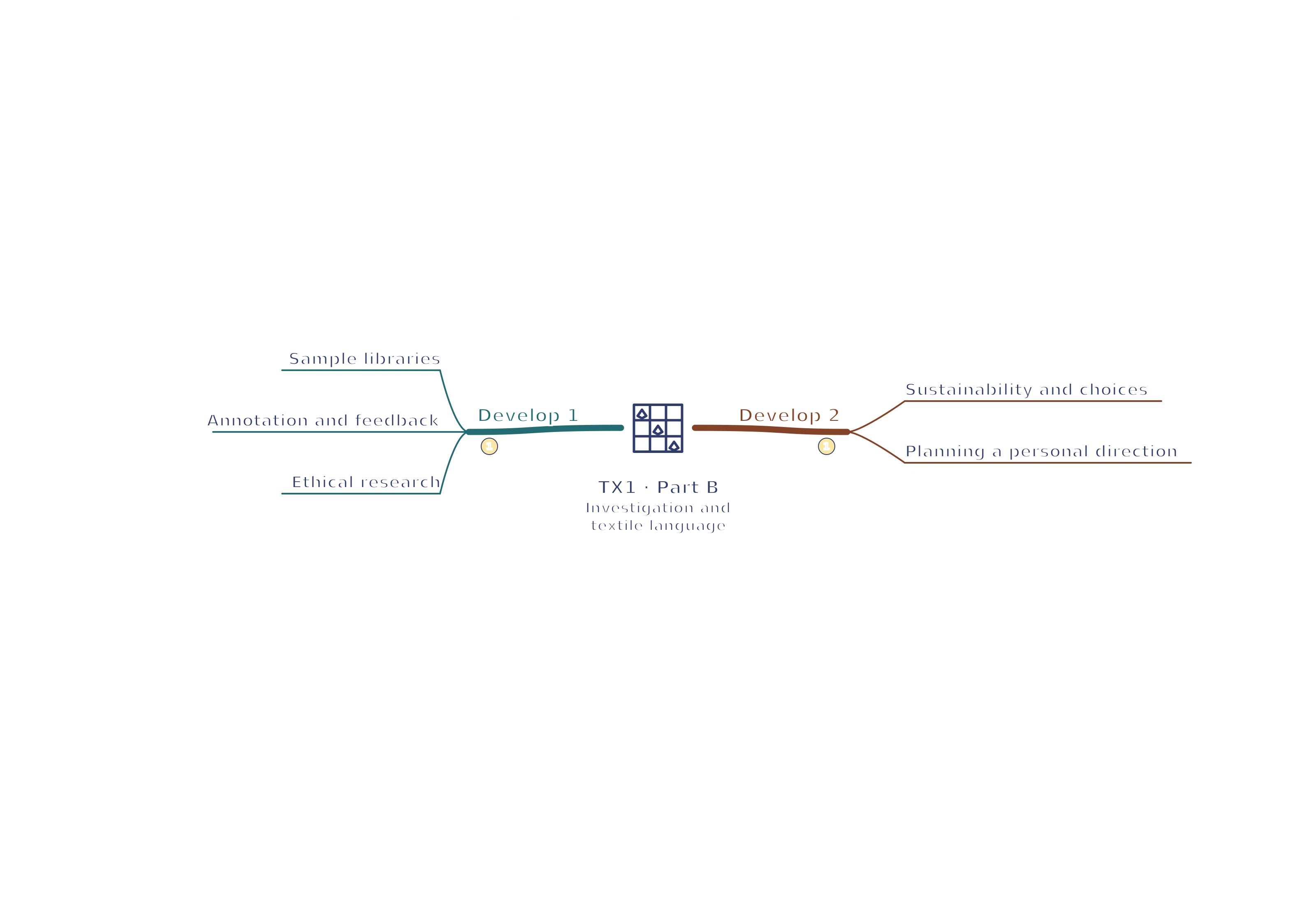
- Sample libraries — Label samples with fabric, thread, colourant, process and useful settings. Add the result and a proposed change. A sample without records may be difficult to repeat, while a small controlled comparison can establish which method is worth developing.
- Annotation and feedback — Explain what a sample shows and what you will do next. For example: the dense stitches distort this thin fabric, so I will test a support and lower density. Consider feedback against your intention and document decisions rather than collecting comments without acting on them.
- Ethical research — Respect permissions, cultural significance and source ownership. Ask before photographing people or using personal narratives and follow school guidance for storage and display. An acknowledged influence still needs thoughtful transformation; a source credit alone does not settle whether an adaptation is appropriate.
- Sustainability and choices — Consider material origin, durability, repair, water, energy and waste across the textile's life. Reusing cloth can reduce demand for new material but may require cleaning, testing and reinforcement. Avoid claiming a fibre or process is always sustainable without comparing the actual context.
- Planning a personal direction — Compare two material routes for the same intention, such as translucent layers and dense stitched marks for concealment. Record which communicates more clearly and why. Select evidence that connects sources, experiments and decisions rather than treating a large pile of samples as development by itself.
Translucent cloth lets some light through while partly obscuring what is behind it. Compare how much of an underlying mark remains visible through each layer.