 Mr Kidman's Classroom


Revise the key ideas
2.1.1 · Business growth
- Internal or organic growth expands the business through its own activities, such as opening another branch, developing products or selling into new markets.
- Innovation and research and development can produce improved products or processes. Development costs occur before success is certain; customer research and testing can reduce the risk.
- New markets can be reached through a changed marketing mix, technology or overseas expansion. A website can extend reach but needs suitable delivery, promotion and support.
- Organic growth allows more gradual expansion and can preserve the business's culture. It may be slow, and success depends on finance, demand and management capacity.
- External or inorganic growth combines existing businesses. A merger joins businesses into one organisation; a takeover occurs when one business acquires control of another.
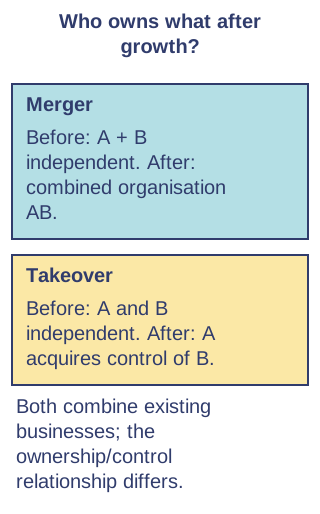
- External growth can quickly increase customers, capacity or expertise. It can also be expensive and create integration problems, duplicated roles and clashes in working practices.
- Growth can spread some fixed costs over more output or improve bargaining power. Larger scale does not automatically reduce every cost: coordination problems can make the business less efficient.
- A public limited company (plc) has limited liability and can offer shares to the public. The word public refers to offering shares to the public; it does not mean that the company is government-owned.
- Public share offers, including a stock-market flotation (offering the company’s shares to the public for the first time and listing them on a stock exchange), can raise substantial share capital. Existing owners may lose some control and shareholders expect information and returns; a flotation has costs and requirements.
- Internal finance includes retained profit and selling assets. Asset sales raise cash but may reduce capacity if needed equipment is sold; retained profit may be limited or needed elsewhere.
- External finance includes loans and share capital. Loan repayments and interest put pressure on cash; share issues dilute ownership but do not require scheduled loan repayments.
- Match finance to the project and risk. A long-lived expansion usually needs finance that remains available long enough, rather than relying entirely on a short-term overdraft.
- Fictional case: a bakery could open its own second shop or buy a rival. A takeover gives immediate premises and customers, but purchasing and integrating it may cost more than the bakery can safely fund.
2.1.2 · Changes in aims and objectives
- Objectives can change as the business evolves. A start-up may prioritise survival; an established business may pursue growth, higher profit or a larger market share.
- Market conditions can change priorities. Falling demand may lead to cost reduction, a smaller workforce or withdrawal from an unprofitable market rather than expansion.
- New technology can enable online growth or make an old product less attractive. Objectives should reflect both the opportunity and the business's ability to adapt.
- Actual performance influences decisions. Strong profit and cash may support investment; poor results may make financial security the immediate objective.
- Legislation may require changes to products, staffing or operations. Internal reasons, such as new leadership, owner priorities or available skills, can also change objectives.
- A business may enter or exit markets, increase or reduce its workforce, and widen or narrow its product range. Growth is one possible direction, not an inevitable goal.
- Changes affect connected functions: a sales-growth objective needs marketing, enough operational capacity, suitable people and finance to support them.
- Fictional judgement: a retailer losing money in a region might close stores to protect survival, but closure costs and damage to customer access should be weighed against future savings.
2.1.3 · Business and globalisation
- Globalisation is increasing connection between economies and markets. Businesses may buy, sell, produce or compete across national borders.
- Imports are bought from overseas; exports are sold overseas. Imported supplies can offer lower costs or greater choice, but delivery, exchange rates and quality must be considered.
- Overseas competitors can increase domestic competition (competition within the home country), putting pressure on prices or encouraging differentiation. Globalisation can create opportunities and threats for the same business.
- Exporting can enlarge the market and spread risk across countries. It also brings language, cultural, legal, delivery and currency issues, so a successful domestic offer may need adapting.
- A multinational operates in more than one country. Locations may be chosen for access to customers, labour, materials, transport or other business conditions.
- Moving production can reduce particular costs or bring the business closer to a market. Coordination, reputation, training and supply reliability may offset some savings.
- A tariff is a tax on imports. It can raise the cost of imported products or materials and affect competitiveness; the importer may absorb the cost or pass it on.
- A trade bloc is a group of countries with agreements intended to reduce trade barriers between members. Trade conditions with non-members can differ; do not assume all tariffs everywhere disappear.
- E-commerce can help businesses reach international customers without a shop in every country. They still need to manage payment, delivery, returns and local customer expectations.
- Adapt the marketing mix: product features or promotion may change for local needs, prices must reflect costs and competition, and distribution must fit the market.
- Worked example: a tariff of 10% on goods with a taxable import value of £5,000 adds £500, giving £5,500 before other charges. The effect on final selling price depends on the firm's decision.
The tariff is 10 ÷ 100 × £5,000 = £500. Adding it to the import value gives £5,000 + £500 = £5,500 before other charges.
2.1.4 · Ethics, the environment and business
- Ethics concerns judgments about acceptable business behaviour. Ethical choices can go beyond minimum legal requirements, such as paying suppliers fairly or avoiding misleading promotion.
- Ethical sourcing and fair treatment may improve reputation, customer loyalty and recruitment. They can also increase costs, and customers may be unwilling to pay a higher price.
- Environmental considerations include energy use, emissions, waste, packaging and resource use. Sustainability means considering whether activity can continue without unacceptable harm or resource depletion.
- Reducing waste or energy use can save money as well as reduce environmental impact. Other measures, such as cleaner equipment, may need substantial investment before savings occur.
- A trade-off means gaining one benefit while giving up another. Trade-offs arise when a choice improves ethics or sustainability but reduces short-term profit. Long-term reputation, efficiency and risk can change that comparison.
- Pressure groups may use campaigns, publicity, petitions or boycotts (refusing to buy from a business to put pressure on it) to influence business behaviour. They can affect demand and encourage changes to sourcing, products, packaging or promotion.
- Claims about ethical or environmental performance need credible evidence. Unsupported claims can damage trust; changing promotion without changing actual practice may be ineffective.
- Fictional judgement: a clothing retailer considering higher-cost responsibly sourced fabric should compare customer willingness to pay, supplier reliability and its long-term brand, rather than assume ethics always increases or reduces profit.
