Mr Kidman's Classroom



Revise the key ideas
Extraction and manufacture
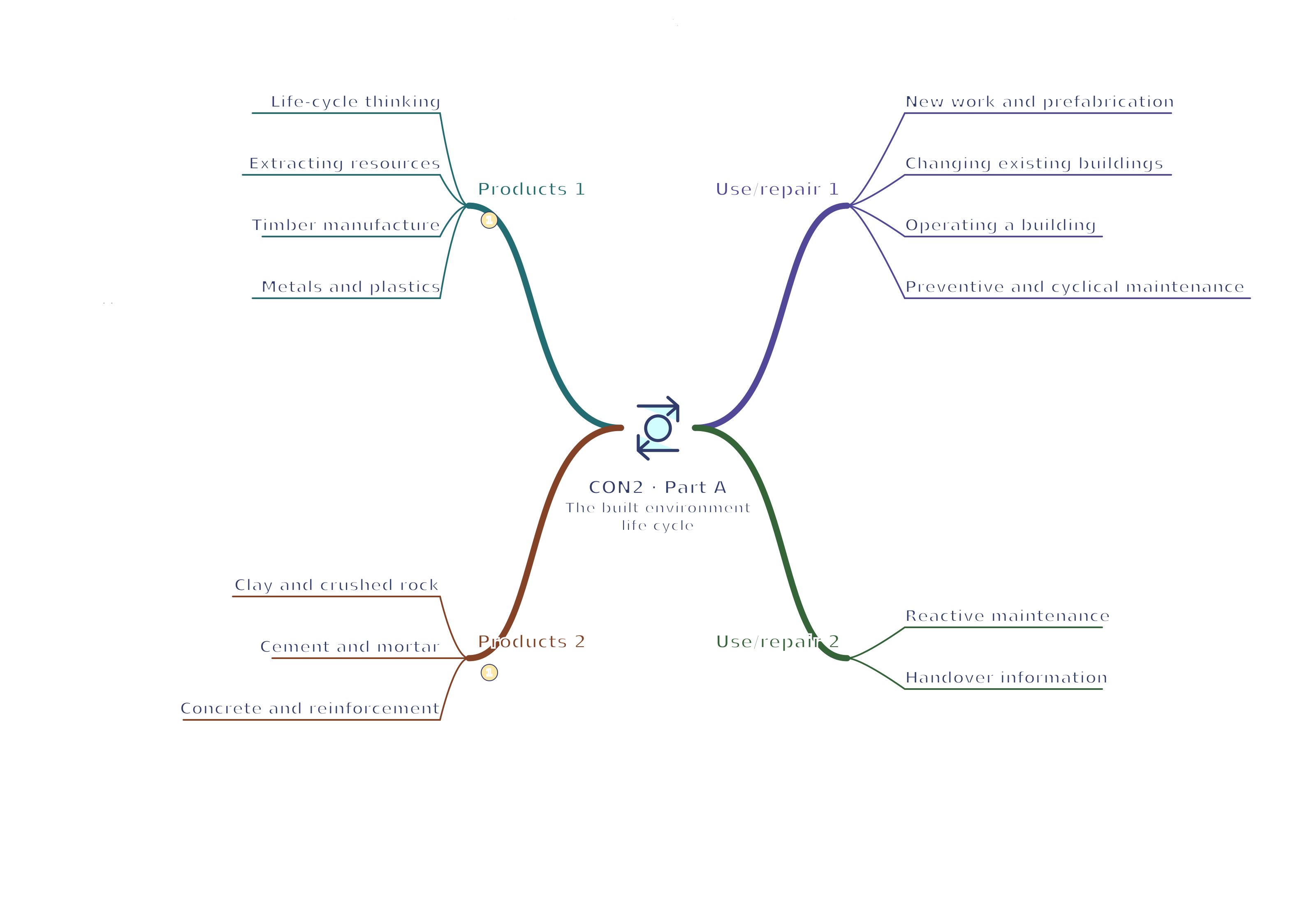
- Life-cycle thinking — The life cycle runs from extracting raw materials through manufacturing, construction, operation and maintenance to demolition and recovery or disposal. Decisions at one stage affect later stages. A durable component may cost more initially yet require fewer replacements; compare the whole service life rather than purchase price alone.
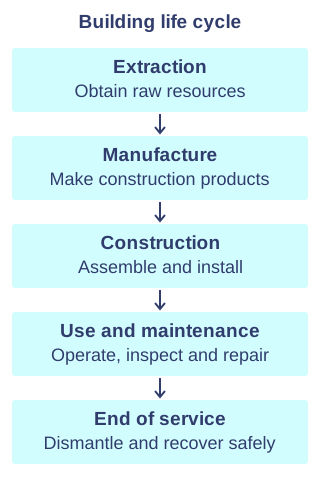
Original teaching schematic. Read with the explanation; not a construction specification. - Extracting resources — Forestry supplies timber; quarrying supplies stone, limestone, sand and aggregate; mining extracts ores; oil and gas extraction supplies fuels and chemical feedstocks. Extraction can disturb habitats and use energy. Timber is renewable only when forests are responsibly managed and regrown; metal ores and fossil resources are finite on human timescales.
Aggregate is granular material such as sand, gravel or crushed rock. A feedstock is a starting raw material used to make another material or product.
- Timber manufacture — Logs are converted into usable sections and seasoned to reduce moisture content. Inadequate drying can lead to shrinkage and distortion after installation. Engineered products overcome some size and consistency limits: plywood uses bonded veneers, OSB uses oriented wood strands, and engineered sections or trusses can span further than a small solid board.
Veneers are thin sheets of wood. OSB means oriented strand board: wood strands are arranged in layers and bonded into a board.
- Metals and plastics — Structural steel is formed into beams and columns; stainless steel provides corrosion-resistant fixings; thin steel can form rails, purlins and profiled cladding. Copper is drawn into conductors or made into pipes. Plastics can form pipes and insulation. Choose by required properties and conditions, not simply by whether a material looks strong.
- Clay and crushed rock — Clay is shaped, dried and fired to make bricks; firing gives a durable ceramic product. Rock can be crushed and graded for hardcore and granular fill. A stated grading, such as 20 mm, refers to the specified aggregate size range, not a promise that every particle is exactly 20 mm. Compaction and the correct grading affect performance.
Hardcore is coarse material used in a suitable prepared base. Compaction presses particles closer together to reduce voids; the actual material and method must match the design.
- Cement and mortar — Cement is made by processing and heating raw materials including limestone, then grinding the product with additions. Mortar commonly combines binder, sand and water to bed masonry and finish joints. Cement is an ingredient, not another name for mortar. Mix selection must suit the work; adding extra cement does not automatically improve compatibility or durability.
The binder is the ingredient that helps hold the other particles together as the mixture sets and develops its properties.
- Concrete and reinforcement — Concrete combines cementitious binder, water and fine/coarse aggregate. It resists compression well but has limited tensile capacity; reinforcement helps resist tension. Prestressed products use deliberately stressed tendons to improve performance in service. A precast beam is made before arrival on site; prestressed and precast describe different features and are not synonyms.
Construction and occupation
- New work and prefabrication — New construction includes buildings, roads, bridges, drainage and foundations. Prefabricated components are manufactured before installation, then transported and assembled. Off-site work can improve controlled production and reduce site time, but transport dimensions, lifting, tolerances and connection details need planning. It does not remove the need for inspection.
- Changing existing buildings — An alteration changes an existing feature; conversion changes use, such as a warehouse becoming flats; renovation improves or restores condition. Existing services, hidden defects, structural capacity and occupants affect sequencing. Service installation includes mechanical, electrical, gas and communication systems, coordinated with the work around them.
- Operating a building — Operation includes heating, cooling and lighting control, security, cleaning and routine testing. Fire alarm tests and evacuation arrangements support safe occupation. A well-insulated building can still waste energy if controls are left at unsuitable settings. Operators need clear information and training at handover.
- Preventive and cyclical maintenance — Preventive maintenance acts before failure, such as servicing a ventilation system. Cyclical work repeats over a planned interval, such as redecorating exposed surfaces. The interval depends on wear, exposure and manufacturer advice. Keeping gutters clear may prevent water penetration and damage that would cost much more to repair later.
- Reactive maintenance — Reactive work follows a failure, such as repairing a leaking pipe. Emergency work responds to an immediate threat, such as making a dangerous loose component safe. Urgency does not justify untrained repair. Secure the area, report the defect and use competent personnel while managing the effects on occupants.
- Handover information — An operation and maintenance manual describes installed equipment, controls, servicing and relevant contacts. As-built drawings record actual locations. The health and safety file, where required, is a related but distinct record of information needed for future construction work. Neither document is a substitute for current risk assessment before alterations or demolition.
Demolition and recovery
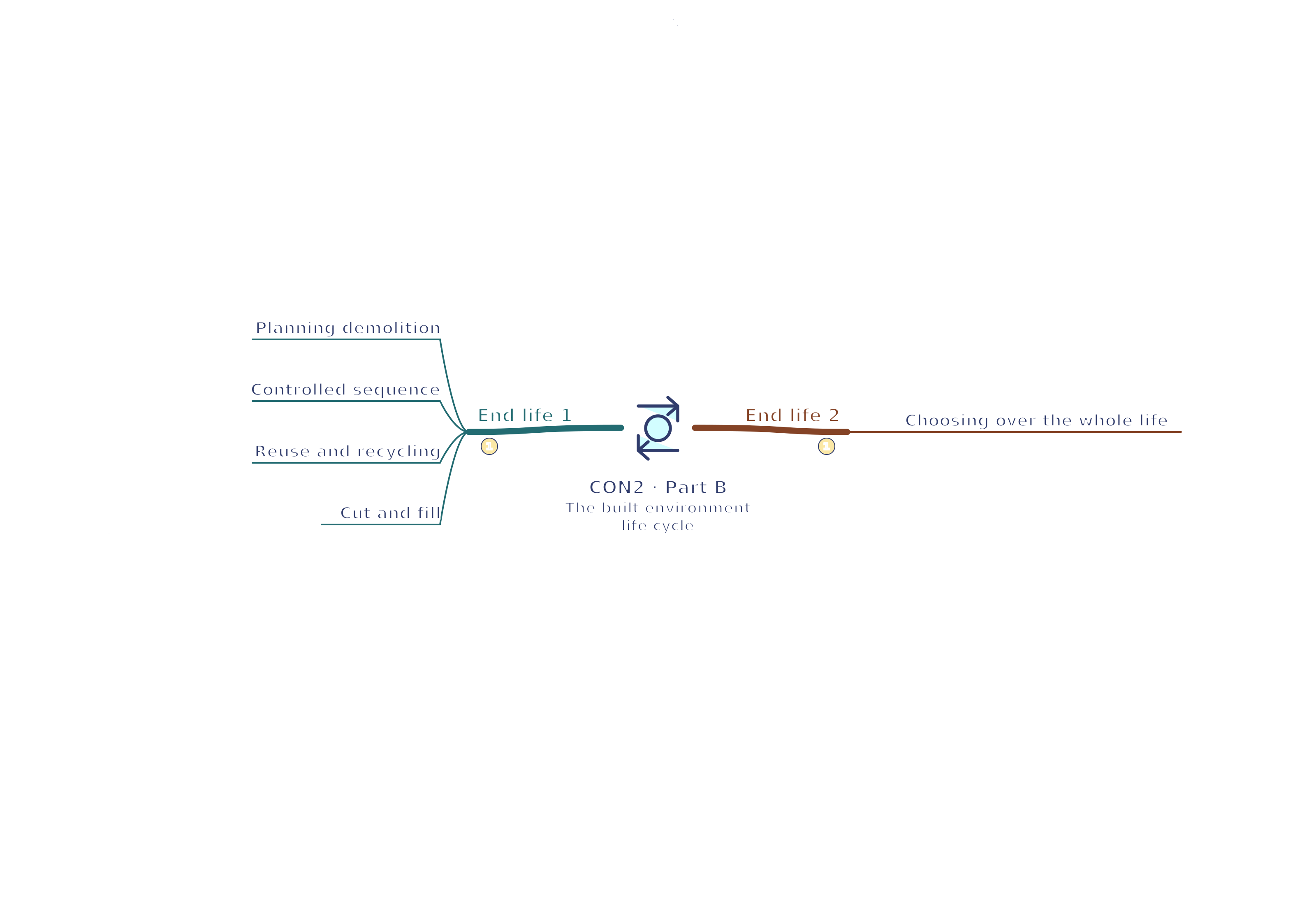
- Planning demolition — A pre-demolition plan considers structure, shared walls, nearby buildings, access, services and hazardous materials. Asbestos requires specialist assessment; wood dust and some foams also require appropriate controls but are not the same hazard. Competent people choose hand, machine or specialist explosive methods. Learners must not infer a safe demolition sequence from a photograph.
- Controlled sequence — Typical planned stages include securing the site, arranging verified utility disconnections, dealing with hazardous materials, soft stripping non-structural fittings, dismantling the superstructure and removing slabs or foundations. The actual engineered sequence depends on the building. Dust suppression and segregation protect workers and neighbours throughout, rather than only during final clearance.
Superstructure refers to the main building above its substructure. The terms describe building parts; they do not establish a safe dismantling method.
- Reuse and recycling — An intact reclaimed door reused as a door retains most of its form. Crushing concrete into aggregate is recycling. Both can reduce demand for virgin material, but suitability, contamination, transport and testing matter. Materials that cannot be safely recovered require authorised disposal rather than mixing unknown waste into clean stock.
Virgin material is newly obtained raw material rather than material recovered from a previous product or use.
- Cut and fill — Cut removes material from a high area; fill places suitable material in a lower one. Reusing clean suitable excavated material on site can reduce vehicle movements. A landscape bund is a shaped mound and must be designed appropriately. Contaminated or unsuitable material cannot simply be hidden under landscaping.
- Choosing over the whole life — A fictional roof choice should consider extraction, manufacturing energy, transport, installation, maintenance, expected life and eventual recovery. Reclaimed slate may reduce new extraction but needs inspection and suitable fixings. Explain a trade-off with evidence; a label such as recycled does not prove the option is best in every situation.
Extraction and manufacture
- Materials under load — Compression squeezes a member; tension pulls it apart. Concrete performs well in compression but can crack under tension, so reinforcement is located and detailed by the design to resist tensile action. A beam can experience both: under a simple downward load, different zones may be compressed or stretched. Material choice therefore depends on the action and member arrangement, not a single label such as strong. Do not infer reinforcement position for real work from this schematic explanation.