Mr Kidman's Classroom


Revise the key ideas
Whole-life sustainability
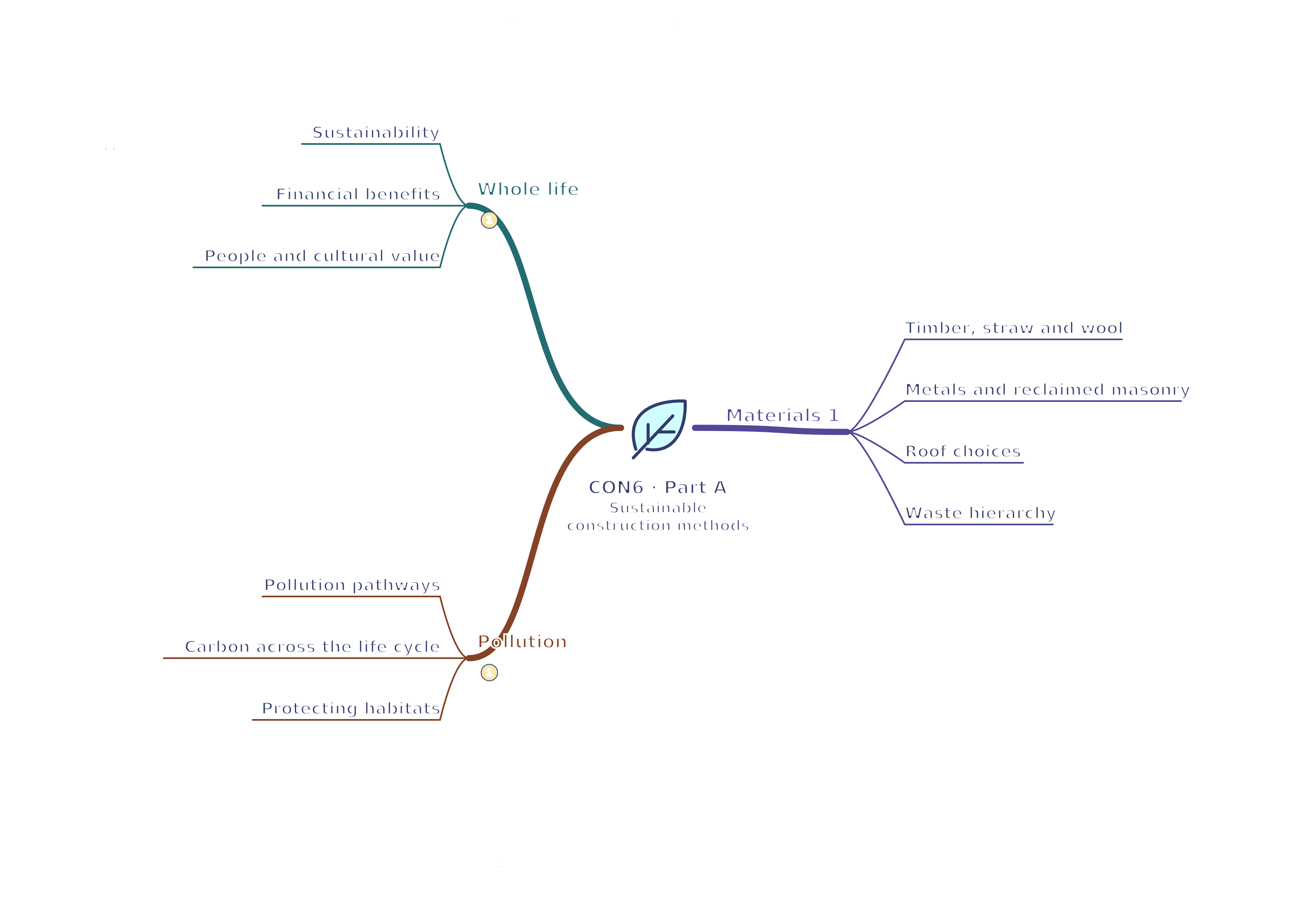
- Sustainability — Sustainable construction considers environmental, social, cultural and financial effects over the building's life. A cheap initial option can create high operating costs or frequent replacement. Compare the service provided and expected life as well as material quantities. Sustainability is a reasoned comparison, not a label attached to one material.
- Financial benefits — Accurate ordering reduces waste and disposal costs; good insulation and controls can reduce energy demand; water-efficient fittings can reduce consumption. Initial investment may be higher. A fictional improvement costing £1,200 and saving £200 annually has a simple payback of six years, ignoring changing prices, maintenance and discounting.
Simple payback divides the initial cost by the stated annual saving: £1,200 ÷ £200 = 6 years. Discounting is a separate calculation adjusting future costs or savings to a present value; it is excluded from this simple illustration.
- People and cultural value — Good daylight, suitable temperatures, accessible layouts and air quality can support comfort and productivity. Retaining valued buildings can protect local character. An aesthetically pleasing scheme is not automatically accessible or affordable; evaluate who benefits and whether the building works for its users.
Pollution and habitats
- Pollution pathways — Construction can create dust, noise, exhaust emissions, contaminated runoff and spills. Suppress dust at source, use suitable extraction, contain substances and protect drains. A drain can carry pollution far beyond the work area. Clean-looking water is not proof that it contains no harmful material.
- Carbon across the life cycle — Embodied emissions arise from materials, transport, construction and other life-cycle stages. Operational emissions arise from energy used during occupation. Retaining a sound structure can avoid some new material emissions, while improving its operation may save energy. Compare both rather than shifting impacts out of view.
- Protecting habitats — Survey the site and avoid sensitive areas where possible. Protected sites and species can restrict work. Wildlife crossings and alternative roosts are examples of mitigation, not a guarantee that any damage is acceptable. Relevant bodies include Natural England, Natural Resources Wales, NatureScot and Northern Ireland's DAERA; the required permissions depend on location and the proposal.
Mitigation means action intended to reduce harm. It should be assessed by its actual effect on the habitat or species, not just by whether a measure has been installed.
Material choices and waste
- Timber, straw and wool — Responsibly sourced timber can regrow; straw bales may provide infill within a designed frame; wool can provide insulation. Moisture, fire, durability, pests, transport and performance certification affect suitability. Renewable does not mean maintenance-free or appropriate for every exposed location.
- Metals and reclaimed masonry — Steel can contain recycled metal and can be recovered again. Intact bricks can be reused if suitable, while damaged masonry may be crushed into aggregate. Check quality and compatibility: reclaimed bricks of unknown strength or frost resistance should not automatically replace specified structural products.
- Roof choices — Sound reclaimed slates or tiles may be reused; thatch and timber shingles can suit particular settings. Roof pitch, support, weather exposure, fire precautions and maintenance matter. A traditional material may support cultural value but still require specialist installation and periodic replacement.
Pitch means the roof’s slope. Shingles are individual overlapping roof-covering pieces; in this example they are made from timber.
- Waste hierarchy — Avoid unnecessary material use, then consider reuse, recycling and other recovery before disposal. Plan cuts, protect stored materials and order carefully. Reuse retains a product with little processing; recycling changes it, for example by crushing or smelting. Recycling requires energy and is not a reason to create avoidable waste.
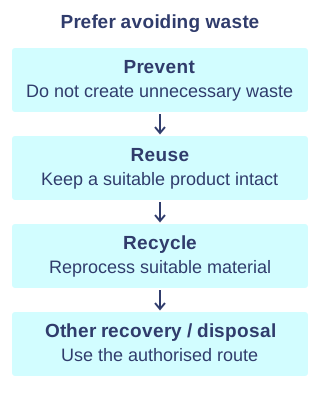
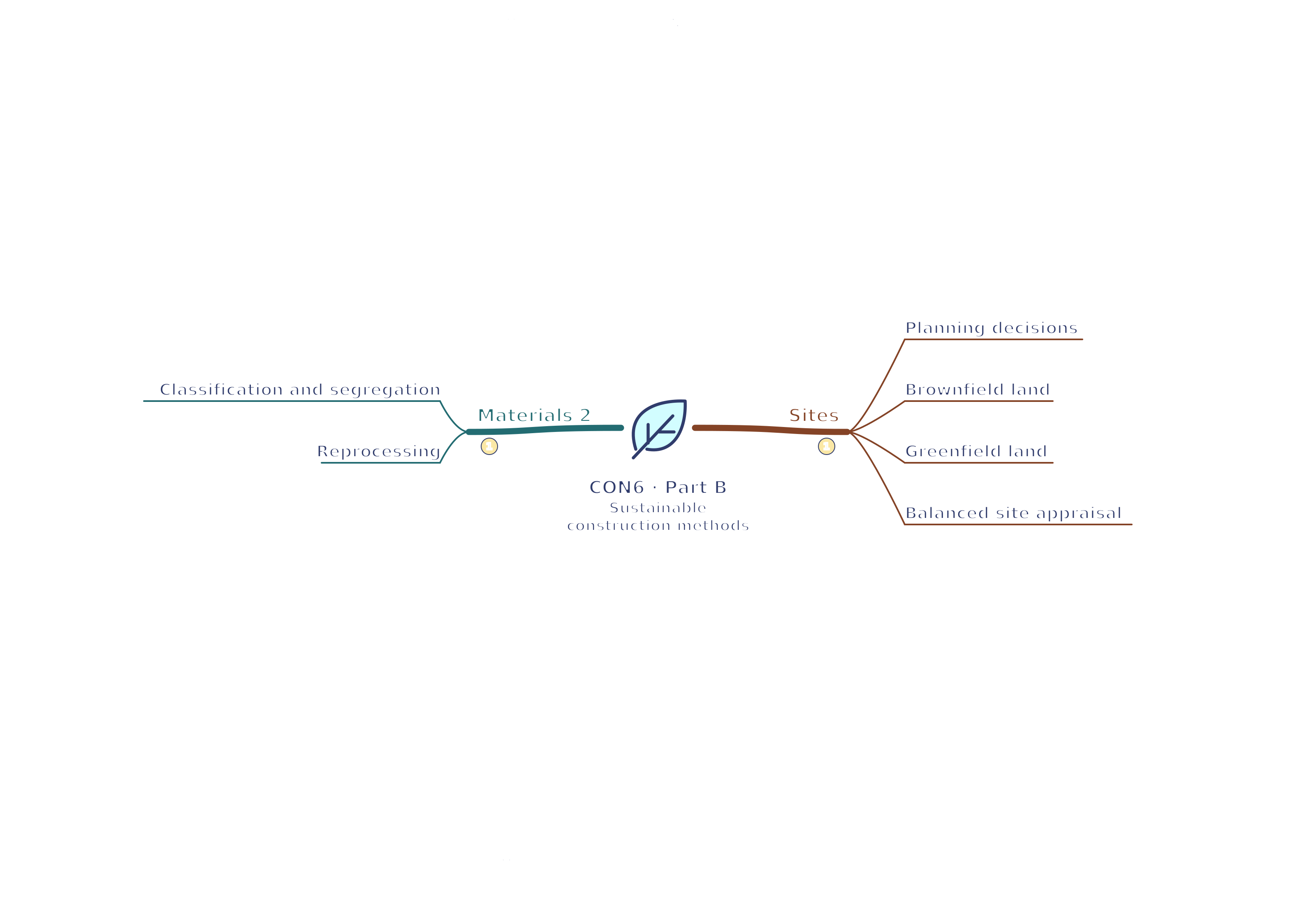
Original teaching schematic. Read with the explanation; not a construction specification. - Classification and segregation — Identify waste by source, properties and hazards. Separate clean timber, metals and masonry where appropriate; contamination can prevent recovery. Hazardous waste requires suitable storage and authorised handling. Landfill has financial, environmental and social costs, including transport, lost resources and potential pollution.
- Reprocessing — Concrete may be crushed, metals sorted and smelted, and glass or plastics cleaned and reprocessed into suitable products. Decontamination may be needed before recovery. Use an authorised route and keep required records. Mixing unknown substances into a skip can make an otherwise recyclable load unsuitable.
Sites and permission
- Planning decisions — Local planning authorities control development through planning systems. Proposals may be assessed for location, appearance, access, neighbours and environmental effects. Building regulations address technical matters such as safety and energy performance. The need for either process depends on the work and location; securing one does not automatically secure the other.
- Brownfield land — Brownfield sites may have roads, drains and utility connections and redevelopment can improve derelict land. Demolition, contamination, unstable ground or obsolete services can raise costs. Existing infrastructure must be checked, not assumed usable. Reusing land can reduce pressure on undeveloped sites but does not remove habitat considerations.
Brownfield commonly describes previously developed land. The formal planning definition and exceptions depend on the location, so apply the relevant current requirements.
- Greenfield land — Greenfield sites have not previously been developed in the relevant sense. They may offer a less constrained layout but can remove farmland or habitats and need roads and services. Greenfield and green belt are different terms: a green belt is a planning designation. Cheaper construction is not guaranteed once infrastructure and constraints are considered.
A planning designation is an official classification to which particular planning policies apply. It is different from describing whether a site has previously been built on.
- Balanced site appraisal — Compare a fictional disused factory site with a field by considering access, contamination, housing need, habitats, services, cost and community effects. State uncertainty, such as untested ground conditions, before reaching a conditional recommendation. Choosing brownfield is not sufficient justification without explaining the relevant benefits and drawbacks.