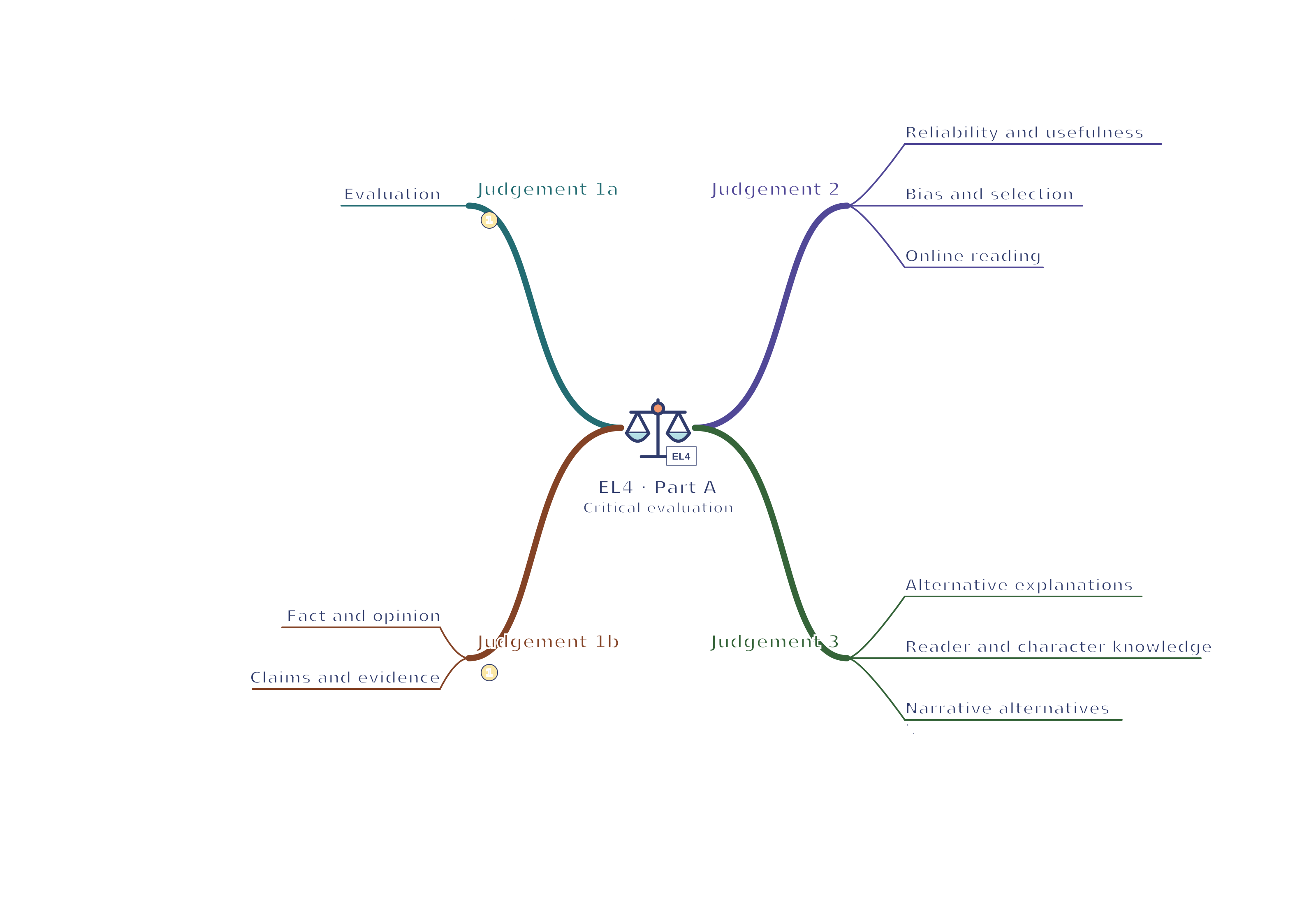
Evaluation — Evaluation makes a supported judgement against a relevant criterion. Ask whether an explanation is clear, a claim convincing or a description effective, then show why. Personal liking can begin a response but cannot replace evidence.
Fact and opinion — A factual claim can be checked; an opinion expresses a judgement or preference. A factual claim may be false and an opinion may be well supported. Do not equate “fact” with “a statement I agree with”.
Claims and evidence — Identify what is claimed and what evidence is offered. A large number without a source, date or clear denominator (the total number or group being measured) can mislead. Ask whether the evidence addresses the actual claim rather than a neighbouring issue.
Reliability and usefulness — A source can be useful for showing a viewpoint while unreliable about a disputed event. Consider authorship, purpose, access to evidence, date and corroboration: checking whether independent evidence supports the account. “Biased” is an observation to explain, not a reason to ignore every detail.
Bias and selection — A writer can influence a response by selecting some details and omitting others. Compare descriptions of the same event and note whose perspectives are absent. Every account selects; demonstrate the consequence of a particular selection.
Online reading — Check original authorship, publication date and supporting evidence before repeating a claim. A polished layout, search ranking or repeated social-media post does not establish accuracy. Trace a quotation to its source when its wording matters.
Alternative explanations — Test your judgement against a reasonable alternative. If a report gives only one cause for a delay, consider whether other factors are supported by evidence. Avoid inventing alternatives simply to appear balanced.
Reader and character knowledge — Dramatic irony can occur in prose when a reader knows something a character does not. An original narrator may reveal a concealed letter before a character trusts its sender. The information gap can make reassurance seem ominous. Explain the actual gap and its contribution rather than inventing a later consequence.
Narrative alternatives — Compare an original character’s “I am sure” followed by a steady gesture with the same words followed by a shaking hand. Surrounding narration can complicate the spoken assertion and support different interpretations of confidence. Evaluate the evidence and degree of support rather than assuming that a statement reveals the whole truth.
Concluding a judgement — Weigh the strongest evidence, acknowledge a relevant limit and answer the question directly. A conclusion should refine the judgement reached, not introduce a completely new unsupported argument.
GCSE critical evaluation
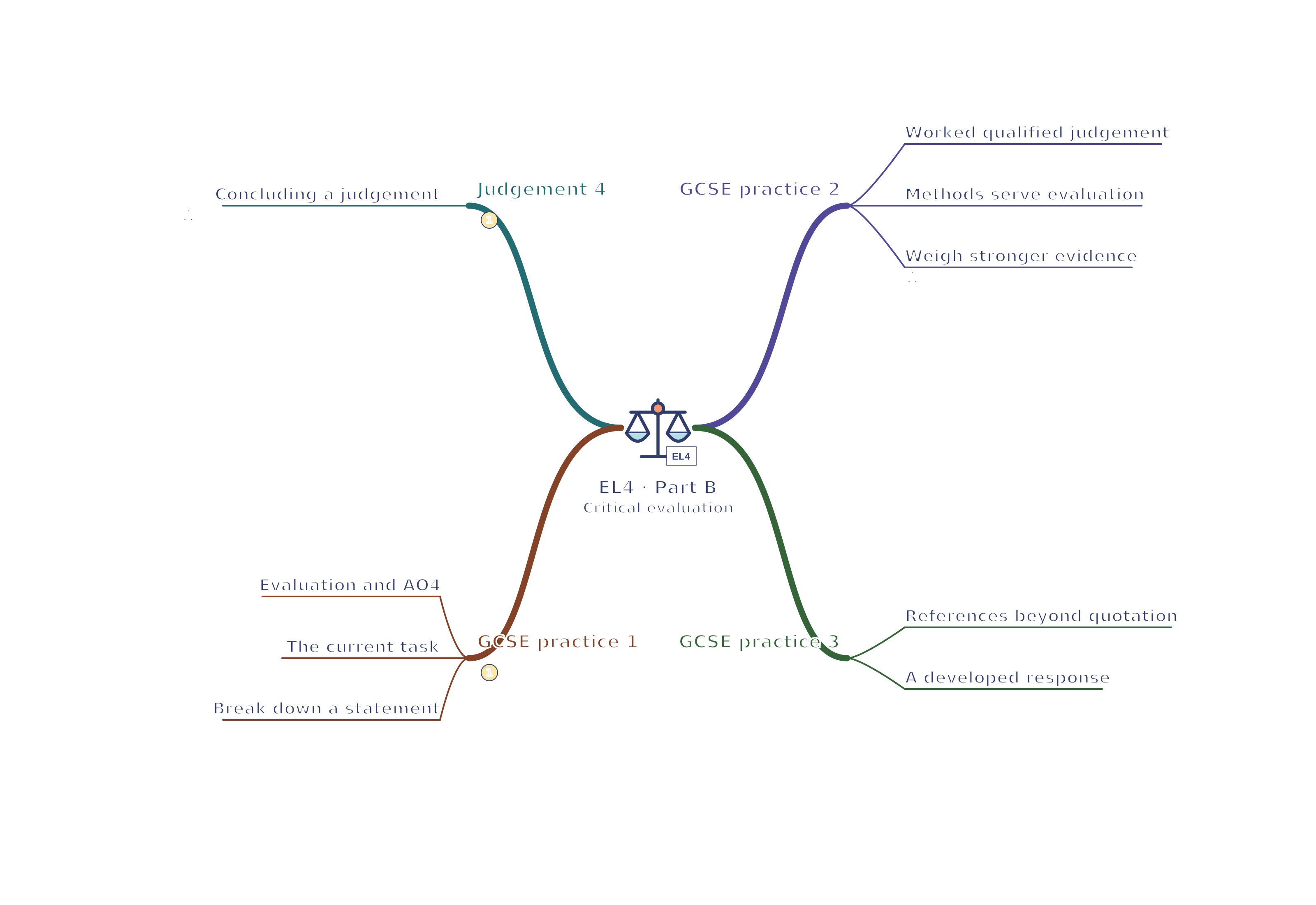
Evaluation and AO4 — Paper 1 Q4 carries twenty marks and asks for critical evaluation of a statement about a specified part of the fiction extract. Establish a judgement, test it against references and explain the writer's methods where relevant. Evaluation concerns how convincingly or effectively the text supports a reading; it is not a review saying whether you personally enjoyed the story.
The current task — From 2026 the question foregrounds the extract range and allows agreement and/or disagreement with the statement. You can agree strongly, disagree or qualify different parts when evidence supports that position. Do not manufacture a weak disagreement for balance or assume that agreeing guarantees marks. Follow the specific statement rather than reciting a prepared response.
Break down a statement — For “The traveller seems calm and entirely in control”, separate calm from entirely in control. A composed voice may support the first claim, while repeated checking of a locked door may weaken the second. Degree words such as entirely, only and always matter. Your final position can distinguish an outward appearance from an underlying situation.
Worked qualified judgement — Original evidence: “He smiled at the porter, but his ticket shook between two fingers.” The smile may support outward composure; the shaking ticket suggests tension, making complete calm less convincing. The contrast between expression and involuntary movement supports a qualified judgement. Do not diagnose an illness or invent a later event to explain the shaking.
Methods serve evaluation — If the narration delays revealing why a character is waiting, the withholding may make a claim about confidence less secure. If a description repeatedly stresses physical barriers, it may strengthen a threatening impression. Explain the contribution of diction, imagery, contrast, narration or structure to the judgement rather than attaching an unrelated terminology sentence.
Weigh stronger evidence — One cheerful adjective does not necessarily outweigh several indications of discomfort. Consider the range, the context and an alternative explanation. You do not need equal numbers of agreeing and disagreeing paragraphs. A convincing answer follows the balance of evidence and acknowledges a genuine complication when relevant.
References beyond quotation — A precise reference to a narrated action or change can support judgement as well as a quotation. Keep it accurate and specific. If you quote, select words you will discuss; copying a long paragraph does not demonstrate evaluation. Link each reference back to the statement's exact claim.
A developed response — Start with a clear position, develop evidence-based reasons and consider a meaningful tension before reaching a coherent overall judgement. For example, the traveller acts as if calm but the contrast in physical detail undermines complete control. Repeating the statement at the end of every paragraph without explaining why it is justified adds little.
GCSE critical evaluation
Weigh a judgement — Original example: “I said the bridge was sound. Under my first step, a bolt dropped into the water.” For a judgement that the narrator is overconfident, contrast the assurance with the immediate contrary observation. The ordering makes certainty look premature, although one loose bolt alone does not establish the whole bridge's condition. A developed response can agree with the judgement to that extent while qualifying it using the text. Evaluation needs a reasoned position supported by choices, rather than an unsupported reaction such as it is effective.
Test yourself
30 questions · Random sets of 10. These quick checks support revision; practise longer explanations and justified judgements too.
Mind map
Use the branches to recall the ideas and explain their connections. Check the revision notes for the full detail.
EL4 · 1
View EL4 · 1 mind mapOpen the full-size map to zoom. Use the printable view for A4 landscape or enlarge to A3.
 Mr Kidman's Classroom