Purpose — Purpose is what a text tries to achieve: inform, explain, persuade, advise, entertain or explore. A text may combine purposes. Identify the main task before selecting vocabulary, detail and organisation.
Audience — Consider who will read, what they already know, what they need and how they may respond. Writing for younger pupils may require explanation of terms, not simply shorter words or a patronising voice.
Form and conventions — Form is the kind of text, such as letter, report, review or article. Conventions help readers navigate, but should serve the task. A decorative headline cannot compensate for an article with no clear information.
Context and constraints — A notice beside a closed gate must communicate quickly; a detailed report can explain evidence at length. Consider space, medium, urgency and relationship as well as audience. Do not assume every digital text is informal.
Selecting detail — Choose factual detail relevant to the purpose and make its source clear when needed. A report of an event should distinguish witnessed facts from uncertain accounts. Do not invent statistics to make persuasion seem authoritative.
Register and tone — Register concerns choices suited to the situation; tone concerns the attitude conveyed. A formal complaint can be firm and courteous. Insults may weaken its purpose even if the writer feels justifiably frustrated.
Common forms
Articles — An article needs a focus, an opening that orientates readers and organised development. A headline can capture the central issue without exaggerating the evidence. Use subheadings when they help, rather than making every paragraph a separate section.
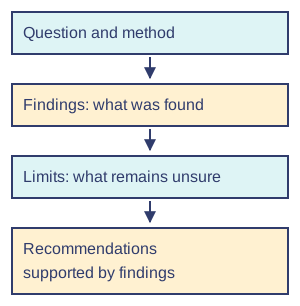
Reports — A report presents organised findings for a defined purpose. Establish what was investigated, distinguish findings from recommendations and qualify limitations. An impersonal style can help, but clarity matters more than making every sentence passive.Original explanatory model. Full-size diagram
Reviews — A review combines relevant description with evaluation against criteria. Explain what an audience might value and support judgements with examples. A review of a performance should discuss acting or staging, not simply retell the play.
Formal letters — State the reason for writing early, organise supporting information and make any requested action clear. Include relevant address/date conventions when the task requires them. Courtesy and precision often persuade more effectively than exaggerated praise or anger.
Personal letters — A personal letter can use shared references and a conversational voice, while still maintaining a clear sequence. Consider the actual relationship; personal does not mean careless, and private details should be chosen thoughtfully.
Emails — Use a subject line that identifies the purpose, a suitable greeting and clear paragraphs. Check names, attachments and the requested response. An email to a headteacher can require as much care as a formal letter.
Instructions — Put actions in a safe, workable order and specify necessary conditions or materials. Commands can make steps clear, but explain unfamiliar terms. Test whether a reader could follow without knowing what you intended.
Advice — Advice explains options or recommends action for a reader's situation. Distinguish a recommendation from an absolute rule, and avoid promising outcomes you cannot guarantee. A supportive tone should not hide important qualifications.
Speeches and scripts — A spoken script needs clear signposting, pronounceable sentences and transitions listeners can follow once. Short notes can prompt rather than replace an entire script. Rehearse aloud to test timing and emphasis.
Explanations — An explanation shows how or why something happens. Organise stages, causes or relationships and define necessary terms. A sequence of commands tells someone what to do; it does not by itself explain a process.
Recounts and narrative essays — A recount selects and orders past events for a purpose. A narrative essay can shape an experience to develop an idea or reflection. Make the relationship between events and insight clear, rather than adding a moral unrelated to the experience.
Adaptation and checking
Persuasive openings — Introduce the issue and give the audience a reason to care without overstating facts. A shared problem or relevant example may work better than an unsupported dramatic claim. Match the approach to the readers and situation.
Paragraph focus — Give each paragraph a clear function and connect it to the surrounding argument or explanation. A paragraph can develop one reason, offer evidence or answer an objection. Its role matters more than a fixed sentence count.
Conclusions and calls to action — An ending may summarise findings, recommend a step or invite a response. Make a requested action practical and connected to the case already made. Avoid introducing a major new reason in the final line.
Attribution — Make clear whose ideas, information or quotations you use. “According to the school survey…” identifies a source, but the survey still needs accurate description. Do not present a paraphrase as your original discovery.
Facts in imagined tasks — If a classroom task supplies invented data or a fictional event, use it consistently and treat it as part of that scenario. Do not present classroom examples as real public research or fabricate quotations from real people.
Adapting a single message — “Return the form by Friday” may suit a notice. An email to a parent might add why it matters and whom to contact. The central information remains accurate while the support changes for the audience.
Checking success — Ask whether a reader can identify the purpose, follow the information, judge the evidence and know what to do next. Check required conventions after the content works. Layout and spelling support communication rather than replace it.
Building a case
An arguable claim — A claim is a position that needs support, such as whether a school library should open later. Make its scope clear. “Libraries are good” is too broad to organise a focused argument about one practical proposal.
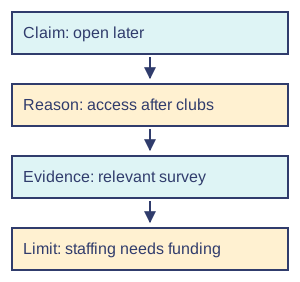
Reasons and evidence — A reason explains why a claim should be accepted; evidence supports the reason. “Later opening helps pupils without quiet study space” is a reason. Relevant survey responses may support it, provided their source and limitations are clear.Original explanatory model. Full-size diagram
Examples and representativeness — An example can make a point concrete, but one experience does not prove a general pattern. Explain what it illustrates and seek wider evidence when making a broader claim. Do not disguise an anecdote (a short account of one experience) as a reliable sample.
Counterarguments — A counterargument raises a reasonable objection or alternative view. Present it fairly before responding. “Opponents hate reading” attacks people instead of considering a concern such as staffing costs.
Rebuttal and concession — A rebuttal answers an objection with reasons or evidence. A concession accepts a valid part: later opening could help, but staffing must be funded. A qualified conclusion can be more convincing than denying every difficulty.
Persuasive devices — Rhetorical questions, repetition and direct address can emphasise a case, but cannot substitute for sound reasons. Select devices for a specific audience rather than aiming to include every device in a checklist.
Emotive language — Words such as neglected or thriving can encourage a judgement. Use them responsibly and explain the situation. Strong feeling does not establish factual accuracy; manipulative exaggeration can undermine credibility.
Logical connections — Use because for a reason, therefore for a consequence and however for a contrast only when that relationship exists. A connective cannot repair a missing logical step. Read the claim without the connective to test the reasoning.
Exposition and analysis
Expository writing — Expository writing develops an explanation or account of a subject. Establish a clear focus, organise material and explain relevant relationships. It may include different viewpoints without campaigning for one outcome.
Cause and correlation — Two events happening together does not prove one caused the other. In an argument, distinguish evidence of a pattern from evidence of a cause. Consider other explanations before using words such as proves or caused.
Essay questions — Identify the topic, task word and scope. “How does the writer present conflict in this scene?” asks about methods in a specified passage, not every event in the play. Keep the question visible while planning and drafting.
A thesis — A thesis is the central interpretation or argument developed by an essay. It can be qualified: The scene presents conflict as both public rivalry and personal pressure. Choose a position that the available evidence can support.
Introductions — Introduce the focus and direction of the response without retelling the entire plot. A useful introduction gives a reader a reason to follow the argument. Avoid empty promises such as “In this essay I will use many techniques”.
Analytical paragraphs — Develop a point, select evidence and explain how particular choices support the interpretation. Then relate the discussion to the question or wider argument. A paragraph acronym can prompt thinking, but does not guarantee analysis.Original explanatory model. Full-size diagram
Exploring a word — Select a word central to the point, consider its associations or grammatical role and explain the contribution in context. Avoid listing possible dictionary meanings that do not fit the passage.
Methods and meaning — A method label is useful when accurate, but explanation matters more. Showing how a repeated question reveals uncertainty is stronger than naming “rhetorical question” incorrectly. Technical vocabulary should clarify thinking.
Judgement and development
Integrating context — Use relevant contextual information to clarify a claim or textual choice. A source describing a long commute can make a later complaint about travel costs more intelligible. Explain that relationship rather than adding unrelated historical facts or inventing a writer’s life. Context supports close reasoning; it does not replace it.
Different readings — Acknowledge a supported alternative where it sharpens your argument. Explain why your reading fits particular details better or how both can coexist. Qualification is not indecision when the text is complex.
Avoiding intention claims — A text can produce an effect without proving what its author privately intended. “The contrast emphasises division” is more defensible than “The writer definitely wanted every person to feel angry”. Explain the contribution of the actual choices and qualify a claim about intention when the evidence does not establish it.
Developing an argument — Order paragraphs so each adds something: establish the conflict, examine its consequences, then evaluate a turning point. Repeating the thesis with a new quotation is not necessarily development.
Worked qualified argument — Original scenario: a committee chair says a late decision was unavoidable, but the supplied notes show that an earlier warning was ignored. A reasoned argument can acknowledge time pressure while questioning the claim of inevitability. Refer precisely to both details, explain their relationship and avoid assuming motives not given by the source.
Conclusions — Return to the question and draw together the reasoning. Explain what the combined evidence shows, with a qualification if necessary. Do not simply repeat the introduction word for word or introduce unexamined evidence.
Editing for reasoning — Check whether every paragraph has a defensible point, appropriate evidence and explanation. Remove unsupported generalisations and make missing steps explicit before correcting surface errors. A polished sentence can still express a weak argument.
Independence and attribution — Use model responses to learn approaches, then select and explain evidence yourself. A memorised paragraph may not answer a new question. Credit borrowed ideas and distinguish an original interpretation from copied wording.
GCSE viewpoint writing
Paper 2 writing task — Q5 is one forty-mark task specifying a form, purpose and audience. It awards twenty-four marks for content/organisation and sixteen for technical accuracy. Read the actual statement and scenario; adopt a coherent position which may be qualified. A prepared essay that ignores the requested reader or form will not fulfil the task.
Build a reasoned case — For a proposal to extend library opening hours, explain who benefits, how the extra access helps and what a plausible cost or constraint would be. “Libraries are good” is an assertion, not development. A concession about staffing can lead to a limited pilot (a small trial to test the idea) rather than a contradiction of the whole argument.
Audience adaptation — A letter to a council should specify the local decision and a credible action; a speech to pupils may use direct address and spoken transitions. Audience awareness involves the content, assumptions and register, not only adding you. Do not assume that formality requires obscure vocabulary or hostility.
Articles and essays — An article needs an engaging opening and coherent development for its readership; a relevant heading can help but is not a substitute for substance. An essay develops a sustained argument in an appropriate register. Avoid pretending the examiner requires a fixed headline, subheading or paragraph count when the task does not say so.
Letters and speeches — A letter identifies the recipient and purpose and moves towards a suitable conclusion or request. A speech needs an opening suited to listeners, clear signposting and a purposeful ending. Use conventions appropriately, but do not spend most of the writing time on postal formatting or stage directions.
Methods with substance — A rhetorical question can challenge an assumption; an anecdote can make a consequence concrete; repetition can emphasise an idea developed elsewhere. They do not replace reasons. “Who could disagree?” is weak if the next paragraph ignores a serious objection. Integrate methods into the argument rather than applying a device checklist.
Honest evidence — In an imaginative exam task you can develop plausible illustrative situations, but do not present invented research as verified fact. “Imagine a pupil unable to find a quiet place to work” openly supplies an example. “Studies prove 97% improve” fabricates authority unless real evidence has been supplied. Reasoning can be convincing without false precision.
Counterargument and conclusion — Present a meaningful objection fairly, answer it with a reason and revise your proposal if necessary. End by drawing the main reasoning together and offering an appropriate implication or action. Repeating the introduction word for word or introducing a major unsupported new claim weakens coherence.
Antithesis and parenthesis — Antithesis places contrasting ideas in a deliberate relationship: “We need places to learn, not barriers to learning.” Its parallel phrasing, which repeats a similar grammatical pattern, sharpens the opposed priorities. Parenthesis inserts a relevant aside: “The library — our only free study space — should stay open.” The aside emphasises a reason while leaving the main clause intact. Use these methods where their meaning supports the argument, rather than inserting a compulsory number.
Writing from supplied material — If a task gives information from others, select details relevant to the new purpose, preserve their qualifications and reshape them for the specified form. Notes saying “some families lack quiet study space” do not justify “all homes are unsuitable”. Attribute a quotation when needed, distinguish a source's view from your own and develop the implication rather than copying an unrelated block.
Emotional impact with reasoning — A concrete imagined case can invite concern: “Picture a pupil balancing a notebook on the stairs because every room is noisy.” Make its illustrative status clear, then explain how a quiet public space could help and what the proposal can realistically achieve. Emotion can support a reasoned case; shaming opponents or fabricating suffering can undermine trust.
Test yourself
30 questions · Random sets of 10. These quick checks support revision; practise longer explanations and justified judgements too.
Mind map
Use the branches to recall the ideas and explain their connections. Check the revision notes for the full detail.
EL7 · 1
View EL7 · 1 mind mapOpen the full-size map to zoom. Use the printable view for A4 landscape or enlarge to A3.
 Mr Kidman's Classroom