Word classes — A word class describes a word's grammatical behaviour. Identify its job in a particular sentence: “paint” is a noun in “the paint dried” but a verb in “we paint doors”. Meaning alone is not a reliable test.
Nouns — Nouns can name people, places, objects, ideas or processes. “Justice” and “arrival” are nouns although neither can be touched. Test possible noun behaviour with a determiner or plural, allowing for exceptions such as uncountable nouns: furniture names things but is not normally made plural as furnitures.
Proper and common nouns — A proper noun names a particular person or place, such as Hermia or Athens, and normally begins with a capital. A common noun names a category, such as daughter or city. Capitalisation alone does not explain a word's role.
Determiners — Determiners introduce noun phrases and help specify reference or quantity: “the letter”, “this letter”, “some letters”. “A” and “an” are articles used before singular count nouns; choose between them by the following sound, as in “an hour”.
Pronouns and reference — Pronouns can stand in place of noun phrases: “Hermia read the letter. She folded it.” Make clear who “she” and what “it” refer to. “It” can also have a grammatical role without referring to an object, as in “It is raining”.
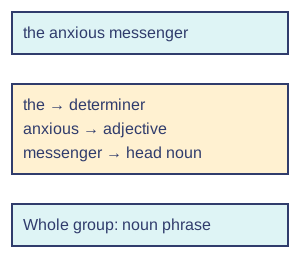
Adjectives — Adjectives often modify nouns or follow a linking verb: “the anxious messenger”; “the messenger seemed anxious”. They can express judgements as well as physical qualities. Adding many adjectives does not automatically make description precise.
Verbs beyond action — Verbs express actions, events or states: “run”, “happen”, “know” and “be”. In “She has been waiting”, several verbs form a verb phrase. Find the whole phrase before deciding its tense or aspect.
Auxiliaries and modals — Auxiliary verbs help form constructions: “has arrived”, “is waiting”, “was sent”. Modal verbs such as might, must and should express possibility, obligation or judgement. “Might return” makes a weaker commitment than “will return”.
Adverbs and adverbials — Adverbs can modify verbs, adjectives or other adverbs: “spoke softly”, “very quiet”. An adverbial is a function giving circumstances such as time or place; “after the meeting” is a phrase functioning as an adverbial, not a single adverb.
Prepositions — Prepositions head phrases such as “under the bridge”, “after dinner” and “because of the delay”. They express relationships including place, time and cause. A preposition is not simply any word telling us where something is.
Conjunctions — Coordinating conjunctions link elements of equal grammatical status: “Lysander waited and Hermia listened”. Subordinating conjunctions introduce dependent clauses, as in “although Lysander waited”. Do not classify every linking expression as a conjunction: “however” cannot normally join two main clauses with only a comma. Write: Lysander waited. However, Hermia left.
Phrases and heads — A phrase is organised around a head word. “The frightened young messenger” is a noun phrase with messenger as its head. A phrase may contain just one word; expanded noun phrases add useful detail rather than changing the head's class.Original explanatory model. Full-size diagram
Clauses and relationships
Clauses — A clause is a grammatical unit built around a verb and typically a subject. “Hermia waited” has a subject and finite verb. Commands such as “Wait here” normally leave the subject you unexpressed. Not every group containing a verb is a complete sentence.
Subject and object — In “Puck carried the message”, Puck is the subject and the message is the object. Subjects are grammatical roles, not always people doing actions: “The message was carried” makes the message the subject.Original explanatory model. Full-size diagram
Main clauses — A main clause can function as a complete sentence: “The gate opened.” A sentence may contain several clauses. Find its finite verb and subject, then check which other units depend on it.
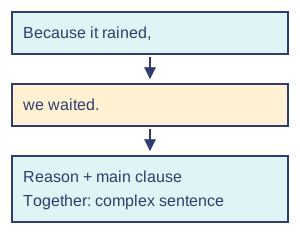
Subordinate clauses — A subordinate clause depends on another part of a sentence. “Because the gate opened” leaves the reader expecting the main clause. Attach it: “Because the gate opened, we entered.” The reason is now connected to an event.Original explanatory model. Full-size diagram
Relative clauses — Relative clauses modify nouns: “The letter that arrived yesterday was damaged.” The clause “that arrived yesterday” identifies the letter. In “The letter, which arrived yesterday, was damaged”, commas present the arrival as additional information.
Finite and non-finite verbs — A finite verb shows tense or forms part of a finite construction: “she waits”, “she waited”. Non-finite forms include “to wait” and “waiting”. “Waiting by the gate, Hermia heard footsteps” contains a non-finite clause; not all clauses have an expressed subject.
Simple sentences — A simple sentence contains one main clause, even if it has a long noun phrase or several modifiers: “The frightened young messenger beside the old bridge waited patiently.” Simple does not mean short or easy.
Compound sentences — A compound sentence links main clauses, often with and, but or or: “The gate opened, but nobody entered.” Each clause can stand alone. Joining two nouns with and does not by itself make a compound sentence.
Complex sentences — A complex sentence contains a main clause and at least one subordinate clause: “When the gate opened, we entered.” “I know that she left” is also complex. Judge the clause relationships, not sentence length.
Sentence functions — Statements give information; questions ask; commands direct; exclamations express an exclamatory meaning using particular structures such as “What a noise that was!” Punctuation and communicative purpose interact: a statement can be spoken as a question, as in You are coming? The word order stays like a statement, while delivery and the question mark indicate a question.
Control and effect
Agreement — In Standard English, a singular subject usually takes a singular present-tense verb: “The list of names is missing.” The subject head list controls agreement, not the nearest plural noun names. Check the whole noun phrase.
Tense and time — Past and present verb forms help locate events, but tense and real time are not identical: “The train leaves tomorrow” uses present tense for a future event. Maintain a clear time frame unless a deliberate shift is needed.
Aspect — Progressive constructions show an event in progress, as in “was waiting”. Perfect constructions relate an earlier event to another time, as in “had left before dawn”. Compare “she left” with “she had left” in the surrounding narrative. In When I arrived, she had left, her leaving happened before my arrival; When I arrived, she left normally suggests she left after I arrived.
Active and passive — In “The guard opened the gate”, the guard is the subject of an active clause. “The gate was opened by the guard” is passive and foregrounds the gate. The agent (whoever or whatever does the action: here, the guard) can be omitted; passive is a choice of focus, not automatically a fault.Original explanatory model. Full-size diagram
Ambiguous modifiers — Place a modifying phrase next to what it describes. “Walking to school, the rain soaked me” wrongly suggests the rain was walking. “Walking to school, I was soaked by the rain” gives the opening clause a sensible subject.
Worked sentence revision — “The gate opened we ran” joins main clauses without a boundary. “The gate opened, so we ran” gives a causal connection; “When the gate opened, we ran” makes the opening a time condition. Choose the relationship you mean, not just a longer sentence.
Purposeful variation — A short sentence can mark a turning point, while subordination can establish cause, contrast or qualification. Neither length guarantees an effect. Explain how a specific sentence works in its context and vary structures without losing accuracy.
Grammar in reading — Compare “The crowd attacked him” with “He was attacked”. The second foregrounds the victim and leaves the agent unnamed. Grammar analysis should connect a precise construction to the presentation of events, not merely label it.
Subjunctive choices — Formal constructions can use a base verb after a demand: The committee requires that she be present. The hypothetical If I were in charge uses were with I. Compare these with ordinary statements, and choose the construction for its meaning and register rather than using it in every sentence.
Boundaries and commas
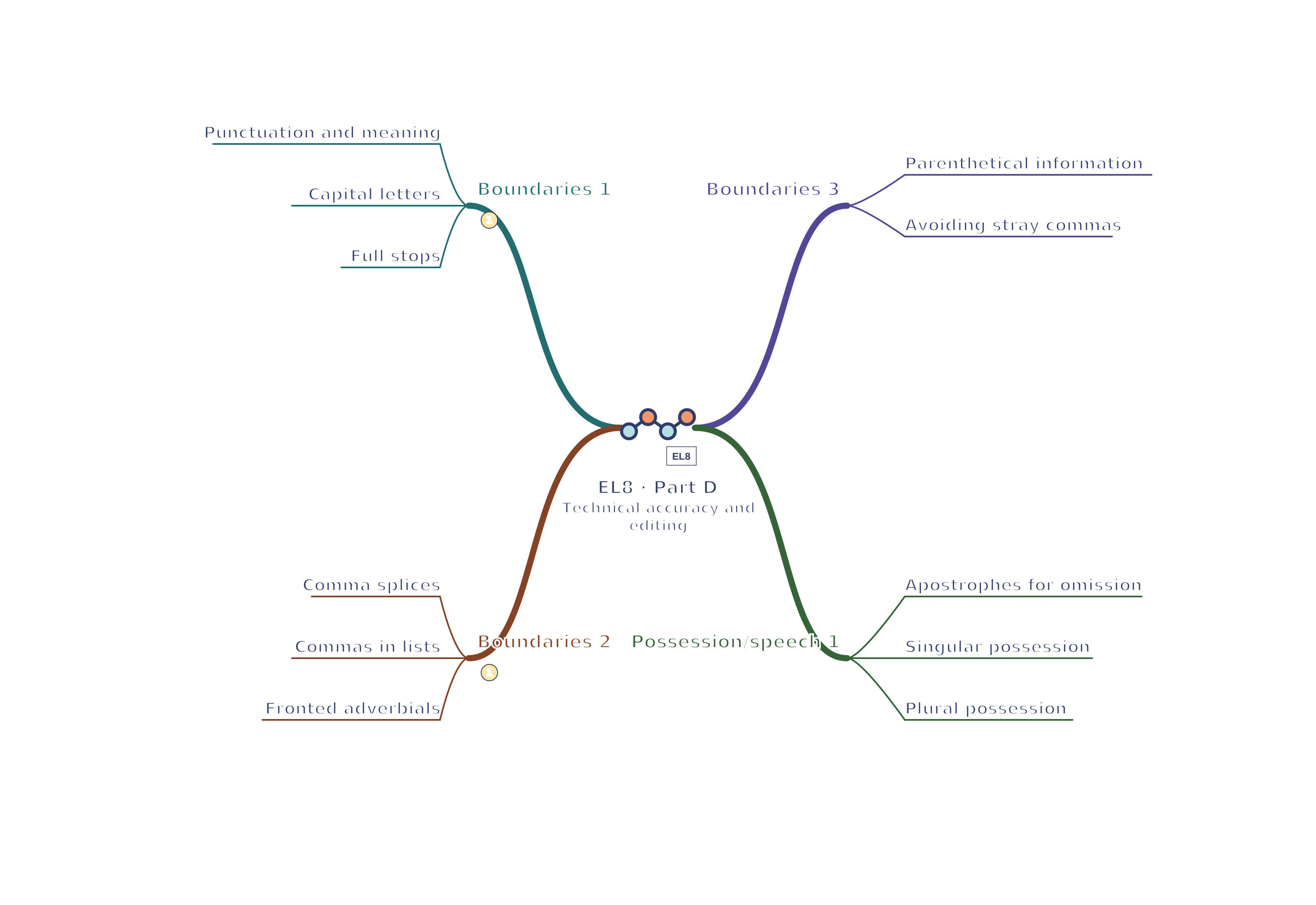
Punctuation and meaning — Punctuation marks grammatical relationships and helps a reader interpret a text. It is not simply a record of where a speaker breathes. Start by finding clauses and phrases, then choose marks that show their relationships.
Capital letters — Use capitals for sentence openings, the pronoun I and proper names such as Athens. Do not capitalise every important noun in ordinary prose. Title conventions vary, so follow the task or chosen publication style consistently.
Full stops — A full stop normally closes a statement or command sentence. Check that the sentence is complete rather than a dependent clause: “Although the street was quiet” normally needs a main clause in formal prose.
Comma splices — A comma alone normally cannot join independent main clauses in formal writing: “The door opened, she entered.” Use a full stop, a semicolon or a suitable conjunction. Choose a repair that expresses the intended relationship.Original explanatory model. Full-size diagram
Commas in lists — Separate items clearly: “pens, paper and folders”. When list items are more complex, additional punctuation may help avoid ambiguity. A comma before the final and can be a style choice; clarity is the priority.
Fronted adverbials — A comma often follows an introductory adverbial, especially a subordinate clause: “When the bell rang, we left.” Short introductory phrases do not always need a comma. Use the construction and clarity rather than a rule that every opening word needs one.
Parenthetical information — Paired commas can set off additional information: “Puck, who knows the plan, waits.” If you open an interruption, check whether it also needs closing. Information essential to identify a noun may require a different treatment: The actor who plays Puck waits identifies which actor, so the relative clause has no enclosing commas.
Avoiding stray commas — Do not separate a subject from its verb with a stray comma: “The students beside the door, were waiting.” The long subject still belongs with were. Parenthetical commas work as a pair around an inserted unit, not as random pauses.
Possession and speech
Apostrophes for omission — An apostrophe marks omitted letters in contractions: do not becomes don't; it is becomes it's. Use contractions when they suit the register. An apostrophe does not automatically make a word possessive.
Singular possession — For a singular possessor, normally add apostrophe-s: “the student's book”. Establish who owns or is associated with what before placing the mark. Style choices for names ending in s vary; remain consistent.
Plural possession — A regular plural ending in s takes an apostrophe after the s: “the students' books”. An irregular plural takes apostrophe-s: “the children's books”. The position reflects the possessor, not how many objects are possessed.Original explanatory model. Full-size diagram
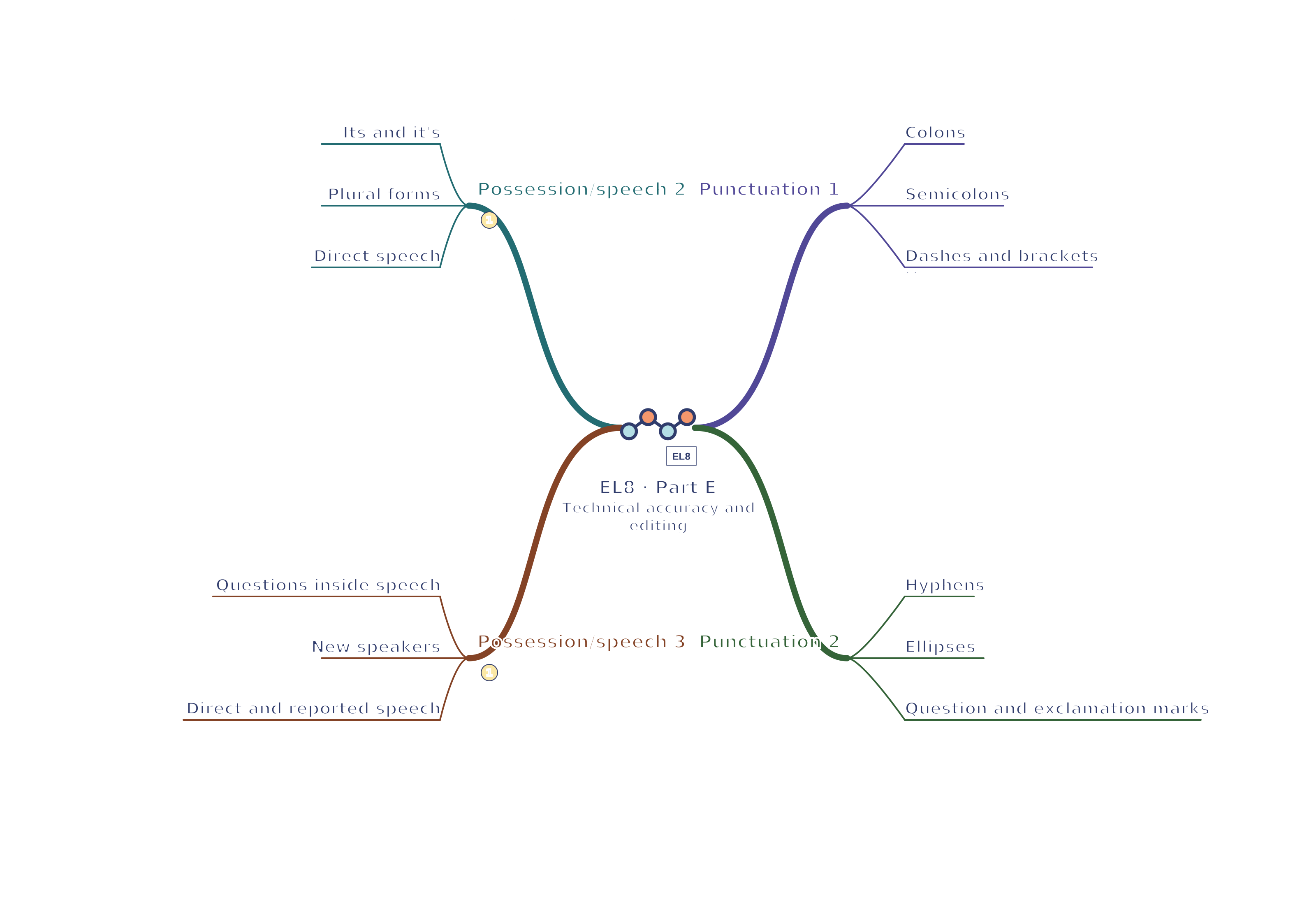
Its and it's — Its is possessive: “The theatre changed its programme.” It's means it is or it has: “It's begun.” Expand the contraction to check. Possessive pronouns such as yours and theirs also have no apostrophe.
Plural forms — Ordinary plurals do not take apostrophes: books, tickets, DVDs. An apostrophe is not a general sign that a word ends in s. Distinguish plural number from possession before editing.
Direct speech — Quotation marks enclose a speaker's exact words. In a common style: “Wait here,” she said. Place the comma before the closing quotation mark when the speech leads into a reporting clause. Check your chosen style consistently.Original explanatory model. Full-size diagram
Questions inside speech — Write “Are you ready?” she asked. The question mark belongs to the spoken question; a second full stop is not added before the closing quotation mark. The reporting clause continues with a lower-case she.
New speakers — Start a new paragraph when the speaker changes in prose dialogue. Separate an action sentence from a reporting clause: “Wait.” She closed the gate. Closed is an action, not a verb meaning said.
Direct and reported speech — Direct speech gives the words as spoken; reported speech represents their content: She said that she was ready. Reported speech normally has no speech marks around the paraphrase. Pronouns and time expressions may need adjustment.
Other punctuation choices
Colons — A colon can introduce an explanation or list after a complete introductory clause: “We needed three things: time, space and trust.” Avoid separating a verb from its object with an unnecessary colon, as in “We needed: time”.
Semicolons — A semicolon can join closely related independent clauses: “The gates were locked; nobody could enter.” Both sides must work as main clauses in this use. It can also separate complex list items that already contain commas.Original explanatory model. Full-size diagram
Dashes and brackets — Paired dashes or brackets can enclose additional information: The library — our only quiet space — stayed open, or The library (our only quiet space) stayed open. A single dash can introduce an emphatic expansion: Only one person remained — Puck. Choose punctuation that fits the meaning and style; brackets are not an excuse to include irrelevant information.
Hyphens — Hyphens can join parts of compound expressions and clarify meaning, as in “a well-known story”. Usage varies by expression, so check a dictionary where uncertain. A hyphen joins within an expression; a dash separates larger units.
Ellipses — An ellipsis can show an omission in quotation or a trailing-off voice in creative writing. In quotation, preserve the source's meaning. Repeated ellipses do not automatically create suspense and can obscure sentence boundaries.
Question and exclamation marks — A question mark marks a direct question. Exclamation marks can signal force or feeling, but do not turn any sentence into the grammatical exclamation form. Repeating marks is usually unsuitable for formal writing.
Worked punctuation choice — “Hermia waited: the message had not arrived” uses a colon to explain the situation. “Hermia waited; Puck hurried home” links related events. “Hermia waited, because…” requires a complete reason clause. Choose according to grammar and intended meaning.
Proofreading punctuation — Find sentence boundaries first, then check paired marks, speech and apostrophes. Do not add sophisticated punctuation to every sentence. Accurate simple choices are more useful than a collection of misused marks.
Understanding and choosing words
Vocabulary growth — Meet words through reading and listening, check their meanings and use them in fresh contexts. Recognising a word once is not the same as being able to use it accurately. Revisit it after a delay.
Dictionary choices — A dictionary can show pronunciation, word class, several meanings and examples. Select the sense that fits the sentence. An older passage may use a sense less common today; check an appropriate historical gloss and then test that sense against the clause and surrounding account.
Nuance — Near-synonyms differ in strength, associations or typical use. Irritated, furious and uneasy do not name the same feeling. Choose the meaning you need rather than replacing a repeated word with any thesaurus suggestion.
Antonyms and contrast — Antonyms express contrasting meanings, but not every word has one neat opposite. Hot and cold allow degrees between them, while some pairs mark categories. Consider the context when deciding what contrast is intended.
Polysemy and homophones — Polysemy means one word has several related senses: head can mean a body part or the person in charge of a school. Context decides which sense is intended. Homophones sound alike but differ in spelling or meaning, such as hear and here. Use grammatical and semantic context to select the correct form.
Collocation — Words often occur in conventional combinations, such as heavy rain and make a decision. A grammatical sentence may still sound unnatural if the combination is unusual. Read examples of a word in use before adopting it.
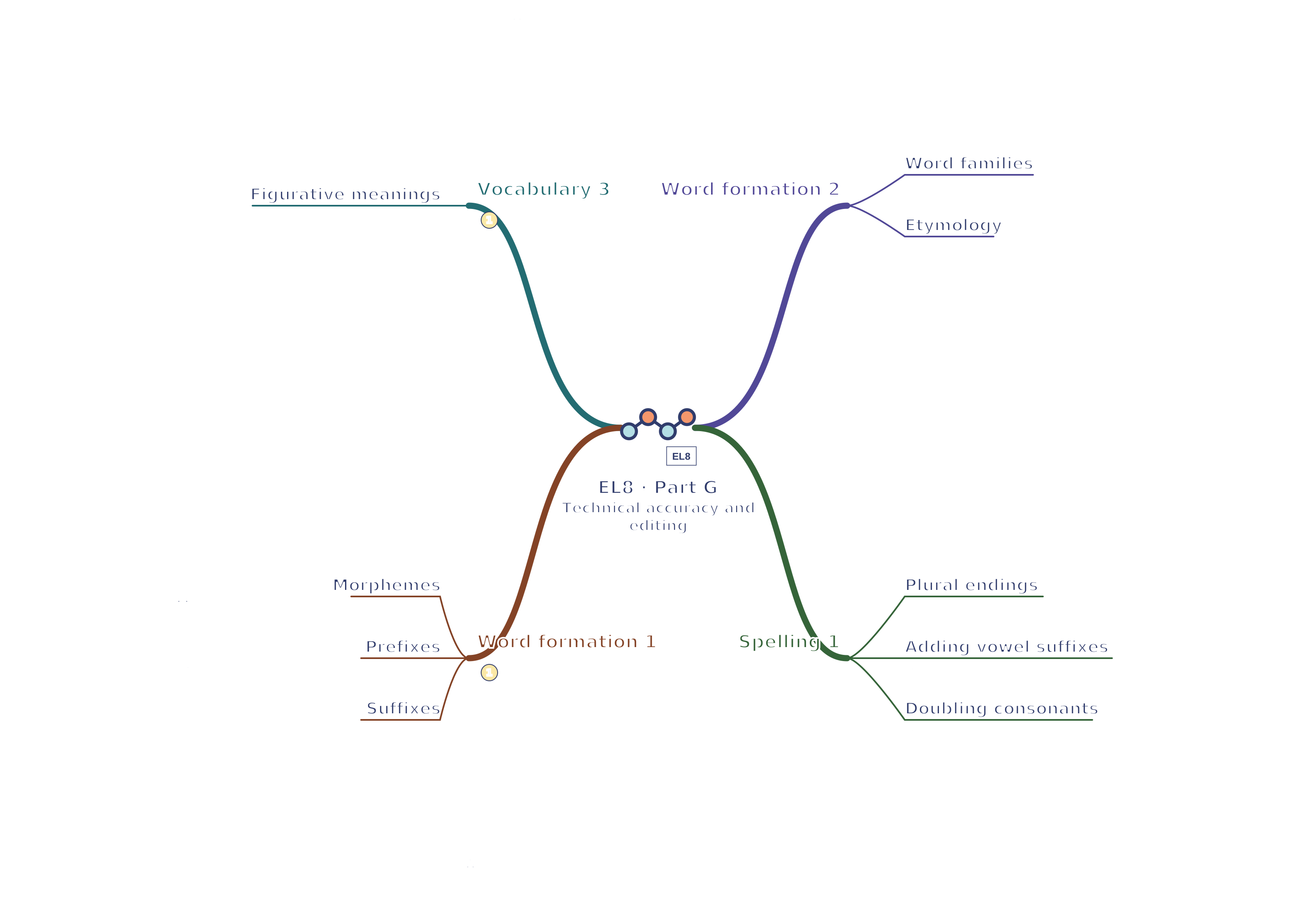
Figurative meanings — A phrase can mean more than its literal parts: “a cold response” concerns attitude. Use the passage to test the figurative sense. Not every unfamiliar expression is an idiom or a metaphor.
Word construction
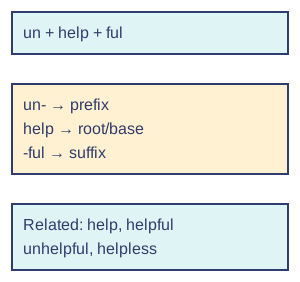
Morphemes — A morpheme is a meaningful word part. Unhelpful contains un-, help and -ful. Breaking a word into parts can aid spelling and interpretation, but some apparent letter groups are not meaningful parts in that word.Original explanatory model. Full-size diagram
Prefixes — A prefix is added before a base, as in unhappy or rewrite. Prefixes can change meaning without changing word class. Un- often negates, while re- often signals again; check rather than assuming every word beginning re has that meaning.
Suffixes — A suffix follows a base and may change class or grammatical form. Hope becomes hopeful; walk becomes walked. Hope to hopeful is a derivational change: it creates a related word and changes a noun or verb into an adjective. Walk to walked is an inflection: it marks past tense without creating a new word of a different class. Plural endings are also inflections.
Word families — Related words can share a root and retain useful spelling clues: sign, signal and signature. Pronunciation may change while spelling preserves a relationship. Use families to connect meaning, not as a guarantee that every similar-looking word is related.
Etymology — Etymology studies word origins and changes. It can explain unusual spelling or relationships, but a modern word does not have to retain its oldest meaning. Avoid deciding present meaning solely from a historical root.
Applying spelling patterns
Plural endings — Most regular nouns add s; some add es, as in boxes. A consonant plus y commonly changes to ies, as in stories, while a vowel plus y usually adds s, as in keys. Check irregular plurals such as children separately.
Adding vowel suffixes — A final silent e is often dropped before a vowel suffix: hope becomes hoping. Keep it where needed, as in changeable. Patterns help predict spelling but require checking for exceptions and pronunciation.
Doubling consonants — A short stressed vowel before a final single consonant can lead to doubling before a vowel suffix: stop becomes stopped; begin becomes beginning. Stress and word ending matter. Do not double every final consonant automatically.
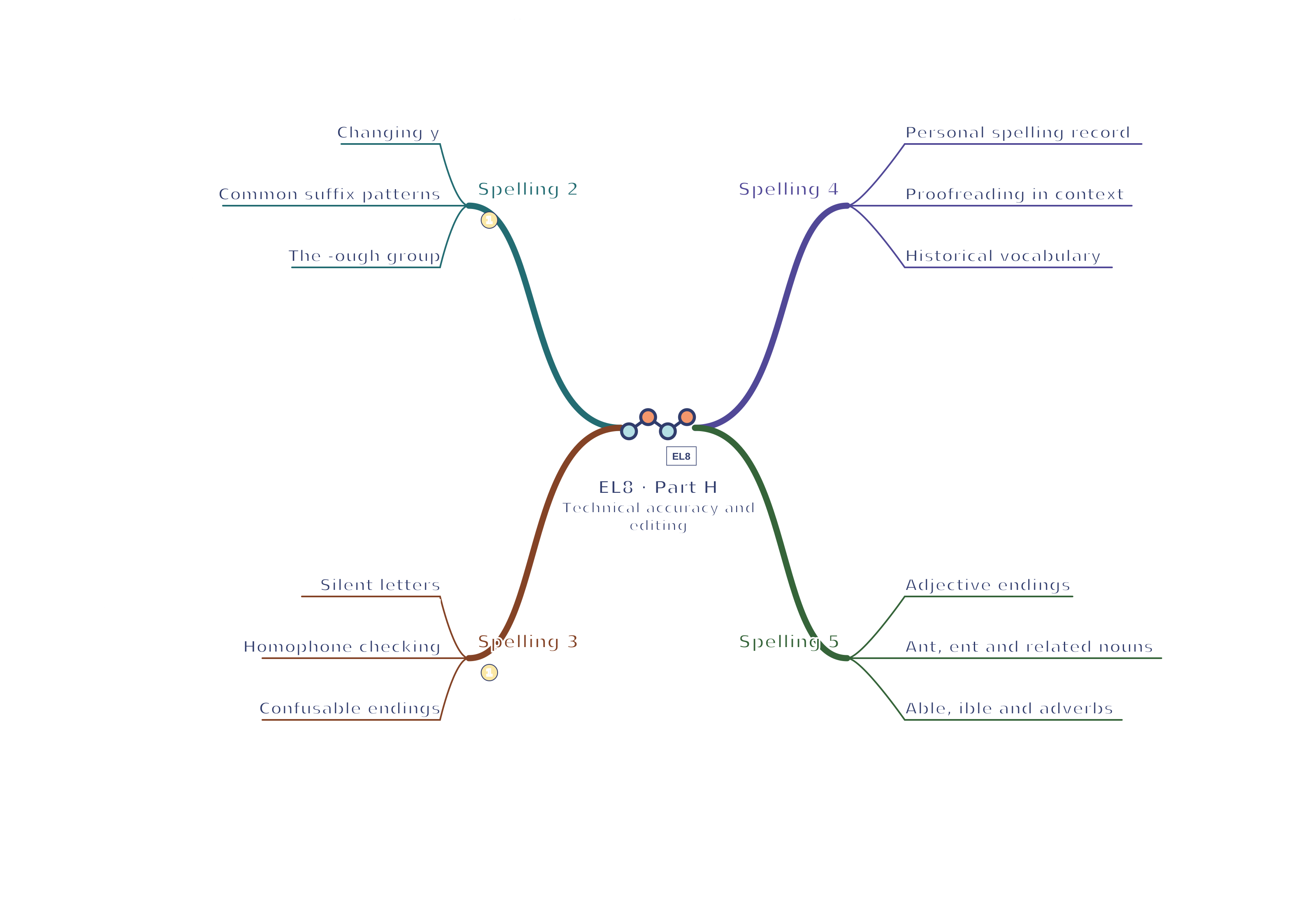
Changing y — With a consonant before y, adding many suffixes changes y to i: happy becomes happiness. Before -ing, y is usually retained: cry becomes crying. A vowel before y commonly keeps it, as in played.
Common suffix patterns — Practise -tion, -sion, -cian and related endings through examples such as action, discussion and musician. Notice the root and grammatical role, then check uncertain words. A sound alone may not identify the spelling.
The -ough group — Though, through, rough and thought show that the same letters can represent different sounds. Learn the spelling in meaningful word groups and sentences rather than assuming a single pronunciation rule.
Silent letters — Words such as doubt, island and knight contain letters not pronounced in typical modern usage. Historical and family relationships can help, but repeated retrieval is often necessary. Do not omit letters simply because you cannot hear them.
Homophone checking — Test the sentence: their shows possession, there often identifies a place or introduces existence, and they're means they are. Spellcheck may accept all three. Use meaning and grammar to choose.
Confusable endings — In many word families a noun in -ence pairs with an adjective in -ent, as in confidence and confident. Other patterns and exceptions exist. Record a difficult pair with examples showing its grammatical use.
Personal spelling record — Keep words you actually misspell, group related patterns and practise recalling them without looking. Check the result, explain the difficult part and use the word in a sentence. Copying a word repeatedly while viewing it is not the same as retrieval.
Proofreading in context — Check endings, homophones and correctly spelled wrong words. Read slowly enough to notice missing letters and duplicated words. A dictionary supports checking; it cannot choose the intended word for you without context.
Historical vocabulary — An older source may use an archaic word or an unfamiliar sense of a common word. Fair can mean favourable or beautiful rather than a public event; its grammatical role and context help distinguish these senses. If forms such as thou or thee occur, use a reliable gloss rather than guessing from their appearance. Do not assume every nineteenth-century text uses the same vocabulary.
Adjective endings — For -cious and -tious, compare vicious, gracious, cautious and ambitious; the related noun can help, but suspicious needs checking. For -cial and -tial, official and partial illustrate common patterns, while exceptions such as initial should be learned. Group checked examples rather than trusting sound alone.
Ant, ent and related nouns — Observation can help connect observant with observance; hesitant and hesitation form another family. Contrast innocent and innocence, decent and decency. A related word can provide a clue, but use a dictionary when the unstressed ending does not reveal its spelling.
Able, ible and adverbs — Enjoy becomes enjoyable and enjoyably; possible becomes possibly. The -able ending is more common, and a complete recognisable base can be a clue, but it is not an infallible rule. Notice changeable and noticeable keeping e to preserve the soft consonant sound.
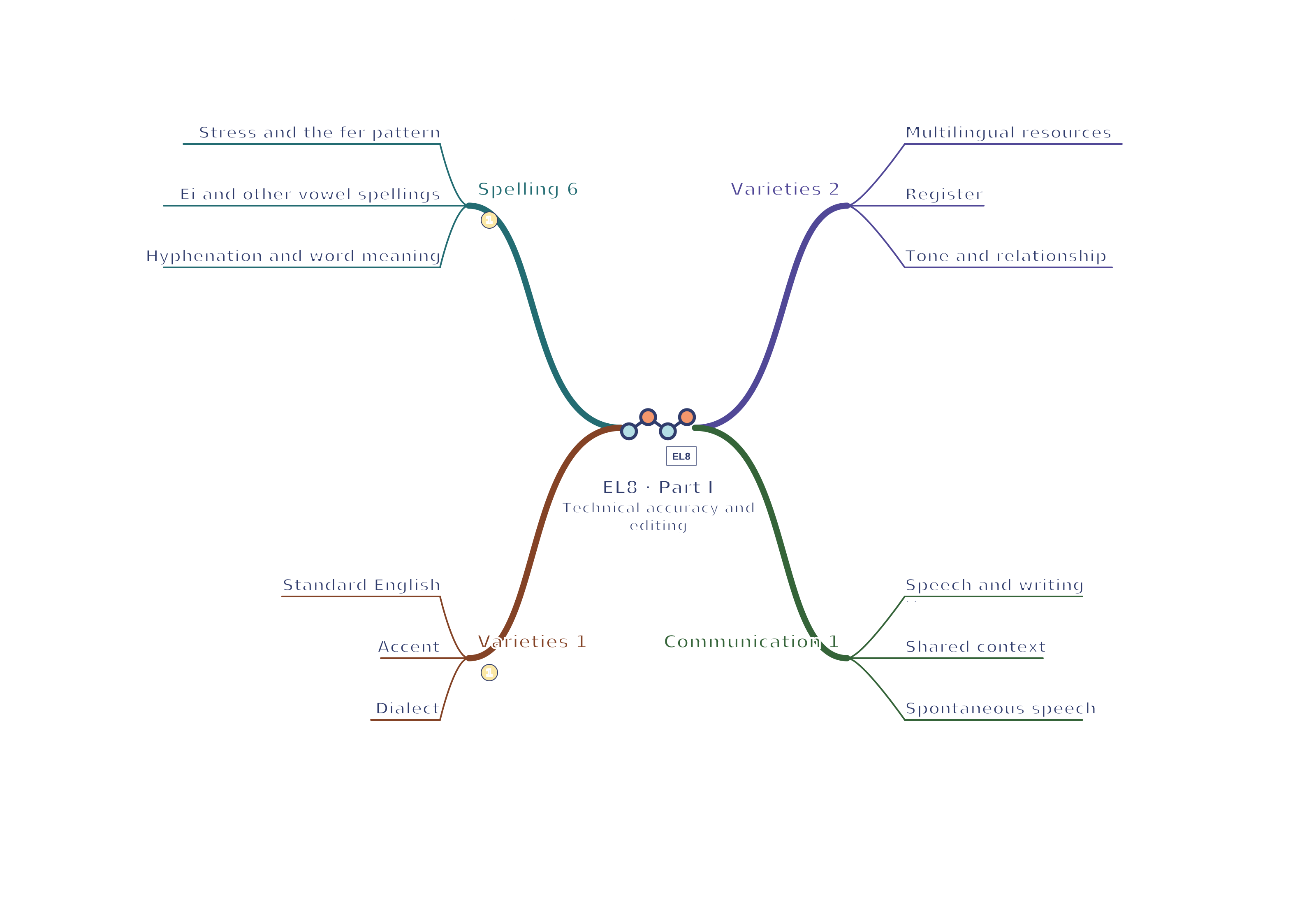
Stress and the fer pattern — Prefer becomes preferred and preferring when the final syllable is stressed. Preference and preferable do not double r because the stress has moved. Pronounce and compare each related form; do not double r in every word ending fer.
Ei and other vowel spellings — Receive, deceive and ceiling illustrate the useful ei-after-c pattern for these words. It is not a universal rule: science, efficient and exceptions such as seize and weird need their own checked examples. Learn common patterns with their limits.
Hyphenation and word meaning — Compare re-cover, meaning cover again, with recover, meaning regain or get better. A hyphen can avoid ambiguity, as in a man-eating creature rather than a man eating food. Check conventions for a compound in a reliable dictionary.
Language varieties
Standard English — Standard English is a widely used variety with conventions of grammar and vocabulary, especially in public and formal contexts. It is not an accent and does not make its users more intelligent. Learn to use it as an additional resource for communication.
Accent — Accent concerns pronunciation. A speaker can use Standard English with a regional accent. Changing grammar and changing pronunciation are different things; no one accent is necessary for thoughtful formal speech.
Dialect — A dialect has characteristic grammar and vocabulary and may be associated with a region or community. Its patterns can be systematic even when they differ from Standard English. Compare conventions precisely rather than describing people as speaking badly.
Multilingual resources — People may draw on several languages and varieties for different purposes and communities. Adapting language to context can be a skill. A classroom task may require Standard English while still valuing the learner's other language knowledge.
Register — Register involves language choices associated with a situation, purpose or audience. Formal and informal are useful descriptions, not two completely separate languages. A formal text can use plain words; an informal text can contain complex ideas.Original explanatory model. Full-size diagram
Tone and relationship — A polite tone can suit a friendly or formal exchange. “Could you send the form?” expresses a request indirectly, while “Send the form” is a command. Explain the relationship and context before deciding which is more appropriate.
Spoken and written communication
Speech and writing — Speech can use voice, gesture, immediate feedback and shared surroundings. Writing often needs to supply context for an absent reader. These are possibilities, not absolute rules: a rehearsed speech may be highly planned and a text chat spontaneous.Original explanatory model. Full-size diagram
Shared context — “Put it there” may work when speaker and listener can see the object and location. A written instruction for an absent reader should identify them. Check what the audience can see or already knows before leaving references unstated.
Spontaneous speech — Hesitation, reformulation and incomplete starts can help people think and negotiate meaning in real time. They are not always signs of poor understanding. In a formal presentation, rehearsal can reduce distracting hesitation while keeping a natural delivery.
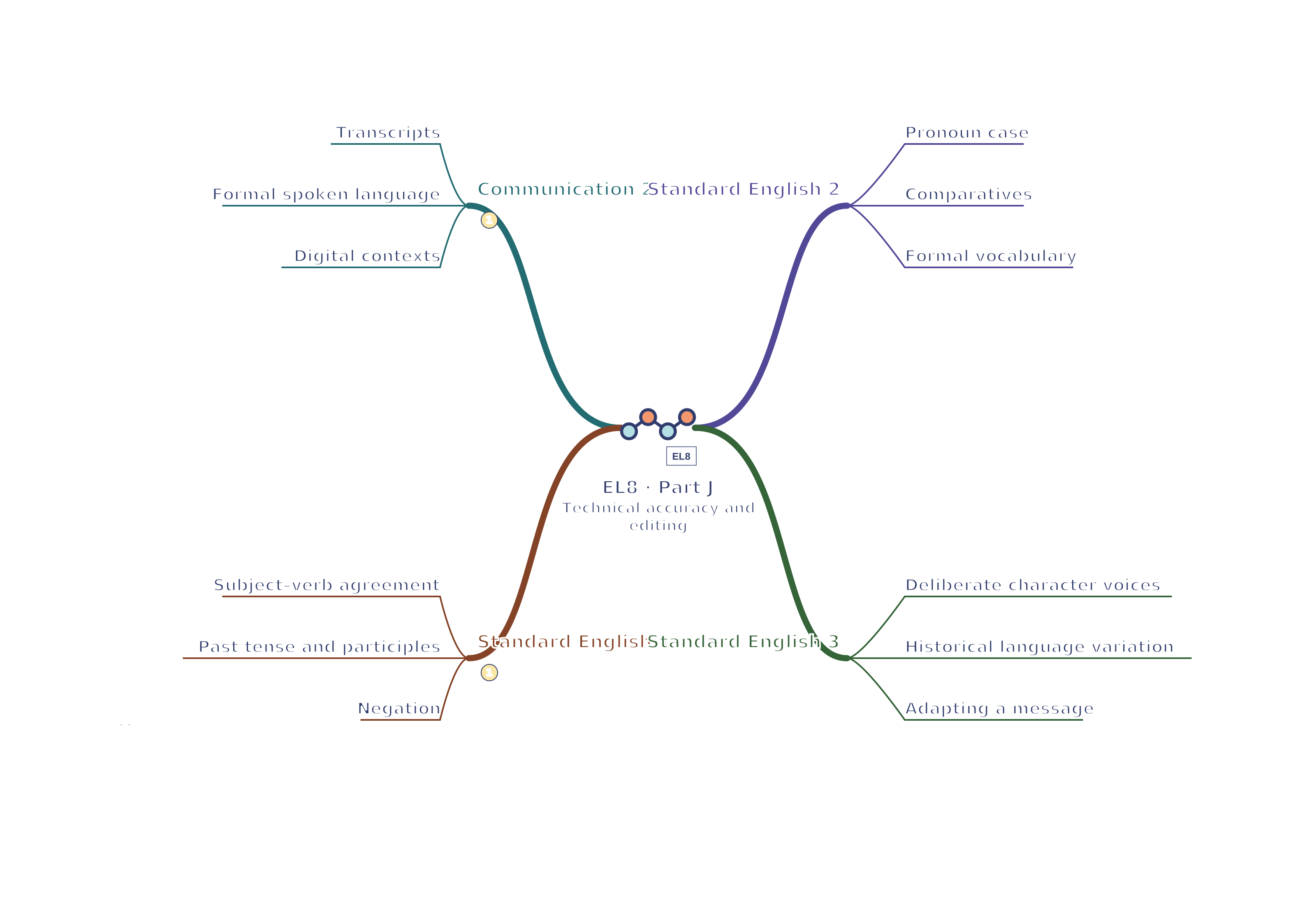
Transcripts — A transcript records speech using chosen conventions; it cannot capture every aspect of sound, gesture and situation. Notice what has been represented or omitted before analysing it. A pause shown on a page is not automatically evidence of fear.
Formal spoken language — Formal speaking often benefits from explicit organisation, accurate names and definitions of unfamiliar terms. Use Standard English where appropriate while retaining your accent. Avoid sounding artificially elaborate at the expense of clarity.
Digital contexts — Email, messaging and posts vary in audience and permanence. A quick private message may use abbreviations that confuse a public reader. Check privacy, tone and possible misunderstanding before sending; medium alone does not decide register.
Applying Standard English
Subject–verb agreement — In Standard English, “we were” and “she was” follow different agreement conventions. Other varieties may pattern differently. When editing a Standard English task, identify the intended subject and select the required form without judging the speaker's identity.
Past tense and participles — Compare “I saw it” with “I have seen it” in Standard English. Have selects a past participle, which may differ from the past-tense form. Learn irregular patterns through examples rather than adding -ed to every verb.
Negation — Standard English normally uses “I didn't see anything” rather than negative concord such as “I didn't see nothing” for the same intended negative meaning. Other varieties can use negative concord systematically. Interpret the intended meaning before editing the required convention.
Pronoun case — In formal Standard English, subject forms include I and she; object forms include me and her. “Ella and I arrived” differs from “They invited Ella and me”. Temporarily removing the other name can help test the role.
Comparatives — Use “larger” or “more useful” according to the adjective's pattern, rather than combining both as “more larger” in Standard English. Superlatives compare with a group: largest or most useful. Check irregular forms such as better and best.
Formal vocabulary — Select vocabulary that is accurate and suited to the reader. “Ask” may be clearer than “make an enquiry” in many formal contexts. Formality is not measured by word length, passive clauses or a ban on every contraction.
Deliberate character voices — Dialogue can represent a character's variety of English when done respectfully and consistently. Avoid spelling every word phonetically or using a dialect as a shortcut for stupidity. Separate a character's voice from the conventions required in an analytical response.
Historical language variation — Earlier English can differ in vocabulary, syntax and inflections. Read a challenging passage in clauses, resolve its references and check unfamiliar forms with a reliable gloss. Avoid treating an unfamiliar expression as a mistake, assuming all older sources sound alike or replacing interpretation with historical labels.
Adapting a message — A friend might hear “Can you look at this?” A formal request may specify the document and deadline. Both can use Standard English. Add information and adjust politeness according to the relationship, not an automatic rule against everyday words.
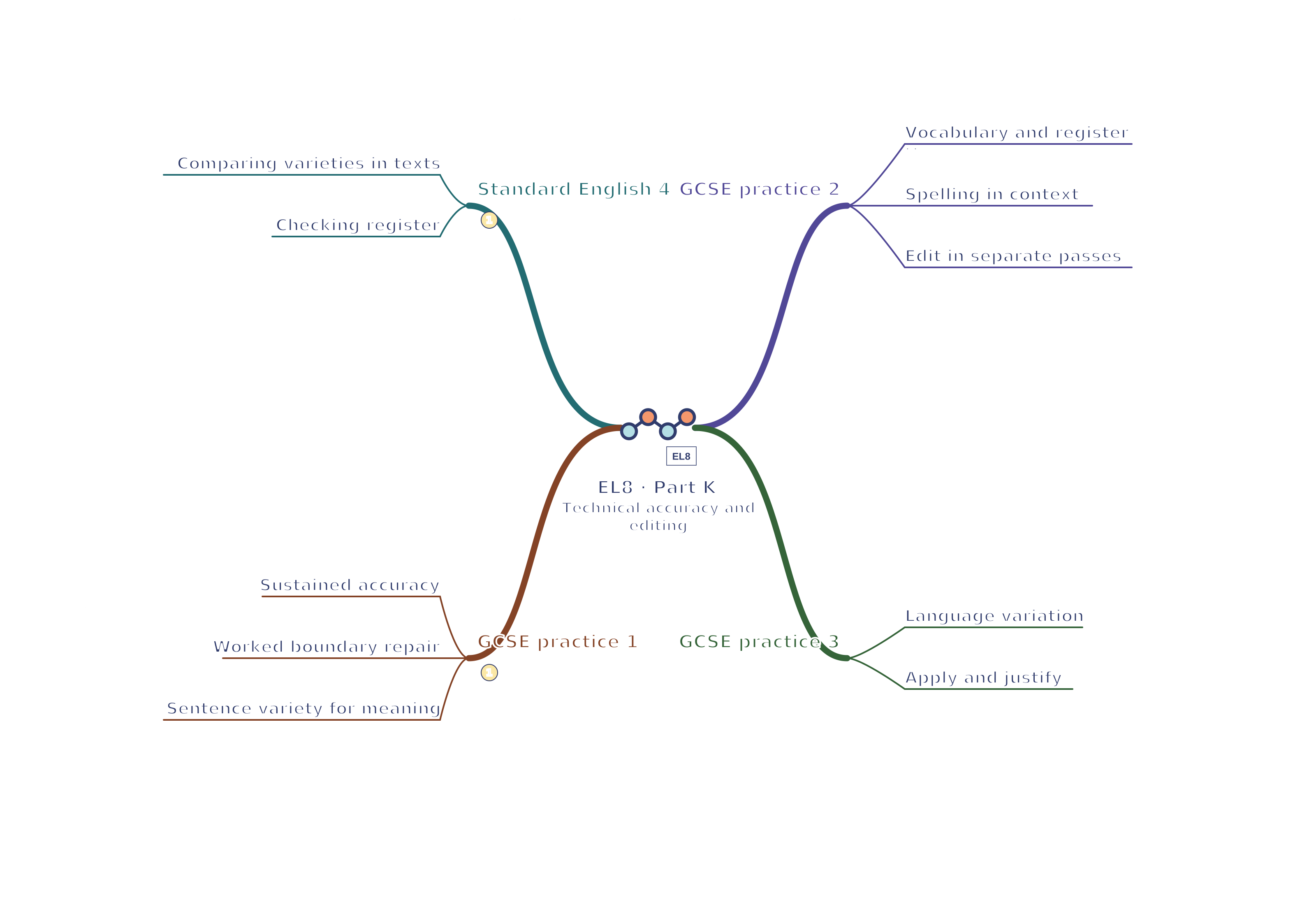
Comparing varieties in texts — Describe exact differences in vocabulary, grammar or pronunciation where evidence is available. Explain their role in characterisation, identity or situation without generalising about an entire group. A fictional representation is not a full survey of real speakers.
Checking register — Review greeting, vocabulary, sentence choices, level of explanation and requested action together. A formal salutation does not repair an insulting or unclear message. Consistency means serving the relationship and purpose throughout.
GCSE technical accuracy and editing
Accuracy is assessed across the piece — AO6 contributes sixteen marks to each forty-mark writing response, twenty per cent of the total GCSE marks overall. Accurate boundaries, spelling and grammar support meaning throughout the writing. A correctly inserted semicolon cannot compensate for repeated uncontrolled sentences, and a deliberate fragment needs clear expressive purpose.
Worked boundary repair — Original error: “The gates closed, we were stranded.” Both parts are main clauses. “The gates closed; we were stranded” links closely related statements; “The gates closed, so we were stranded” explicitly gives a result. “When the gates closed, we were stranded” makes a temporal relationship. Select the version that conveys the intended connection.
Sentence variety for meaning — Subordination can express cause, contrast or qualification; coordination can connect equal ideas; a short main clause can mark a turn. A long sentence is not automatically complex, and a complex sentence is not automatically better. Check its grammatical relationships and effect in the paragraph.
Vocabulary and register — Choose a word for precise meaning and connotation. Replacing walked with strutted implies a conspicuous, possibly self-important manner; it is not a neutral upgrade. Formal Standard English can be plain and direct. Avoid using unfamiliar synonyms or treating every informal expression as intrinsically wrong regardless of purpose.
Spelling in context — Proofread homophones using grammar and meaning: their belongs to them, there refers to a place or introduces existence, and they're means they are. Check a suffix against its base and identify your recurring errors. A spelling checker may accept a correctly spelt word which is wrong in the sentence.
Edit in separate passes — First check task fulfilment and the order of ideas; next check paragraph links and reference; then read each sentence for boundaries, agreement, tense and punctuation; finally target spelling and accidental repetition. Reading aloud can reveal a problem but does not replace a grammatical check. Leave realistic time for this within the paper.
Language variation without prejudice — Accent concerns pronunciation; dialect can include vocabulary and grammar; register changes with context. Standard English is a variety used in many formal written contexts, not a claim that one regional identity is more intelligent. In a specified formal task, demonstrate the appropriate grammatical conventions while respecting variation.
Apply and justify — Repair a paragraph with several errors, explain what changed in meaning or grammatical control, then apply the learning in a new paragraph. Editing recognition questions sample rules, while sustained accurate writing demonstrates whether the rules can be used under real composition demands.
Test yourself
30 questions · Random sets of 10. These quick checks support revision; practise longer explanations and justified judgements too.
Mind map
Use the branches to recall the ideas and explain their connections. Check the revision notes for the full detail.
EL8 · 1
View EL8 · 1 mind mapOpen the full-size map to zoom. Use the printable view for A4 landscape or enlarge to A3.
 Mr Kidman's Classroom