Mr Kidman's Classroom



Revise the key ideas
The whole play and its tragic movement
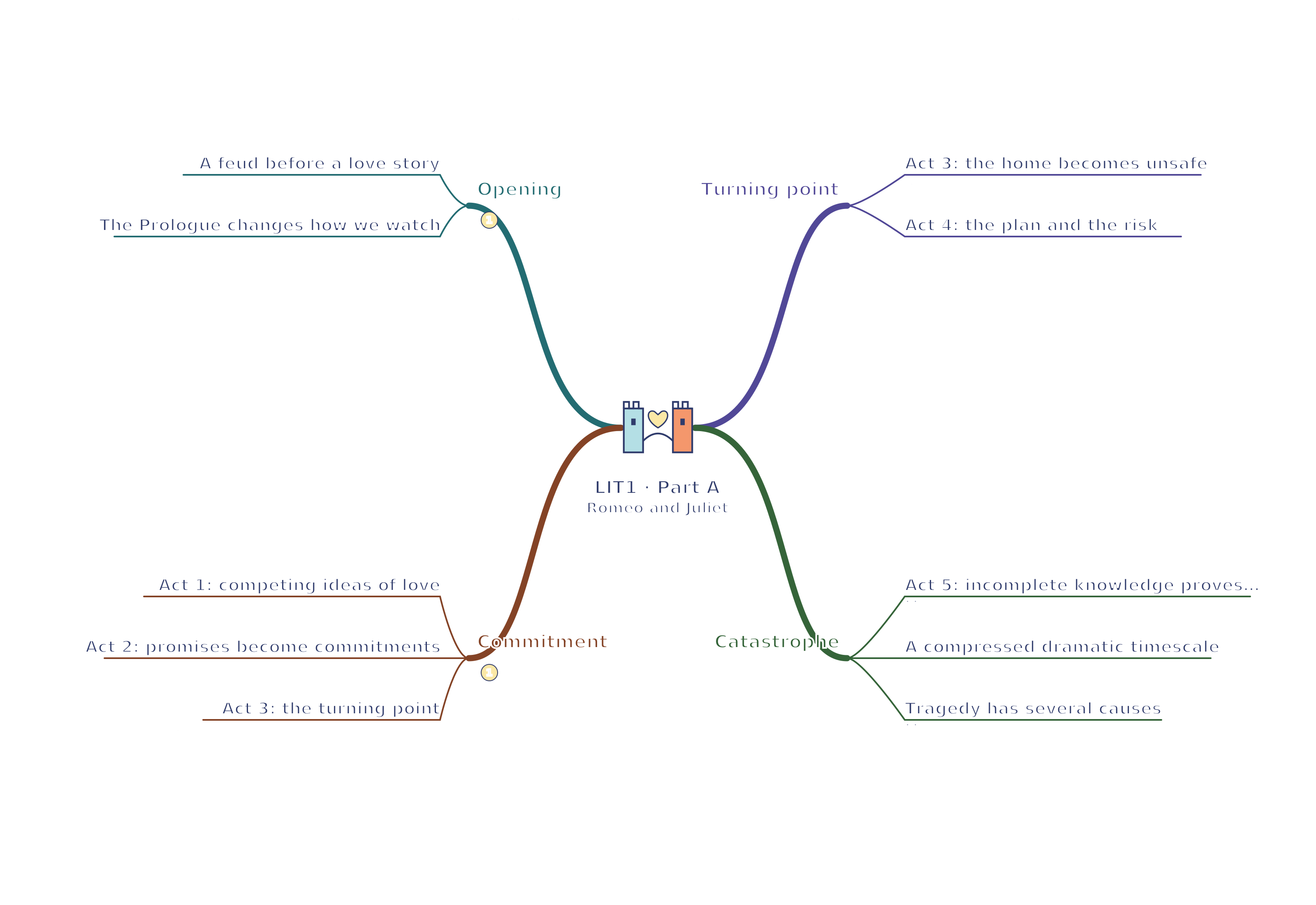
- A feud before a love story — The opening street fight makes the household feud a public danger before the lovers meet. Servants begin the violence, Benvolio tries to stop it and Tybalt escalates it. The Prince's warning establishes consequences beyond private honour: violence threatens civic order (the peace and authority needed for people to live together in the city).
- The Prologue changes how we watch — The opening fourteen-line sonnet tells the audience that the lovers will die and their deaths will end the feud. Suspense therefore concerns how catastrophe becomes possible, rather than whether everyone survives. Its language of fate can be weighed against the choices we subsequently see.
Quotation to use: “star-crossed lovers” (Prologue). The astrological adjective frames love as opposed by fate. Because the ending is announced, suspense concerns how choices bring it about; fate does not remove human responsibility.
- Act 1: competing ideas of love — Romeo begins absorbed in unreturned love for Rosaline; his elaborate contradictions suggest a conventional performance of suffering. At the Capulet feast, his encounter with Juliet produces a shared exchange rather than a solitary display. Tybalt recognises him, so intimacy develops within immediate social danger.
- Act 2: promises become commitments — In the orchard, Juliet challenges the importance of family names and asks Romeo for a serious commitment. The Nurse carries messages and Friar Laurence agrees to marry them, hoping to reconcile the families. Their secret marriage is both a genuine commitment and a solution that leaves the public feud unresolved.
- Act 3: the turning point — By keeping his marriage secret, Romeo cannot explain fully why he refuses Tybalt's challenge without revealing his new family connection. Mercutio fights instead and is fatally wounded when Romeo intervenes. Romeo then kills Tybalt. The movement from romantic possibility to banishment grows from the collision of private loyalties and public expectations.
- Act 3: the home becomes unsafe — Juliet first struggles to reconcile love for Romeo with grief for Tybalt. After the lovers' dawn farewell, her father demands that she marry Paris, while the Nurse advises accepting the new match. Juliet's isolation increases as adult support becomes conditional on obedience.
- Act 4: the plan and the risk — Friar Laurence gives Juliet a potion that will make her appear dead so the planned marriage to Paris can be avoided. Juliet considers deception, suffocation, madness and waking among the dead before drinking. Her fear shows deliberate courage under pressure, rather than an effortless romantic gesture.
- Act 5: incomplete knowledge proves fatal — Friar John's message is prevented from reaching Romeo by quarantine, while Balthasar reports Juliet's apparent death. Romeo purchases poison and returns to the tomb, killing Paris in their confrontation. Romeo dies before Juliet wakes; she subsequently kills herself. The surviving families reconcile after learning what happened.
- A compressed dramatic timescale — Most of the action is compressed into a few days. Rapid decisions, the altered wedding date and the race to the tomb leave little opportunity for reflection or correction. In an argument, connect this acceleration to particular decisions rather than merely stating that the play is fast.
- Tragedy has several causes — Fate imagery and failed communication matter, but so do the feud, coercion (forcing someone through threats or pressure), retaliation and the adults' risky strategies. A convincing reading can trace how these causes interact. Saying the lovers die only because they are young, or only because of fate, overlooks the play's competing pressures.
Characters and relationships
- Romeo changes but remains impulsive — Romeo moves from performing conventional romantic melancholy to sharing love, accepting marriage and risking his life. Yet his quick shifts into revenge and suicide suggest that intense feeling repeatedly outruns judgement. Track differences between scenes rather than treating him as either entirely mature or entirely foolish.
- Juliet develops agency — Juliet initially listens to her mother's proposal about Paris without promising love. She later negotiates marriage, challenges family identity, resists her father's command and chooses the potion. Her growing independence occurs under severe constraints; agency does not mean she has safe or equal choices.
Quotation to use: “My only love sprung from my only hate!” (Juliet, Act 1 Scene 5). The opposed nouns compress her conflict between personal feeling and inherited family loyalty.
Quotation to use: “If all else fail, myself have power to die.” (Juliet, Act 3 Scene 5). Her claim to power shows resolve but also how adult coercion narrows her available choices.
- The lovers are not identical — Romeo often makes sweeping declarations; Juliet repeatedly asks practical questions about sincerity, marriage and discovery. Their exchange develops mutual feeling while revealing different styles of thought. Later both act desperately, so avoid turning this early contrast into an absolute rule about either character.
- Mercutio complicates romance — Mercutio's wit, sexual jokes and Queen Mab speech challenge Romeo's idealisation of love and dreams. His loyalty and readiness to fight also expose the dangerous masculine code beneath the comedy. His death changes the play's emotional register (its tone) and implicates both households.
- Tybalt makes honour violent — Tybalt interprets Romeo's presence at the feast as an insult to family status and later seeks a confrontation. His aggression turns perceived disrespect into physical danger. Contrast his insistence on conflict with Benvolio's attempts at peace and Capulet's initial restraint at the feast.
- Benvolio and the limits of mediation — Benvolio attempts to stop the opening fight and advises Romeo, but his peacekeeping cannot overcome entrenched hostility. His account of the fatal fight gives the Prince information. Calling him simply unimportant misses how he offers an alternative to violence without controlling the outcome.
- Capulet's changing authority — Capulet initially tells Paris that Juliet's willingness matters and restrains Tybalt at the feast. Later he accelerates her wedding and threatens rejection when she refuses. This change exposes the limits of his apparent generosity: paternal care can become coercion when obedience is challenged.
Quotation to use: “My will to her consent is but a part.” (Capulet, Act 1 Scene 2). He initially makes Juliet’s consent important.
Quotation to use: “Hang thee, young baggage!” (Capulet, Act 3 Scene 5). The insult treats his daughter as disposable property. Pair the two moments to trace the collapse of his earlier restraint.
- Lady Capulet and emotional distance — Lady Capulet presents marriage as advantageous and relies on the Nurse's intimacy with Juliet. After Tybalt's death she seeks vengeance and later declines to intervene for her daughter. She can be read as enforcing the same family system that restricts women's power, rather than simply lacking feelings.
- The Nurse: care and compromise — The Nurse remembers Juliet's childhood and facilitates the marriage, providing warmth and comic physicality. Her later advice to marry Paris may seem practical protection, but to Juliet it betrays a sacred commitment. The rupture removes an important confidante (someone she trusts with private thoughts) and pushes Juliet towards secrecy.
- Friar Laurence: good aims, risky means — The Friar hopes that marriage can end hatred and warns against excessive haste. Nevertheless, he enables secrecy and devises a plan dependent on precise timing and successful delivery. Analyse the tension between his humane intentions and his practical responsibility rather than declaring him a simple villain or saviour.
- Paris and the expected marriage — Paris approaches Capulet within recognised social conventions and mourns Juliet at her tomb. He obstructs the lovers' relationship without knowing their marriage exists. His death shows the tragedy extending beyond the central couple; avoid treating him as knowingly plotting against Romeo.
- The Prince and responsibility — The Prince tries to control disorder through punishment, first threatening death and then banishing Romeo after hearing the circumstances. At the end he acknowledges failures of authority alongside the families' guilt. His role links private conflict to the wider community and its institutions.
Themes and relevant contexts
- Love challenges inherited identity — The lovers' relationship crosses the feud's inherited categories. Juliet separates Romeo as a person from his family name, questioning why identity should dictate hatred. Their love offers an alternative value system, but secrecy prevents it immediately transforming the households around them.
Quotation to use: “Deny thy father and refuse thy name” (Juliet, Act 2 Scene 2). The imperatives challenge the authority of inherited identity, rather than literally asking where Romeo is.
- Love is presented in several forms — Romantic devotion exists beside parental love, friendship, sexual attraction and social ideas about marriage. The Nurse, Mercutio, Paris and Friar Laurence each frame relationships differently. Compare these perspectives to show what is distinctive about the lovers without assuming the play supplies one simple definition of love.
- Violence is learned and enforced — Servants, relatives and friends reproduce the feud through insults and challenges. Romeo's attempt to refuse a duel is misread because masculine honour expects retaliation. The play can criticise a social code that makes restraint look shameful and revenge appear necessary.
- Family and patriarchal power — Patriarchy is a system in which men hold most authority in family and public life. Elite marriages could involve property, status and family alliances, while daughters were expected to obey fathers. This context helps explain Capulet's authority and Juliet's limited options. It does not prove that every Elizabethan marriage was forced or that the audience would all respond in the same way.
- Fate and human responsibility — References to stars, dreams and foreboding create a sense of a future the lovers cannot escape. Yet the stage also shows choices with recognisable consequences. An interpretation may argue that fate frames the story while social and personal actions give that tragic framing its concrete form.
Quotation to use: “O, I am Fortune’s fool!” (Romeo, Act 3 Scene 1). Personifying Fortune presents him as its victim immediately after his own decision to kill Tybalt; test his explanation against his actions.
- Religion and sacred promises — Saints, pilgrims, prayer and marriage give the lovers' language a sacred register. The Italian setting is Catholic, while Shakespeare wrote for an England shaped by the Reformation: religious changes that challenged Catholic authority and established Protestant churches. Use this distinction carefully: the religious imagery may dignify desire and also reveal tension between spiritual language and bodily attraction.
- Youth, age and failed guidance — Adults sometimes warn against haste, but their actions also create urgency or fail to supply protection. The play therefore permits criticism of youthful impulsiveness and adult authority together. Avoid a blanket claim that all young people are wise or all adults cruel.
- Death ends the feud at a cost — The final reconciliation fulfils the Prologue's promise, but it arrives only after multiple deaths. The proposed memorials can express grief and renewed rivalry in material display. Ask whether the ending offers repair, indictment (a judgement blaming the society that allowed these deaths) or both, supporting the reading from the surviving characters' responses.
Quotation to use: “All are punished.” (Prince, Act 5 Scene 3). The inclusive pronoun extends responsibility beyond the lovers to families and civic authority.
Language, dramatic form and analysis
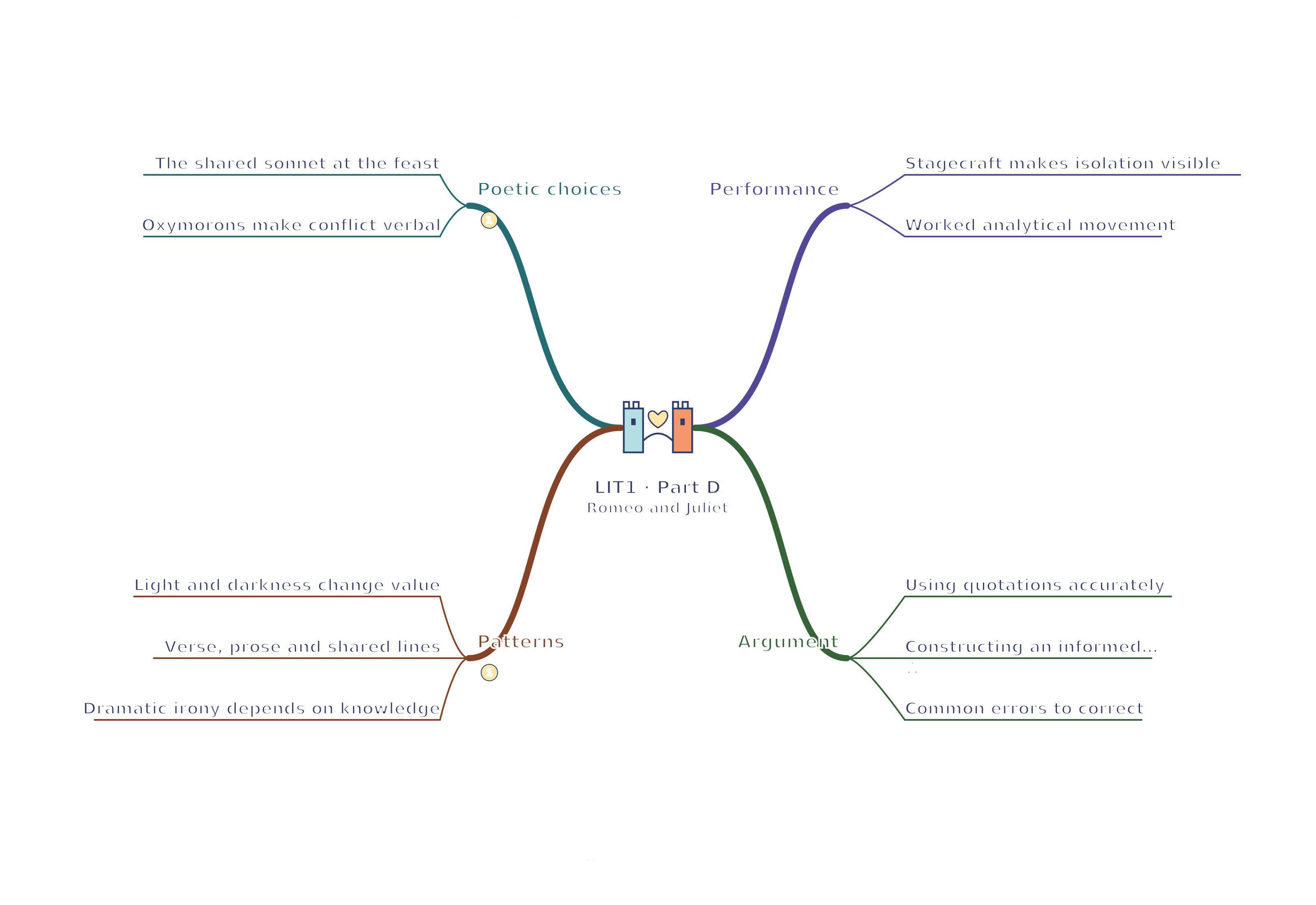
- The shared sonnet at the feast — The lovers' first conversation forms a sonnet jointly spoken, with linked religious images and a concluding movement towards a kiss. Sharing the form can suggest compatibility and reciprocal participation. Analyse their developing exchange rather than saying a sonnet automatically proves perfect love.
Quotation to use: “If I profane with my unworthiest hand” (Romeo, Act 1 Scene 5). Religious vocabulary makes courtship sound like worship. Juliet’s replies complete the shared sonnet, showing participation rather than a wholly passive response.
- Oxymorons make conflict verbal — Romeo's early combinations of opposing ideas give love the language of contradiction. Similar tensions later express Juliet's divided response to Tybalt's death and Romeo's action. The effect depends on the scene: conventional romantic display and genuine moral conflict are not identical uses.
- Light and darkness change value — Romeo describes Juliet through sources of light, suggesting beauty, guidance and exceptional value. Yet darkness often protects the lovers while daylight threatens discovery or separation. This unstable pattern complicates a simple equation of light with good and darkness with evil.
- Verse, prose and shared lines — Shakespeare varies blank verse, rhymed forms and prose. These choices can help shape intimacy, performance, informality or emotional disruption, but social rank alone does not explain every switch. Locate a specific change and show how its rhythm or register interacts with the scene.
- Dramatic irony depends on knowledge — The audience knows the marriage when Tybalt challenges Romeo and knows Juliet is alive when Romeo enters the tomb. This unequal knowledge makes well-meant actions painful to watch. Name the particular information gap; dramatic irony is not simply anything surprising or unfortunate.Audience
Knows the potion plan.Romeo
Receives a report of death.Tomb
Acts before Juliet wakes.Dramatic irony: the audience's knowledge makes Romeo's mistaken conclusion painful to watch. The failed letter connects private planning to the final catastrophe. - Stagecraft makes isolation visible — Scenes can place Juliet among adults who speak about her future while limiting her ability to respond. The tomb juxtaposes, or places side by side, living and apparently dead bodies, entrances and delayed recognition. Explain what an audience sees and hears, since a play is performed action rather than a narrated novel.
- Worked analytical movement — An argument about coercion could begin with Capulet's earlier willingness to consider Juliet's consent, contrast his later threats, then analyse the change in imperatives (commands) and emotional tone. The comparison supports a claim that paternal affection is conditional. Relevant marriage context then explains the stakes rather than replacing textual analysis.
- Using quotations accurately — Learn short, adaptable evidence with speaker and scene, and check wording in your edition. Integrate a quotation into a sentence and explain the significant choice in context. A precise reference to action is also useful; an isolated remembered phrase does not establish a whole-play argument.
- Constructing an informed interpretation — Build an argument around a question or idea, selecting moments from different stages of the play. Develop how language, structure and stagecraft support the reading, and consider a plausible complication. Use present tense for analysis and distinguish what the text shows from what an audience may infer.
- Common errors to correct — Juliet's potion is not the poison Romeo buys; Romeo kills Tybalt after Mercutio dies; and the final catastrophe follows failed communication, not Juliet deliberately rejecting Romeo. Check sequence before interpreting motive. Shakespeare's tragic construction must also be distinguished from a character's beliefs about fate.
Language, dramatic form and analysis
- Hear the shared form — An iamb is a metrical foot moving from a relatively unstressed syllable to a stressed syllable; pentameter has five feet. Blank verse is unrhymed iambic pentameter, although actual spoken lines can vary. Romeo and Juliet's first exchange forms a shared sonnet, so formal completion depends on both voices. Relate that mutual shaping to the exchange's religious imagery and movement towards a kiss. Do not assume that every line has identical stress or that the shared form proves their relationship has no unequal pressures.