Mr Kidman's Classroom


Revise the key ideas
Meaning and perspective
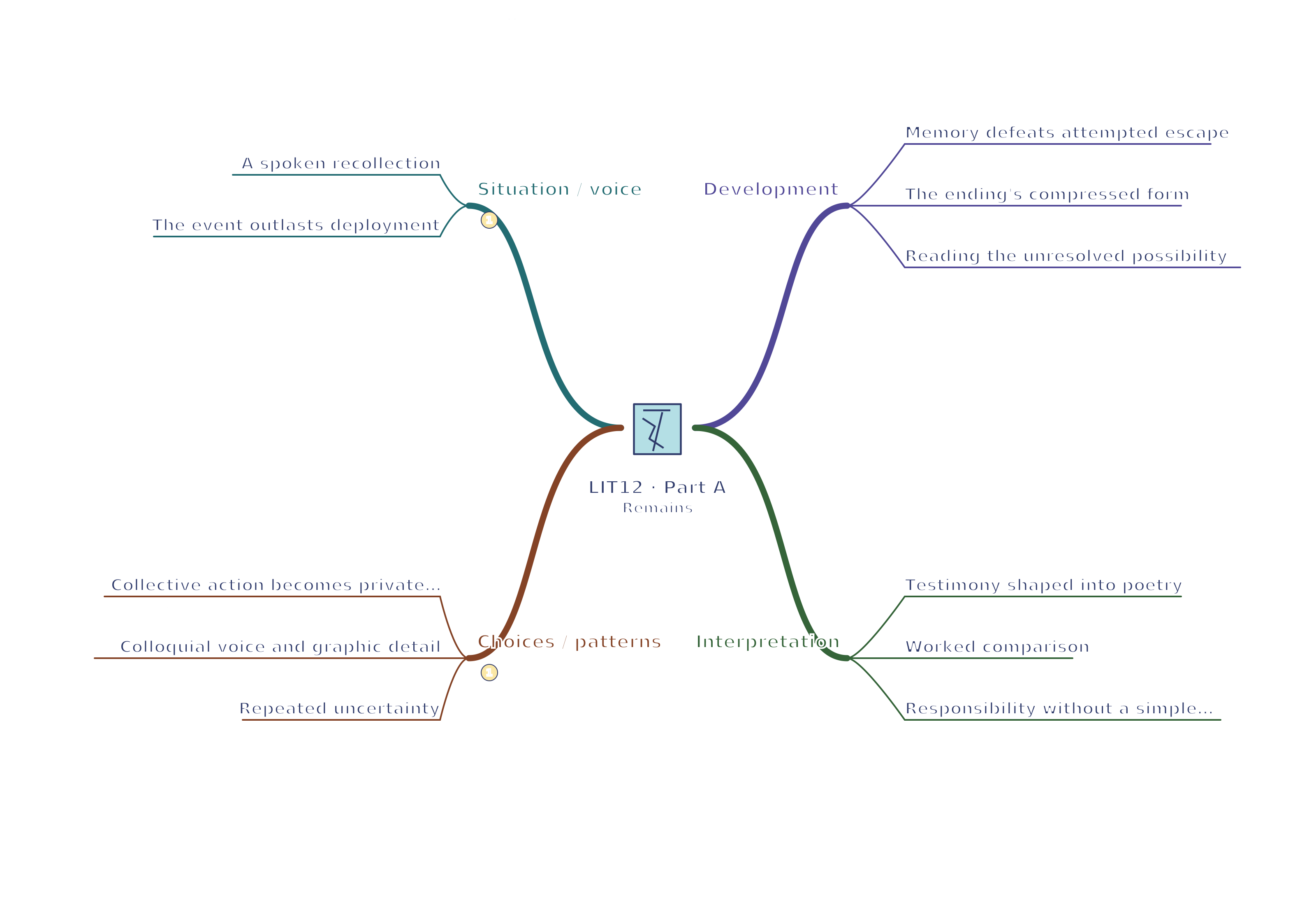
- A spoken recollection — A soldier recalls shooting a suspected looter with other soldiers, initially using an informal matter-of-fact voice. The uncertainty about whether the man was armed is crucial: the account cannot settle it. Retain that doubt rather than converting suspicion into a proved threat or a proved absence of danger.
- The event outlasts deployment — The narrative moves from the incident to its persistence after the soldier returns home. Physical removal from the conflict does not end the remembered violence. The title can suggest both bodily remains and what continues in the mind, linking material death to ongoing psychological consequences.
Methods and development
- Collective action becomes private burden — The shooting is initially described as a shared action, but the later voice concentrates on the speaker's solitary distress. This shift changes the relation between responsibility and experience. Shared participation does not prevent the memory from becoming intensely individual.
- Colloquial voice and graphic detail — Conversational phrasing makes the recollection sound direct and ordinary, while violent bodily images disrupt any comfortable casualness. The contrast can expose how extreme events enter apparently routine speech. Avoid assuming informal language means the speaker is unaffected throughout.
- Repeated uncertainty — The unresolved possibility about the man's weapon returns rather than being explained away. Repetition makes doubt part of the speaker's recurring thought. It is not simply emphasis on one fixed fact: the inability to establish certainty helps sustain guilt and distress.
Quotation to use: “probably armed, possibly not” (first stanza and later recollection). The balanced alternatives keep the justification unresolved; repetition shows that uncertainty surviving the shooting.
- Memory defeats attempted escape — The speaker describes failed attempts to suppress or escape the incident, while the final focus makes the killing feel immediately present. Discuss a portrayal of traumatic symptoms, such as distressing memories returning against someone's will, without diagnosing an individual from a poem. The ending offers no simple cure or moral reassurance.
Quotation to use: “blood-shadow” (middle of the poem). The compound links a physical stain to a haunting trace that the speaker cannot leave behind.
- The ending's compressed form — Most of the poem develops through four-line stanzas before the shorter final unit concentrates on the speaker's continuing burden. The compression can make the unresolved presence feel inescapable, but the interpretation needs the ending's actual reference to the killing. Stanza length is evidence to explain, not a symbolic answer by itself.
Quotation to use: “my bloody hands” (final line). The possessive makes responsibility personal after the earlier collective action; the language also allows anger and guilt to overlap.
- Reading the unresolved possibility — The compact contrast probably armed, possibly not makes an initial judgement and then immediately admits it may be wrong. Repeated later, it exposes the persistence of a question the speaker cannot settle. The two possibilities are not interchangeable with a narrator's verified verdict, so neither should become a factual claim in your response.
Context, interpretation and comparison
- Testimony shaped into poetry — The poem belongs to The Not Dead, a project drawing on soldiers' accounts. Armitage shapes a dramatic voice from testimony; he is not automatically the first-person soldier. That distinction allows discussion of authentic experience and poetic construction together, without treating the poem as an unedited interview.
- Worked comparison — With War Photographer, examine how disturbing images persist beyond the conflict zone. The soldier is implicated in killing and privately haunted; the photographer mediates others' suffering, selecting and presenting it through photographs for an audience whose attention is limited. Both cross the boundary between war and ordinary life, but responsibility and viewpoint differ.
- Responsibility without a simple verdict — The voice can invite sympathy for distress while maintaining attention to the dead person and the act of shooting. Compassion for the speaker need not mean absolution (release from blame), and acknowledgement of responsibility need not deny psychological suffering. A developed interpretation can hold these concerns together through the event and its aftermath.