Mr Kidman's Classroom


Revise the key ideas
Meaning and perspective
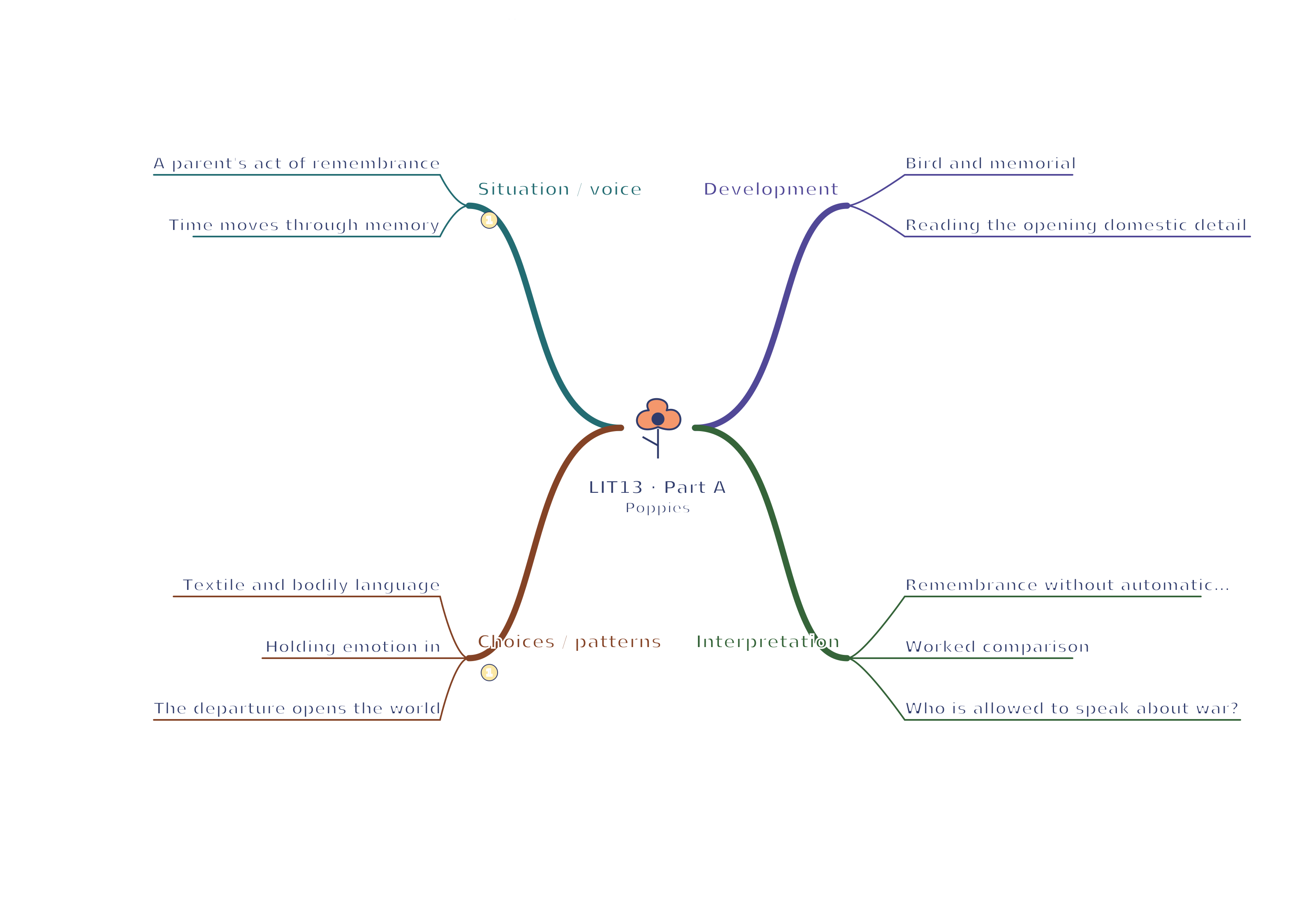
- A parent's act of remembrance — The speaker remembers helping a child prepare to leave, bringing intimate domestic gestures into contact with public remembrance. The child is commonly read as a son, but the speaker's exact circumstances are not fully documented. Do not assume the poem conclusively reports a death merely because mourning imagery is present.
- Time moves through memory — The account combines remembered departure, earlier childhood associations and the speaker's later movement towards a memorial setting. These shifts make separation feel layered rather than confined to one moment. The chronological looseness reflects how thought returns to earlier attachments.
Methods and development
- Textile and bodily language — Fabric, fastening and touch give the speaker's care a tactile quality (a sense of touch), while some descriptions suggest wounding or restraint. Domestic actions can therefore carry the pressure of conflict without a battlefield scene. Explain the double associations rather than asserting every sewing term has one military equivalent.
Quotation to use: “spasms of paper red” (opening stanza). The bodily noun brings pain into the delicate commemorative object, linking domestic preparation with injury.
- Holding emotion in — The speaker controls outward gestures while describing intense inward feeling. This contrast makes restraint emotionally expressive rather than evidence of indifference. Consider what is said indirectly through remembered actions, pauses and associations, distinguishing the speaker's behaviour from the writer's personal biography.
Quotation to use: “steeled the softening” (before departure). The contrast makes emotional restraint sound like an effort to harden the self.
- The departure opens the world — Images of release and movement suggest the child's desire for independence, while the parent experiences loss of closeness. The poem can hold pride, anxiety and grief together. Avoid reducing the relationship to a parent simply forbidding departure or a child rejecting all affection.
- Bird and memorial — The later movement towards a memorial and the image of a bird connect personal separation to public spaces of remembrance and possible release. The ending's search for remembered presence does not resolve the child's fate. Ambiguity sustains the speaker's longing rather than supplying a complete narrative outcome.
Quotation to use: “playground voice” (ending). The remembered childhood sound brings private attachment into a public site of remembrance without confirming the son’s death.
- Reading the opening domestic detail — A blockade is a barrier or action that stops people or supplies getting through. The noun blockade borrows a language of obstruction for the speaker's careful treatment of clothing. Within intimate care, that choice can bring conflict and vulnerability into the home. Its effect depends on the tactile action around it; it is not proof that a literal military blockade surrounds the family.
Context, interpretation and comparison
- Remembrance without automatic certainty — The poppy associates the poem with commemorating war and loss, but the text's emotional reach includes separation more widely. It is neither a factual account of every military family nor proof that the speaker is Jane Weir. Use context to illuminate the gestures without closing the poem's uncertainties.
- Worked comparison — With Kamikaze, compare family attachment and the consequences of a child's or parent's relation to war. Poppies centres an affectionate speaker's restraint and longing; Kamikaze reconstructs a pilot's return and the community's rejection. The contrast concerns different forms of separation, not two confirmed battlefield deaths.
- Who is allowed to speak about war? — The poem foregrounds the person who stays behind rather than a combatant's action. That perspective broadens the consequences of war to anticipation, attachment and waiting. It should not be treated as evidence that those experiences are identical to combat or shared in exactly the same way by every family.