Mr Kidman's Classroom



Revise the key ideas
Narrative sequence and the whole novella
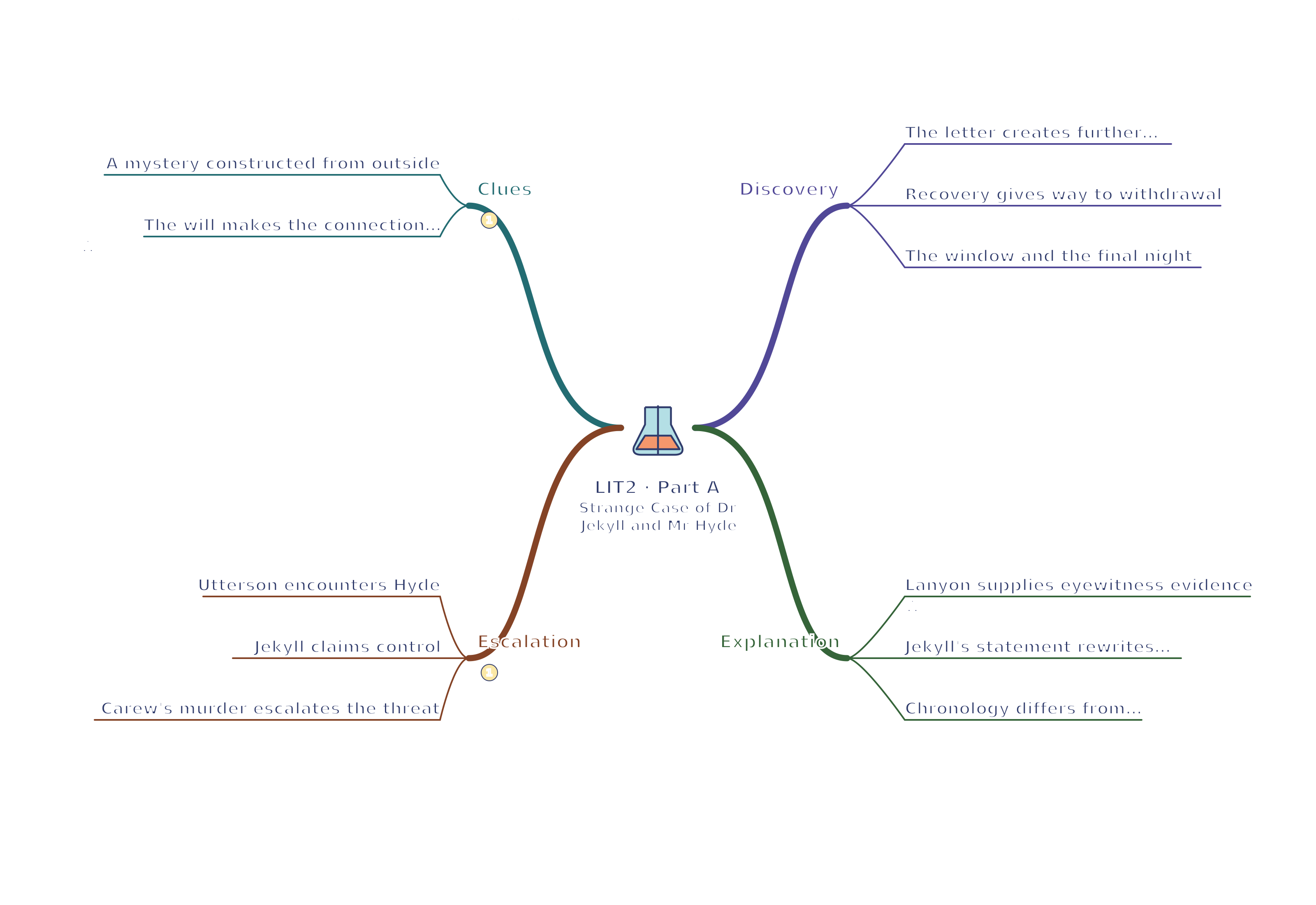
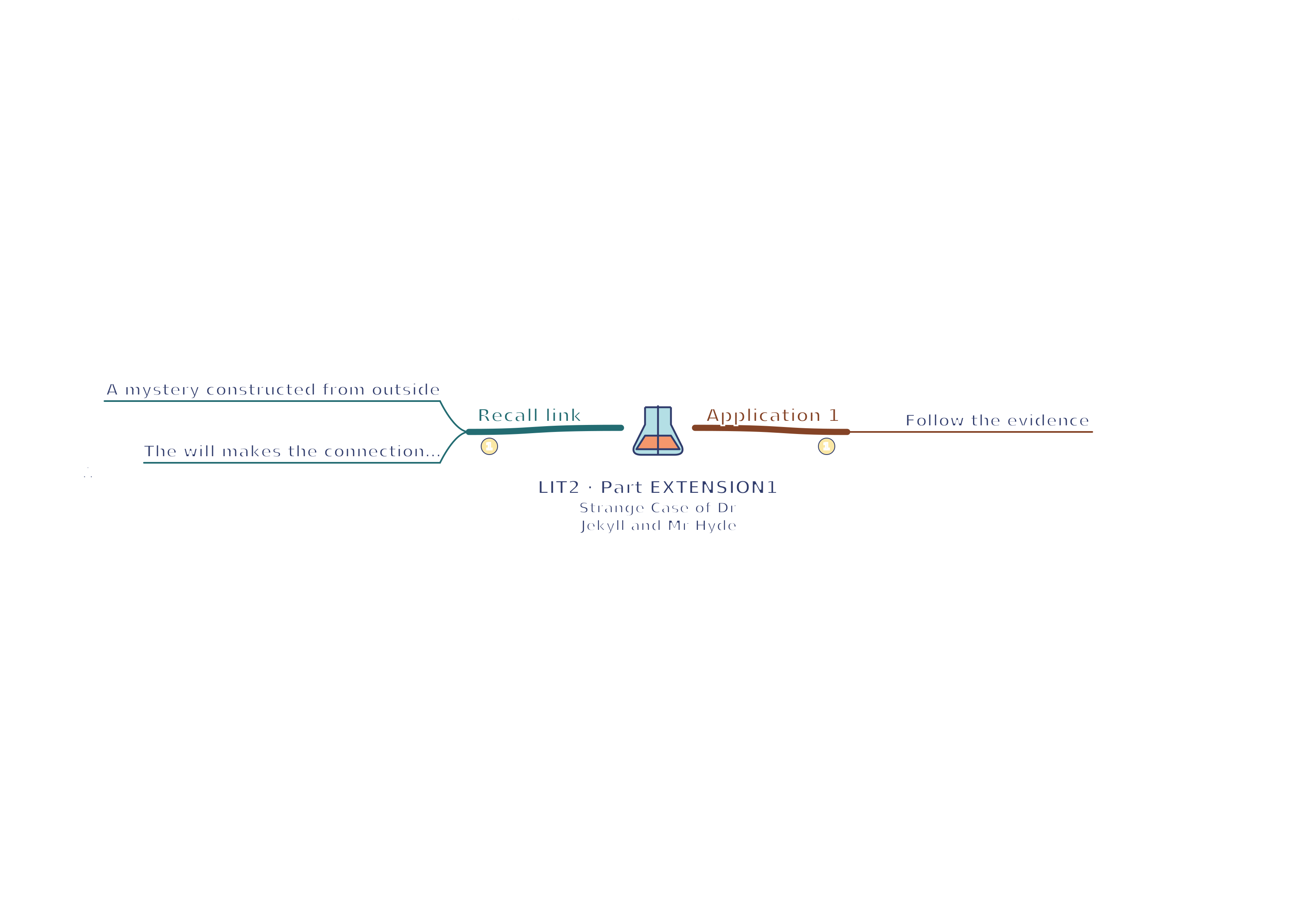
- A mystery constructed from outside — The novella initially follows Utterson's investigation rather than explaining Jekyll's experiment. Enfield's account of Hyde trampling a child introduces violence, money and an unexplained connection to a respectable name. Readers are encouraged to infer a relationship before they know that two apparent individuals share one body.
- The will makes the connection threatening — Jekyll's will benefits Hyde in the event of death or disappearance. Utterson suspects blackmail, a plausible explanation within his social world. This is a character's provisional hypothesis (a possible explanation that still needs testing), not the narrator's final explanation; its limitations show how respectability can obstruct understanding.
- Utterson encounters Hyde — Utterson waits at the neglected door and meets Hyde, finding him disturbingly hard to describe. His impression intensifies the mystery but does not establish that physical appearance reliably indicates morality. Stevenson makes the observers' inability to classify Hyde part of the unease.
- Jekyll claims control — When Utterson raises the will, Jekyll reassures him that he can end his association with Hyde whenever he chooses. Later evidence undermines this confidence. The gap between professed control and developing dependence is central to an argument about self-deception and responsibility.
Quotation to use: “the moment I choose, I can be rid of Mr. Hyde” (Jekyll, Chapter 3, Dr. Jekyll Was Quite at Ease). The confident first-person claim makes later involuntary changes a reversal of his supposed control.
- Carew's murder escalates the threat — A maid witnesses Hyde's attack on Sir Danvers Carew. The brutality expands the violence from an injured child to murder and brings police investigation into the story. Utterson recognises the broken weapon as connected to Jekyll, strengthening the relationship without yet resolving it.
- The letter creates further ambiguity — Jekyll produces a letter apparently from Hyde and claims the relationship has ended. Guest notices a resemblance between the handwriting in this letter and Jekyll's. Utterson infers that Jekyll may have forged a document for a murderer, while the reader receives another clue to a more radical connection.
- Recovery gives way to withdrawal — Jekyll briefly resumes social and charitable activity before becoming inaccessible again. Lanyon becomes visibly distressed and dies after an unexplained rupture with Jekyll. Utterson receives a sealed explanation whose conditions delay access, so documentary evidence exists before it can be read.
- The window and the final night — Utterson and Enfield see Jekyll at a window before his expression changes in terror and the encounter abruptly ends. Later Poole seeks help because he fears something is wrong in the laboratory. They break in, find Hyde dead in Jekyll's clothes and discover papers that reorganise the reader's understanding.
- Lanyon supplies eyewitness evidence — Lanyon's narrative records obtaining a drawer of chemicals and witnessing Hyde transform into Jekyll. His testimony provides an external witness to the impossible event before Jekyll's own retrospective explanation, looking back on earlier events. The order lets readers distinguish observed transformation from Jekyll's account of motives and moral meaning.
- Jekyll's statement rewrites earlier events — The final statement explains the experiment, the freedom Jekyll initially experiences as Hyde and the subsequent loss of control. Earlier clues can now be reread, but this confession remains the account of an implicated person. The explanation of identity does not require accepting every attempt to divide or excuse responsibility.
- Chronology differs from presentation — Jekyll's experiment and early transformations happen before Utterson begins investigating, but readers learn them last. Map the difference between event order and disclosure order to explain suspense, mistaken hypotheses and retrospective irony. A simple chronological plot summary misses the effects of delayed knowledge.Event order
Experiment → Hyde’s actions → investigationDisclosure order
Investigation → Lanyon’s account → Jekyll’s statementOriginal explanatory comparison. Read each relationship alongside the associated explanation.
Character, perspective and responsibility
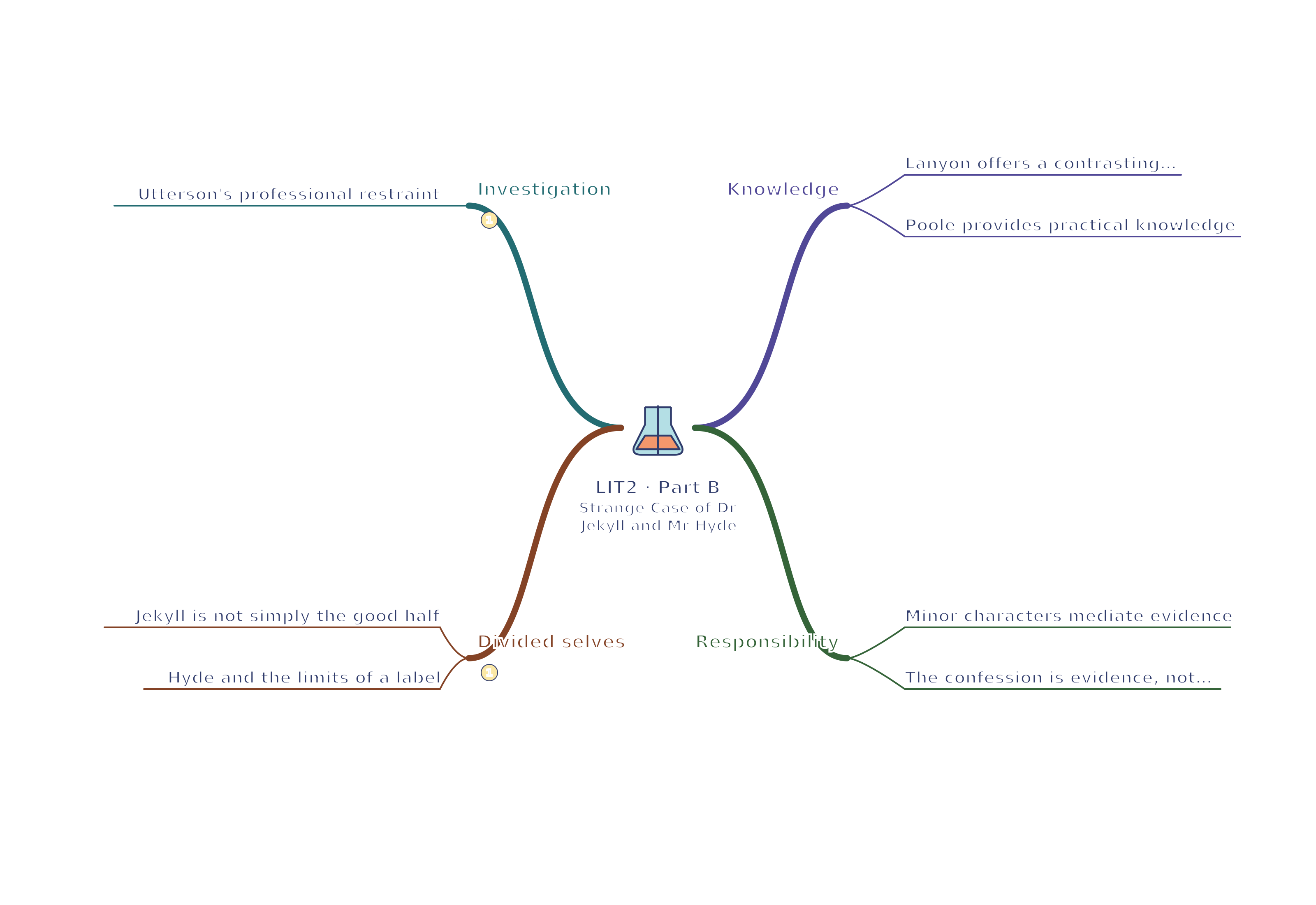
- Utterson's professional restraint — Utterson is loyal, discreet and reluctant to damage a friend's reputation. His legal habits make wills, documents and testimony important, but his reluctance to ask difficult questions can prolong secrecy. His values are both a source of care and a limit on investigation.
Quotation to use: “If he be Mr. Hyde” (Utterson, Chapter 2, Search for Mr. Hyde). The conditional begins his name-based wordplay about seeking Hyde: legal investigation drives the early narrative, while his limited knowledge delays explanation.
- Jekyll is not simply the good half — Jekyll desires pleasure without damage to his respectable identity, invents the experiment and initially benefits from Hyde's freedom. His confession acknowledges a divided character before the physical transformation. Treating him as wholly innocent transfers his agency to Hyde and overlooks the choices that enable violence.
Quotation to use: “man is not truly one, but truly two” (Jekyll’s statement, Chapter 10). The balanced opposition explains his theory of divided identity; it is his claim within a confession, not a neutral scientific conclusion.
- Hyde and the limits of a label — Hyde is associated with cruelty, secrecy and reduced inhibition, but the novella does not describe all his early activities in detail. Avoid inventing offences to fill the silence. His increasing strength and involuntary appearances undermine Jekyll's claim that an unwanted self can be safely compartmentalised: kept separate from the rest of his identity and life.
Quotation to use: “something displeasing, something down-right detestable” (Enfield, Chapter 1, Story of the Door). Repeated indefinite wording makes revulsion stronger than precise description. The witness cannot securely identify the source of his reaction.
- Lanyon offers a contrasting scientific outlook — Lanyon rejects Jekyll's speculative research as unscientific and later witnesses an event his established framework cannot accommodate. Lanyon trusts his established scientific ideas, but witnessing the transformation challenges what he believes is possible and leaves him deeply distressed. The contrast concerns different approaches to knowledge, not a simple division between science and religion.
- Poole provides practical knowledge — Poole notices changes in voice, behaviour and repeated demands for chemicals. His familiarity with the household gives him evidence that Utterson initially resists. The laboratory investigation depends on a servant's observations, complicating any assumption that only professional gentlemen can interpret events.
- Minor characters mediate evidence — Enfield supplies a social anecdote, the maid witnesses a murder and Guest notices handwriting. Their partial accounts build a composite mystery: readers must put the different accounts together. Consider what each person can actually know: a witness may report accurately without understanding the cause or possessing access to every event.
- The confession is evidence, not absolution — Absolution means release from blame. Jekyll describes suffering and loss of control, but he also creates Hyde's separate accommodation and protects the arrangement. An interpretation can acknowledge dependence and fear while holding him responsible for earlier choices. Distinguish explaining a motive from excusing its consequences.
Quotation to use: “my devil had been long caged, he came out roaring” (Jekyll’s statement, Chapter 10). The metaphor casts suppressed desire as a dangerous captive. His account dramatises pressure but does not excuse his decisions to release Hyde.
Themes, settings and contexts
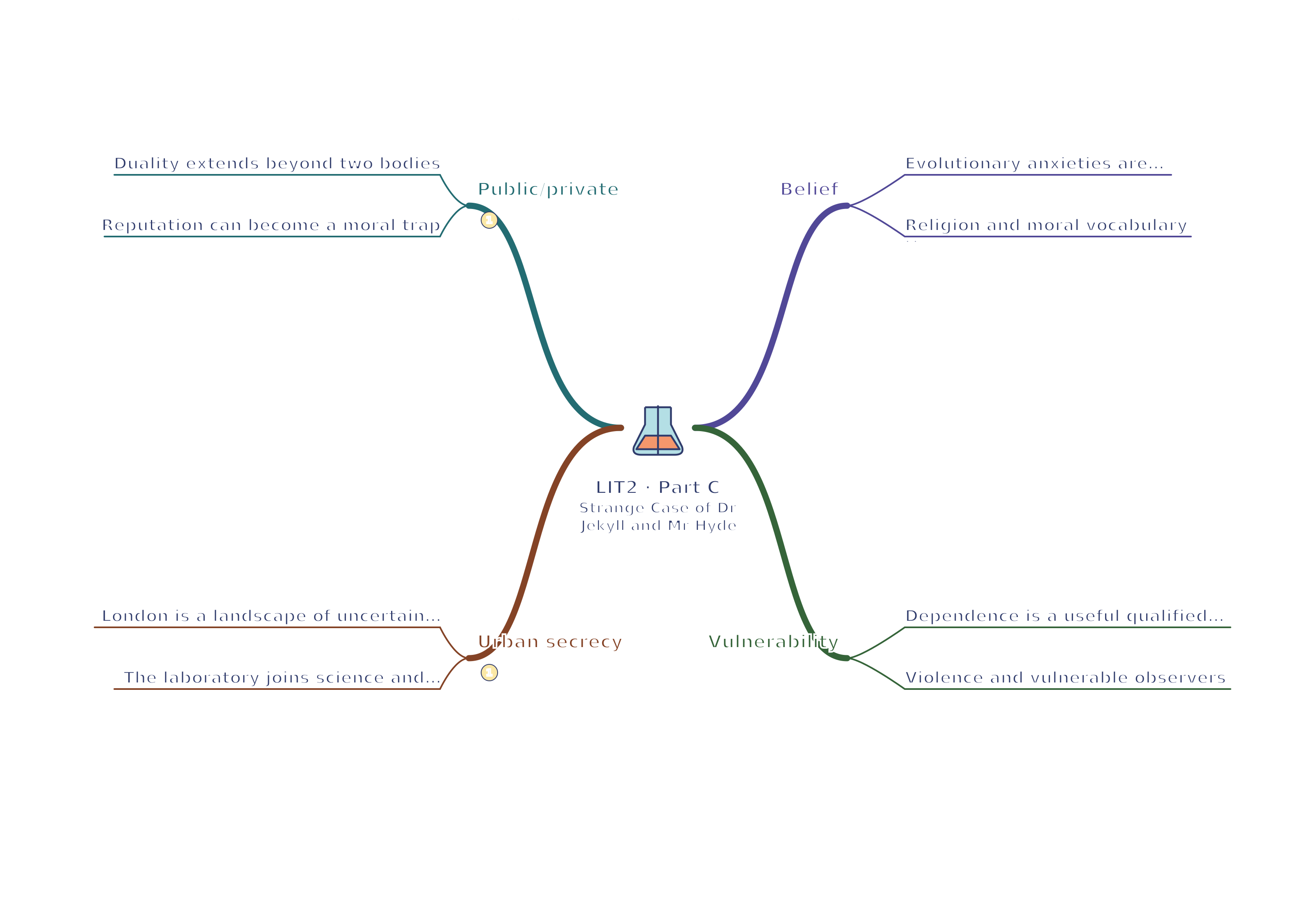
- Duality extends beyond two bodies — Public respectability and private desire coexist within Jekyll before the experiment; Utterson's restrained exterior also contrasts with his curiosity and loyalty. The novella's streets, doors and connected buildings give spatial form to concealed relationships. Duality is a pattern of divided identities and appearances, not merely a twist ending.
- Reputation can become a moral trap — Professional and social standing encourage secrecy when admitting desire or error might cause disgrace. Jekyll's solution protects his name while exposing others to harm. Relate Victorian respectability to this particular mechanism rather than claiming that every Victorian person behaved identically or lived without private freedom.
Quotation to use: “I concealed my pleasures” (Jekyll’s statement, Chapter 10). The active verb identifies deliberate secrecy: respectable appearance and private conduct diverge before the experiment.
- London is a landscape of uncertain knowledge — Fog, darkness and unfamiliar streets impede observation; respectable façades (the fronts of buildings) connect to neglected entrances and hidden rooms. The same city contains wealth, poverty, professional routine and crime. Analyse a specific setting's descriptive choices instead of treating all Gothic darkness as a fixed symbol of evil.
- The laboratory joins science and secrecy — Jekyll's work occurs in a former anatomical setting, used for studying the structure of bodies, linking scientific investigation with the body and concealed interiors. Chemicals promise control over identity but become desperately sought when transformations can no longer be managed. The laboratory makes ambition materially visible rather than providing a realistic medical method.
- Evolutionary anxieties are historical ideas — Animalistic descriptions of Hyde can be linked to nineteenth-century fears about degeneration: losing what society labelled civilised qualities and becoming more animal-like. Such fears questioned a secure distinction between humans and other animals. These descriptions express a historical imaginative framework; they do not prove that cruelty has a visible biological type or validate racial hierarchies. Analyse the language critically without endorsing its assumptions.
- Religion and moral vocabulary — Images of sin, damnation and the devil shape how characters imagine danger and wrongdoing. Such language can show the limits of ordinary explanation as well as moral judgement. It does not settle whether Hyde is literally a supernatural demon, since the narrative also frames transformation through Jekyll's experiment.
- Dependence is a useful qualified comparison — The initial pursuit of pleasure, repeated return, increasing difficulty stopping and loss of control can be discussed as resembling dependence. This is an interpretive comparison, not a clinical diagnosis or a claim that the chemical process is medically plausible. Retain Jekyll's choices alongside his later vulnerability.
- Violence and vulnerable observers — The child and Carew are victims of assaults, while the maid's witnessing makes her vulnerable to shock. The investigation chiefly follows men with professional standing, and women rarely control its explanations. This limitation can inform a reading of whose experiences the narrative foregrounds or leaves at its margins.
Gothic methods and analytical writing
- Withheld names and uncertain descriptions — Indefinite descriptions, unnamed wrongs and the observers' difficulty locating Hyde's deformity leave gaps for readers to interpret. These gaps generate unease and also reveal failures of available language. Support an analysis with the observer and moment rather than claiming vagueness has one automatic effect.
- Nested accounts shape reliability — A third-person narrative closely follows Utterson before letters and first-person statements introduce other perspectives. Each account has different knowledge and interests. The final confession supplies information but remains shaped by Jekyll's self-presentation, so learning the final explanation of the mystery does not settle every question about who is responsible.
- Contrasts turn architecture into argument — The respectable house and neglected door are physically connected, just as the apparently separate men are connected. This relationship lets setting anticipate the identity revelation. The useful point is the concealed connection between surfaces, not a simplistic rule that every attractive place is good.
- Animal imagery and dehumanisation — Hyde's movements and violence are described through animal comparisons. These choices intensify observers' disgust and connect to contemporary anxieties, while also encouraging readers to question how they classify him. Name the particular comparison and its context rather than substituting a general list of Gothic features.
Quotation to use: “ape-like fury” (Carew’s murder, Chapter 4). The animal comparison presents uncontrolled brutality and can connect to Victorian anxieties about degeneration; it does not establish a biological explanation of crime.
- A worked analytical distinction — To analyse responsibility, contrast Jekyll's early assertion of control with his later involuntary transformations. Explain how the changed account undermines his confidence, then consider whether his final separation of selves deflects blame. The argument develops from textual change; a general fact about Victorian secrecy would not establish it alone.
- Extract-to-whole-text reasoning — Locate an extract in the investigation and identify what Utterson, Jekyll and the reader know at that point. Analyse precise language or structural choices, then connect to another stage of the novella that develops or complicates the idea. Avoid revealing the final explanation without considering the extract's original uncertainty.
- Correcting common misconceptions — Jekyll does not discover a wholly external villain; his divided desires predate Hyde. Lanyon witnesses a transformation, and Utterson reads documents rather than seeing that transformation himself. The confession clarifies events but cannot independently prove every moral claim Jekyll makes about himself.
Narrative sequence and the whole novella
- Follow the evidence — Compare the early locked-door mystery with the later written accounts. Early narration withholds a full explanation, encouraging suspicion through observed behaviour and incomplete testimony. Later documents reorganise those events by supplying information earlier observers lacked. Build an argument by naming an early incident, the later disclosure and the change in interpretation. This is a structural effect of delayed knowledge, not evidence that every earlier observation was false or that a confession must be completely reliable.