Mr Kidman's Classroom



Revise the key ideas
Meaning and perspective
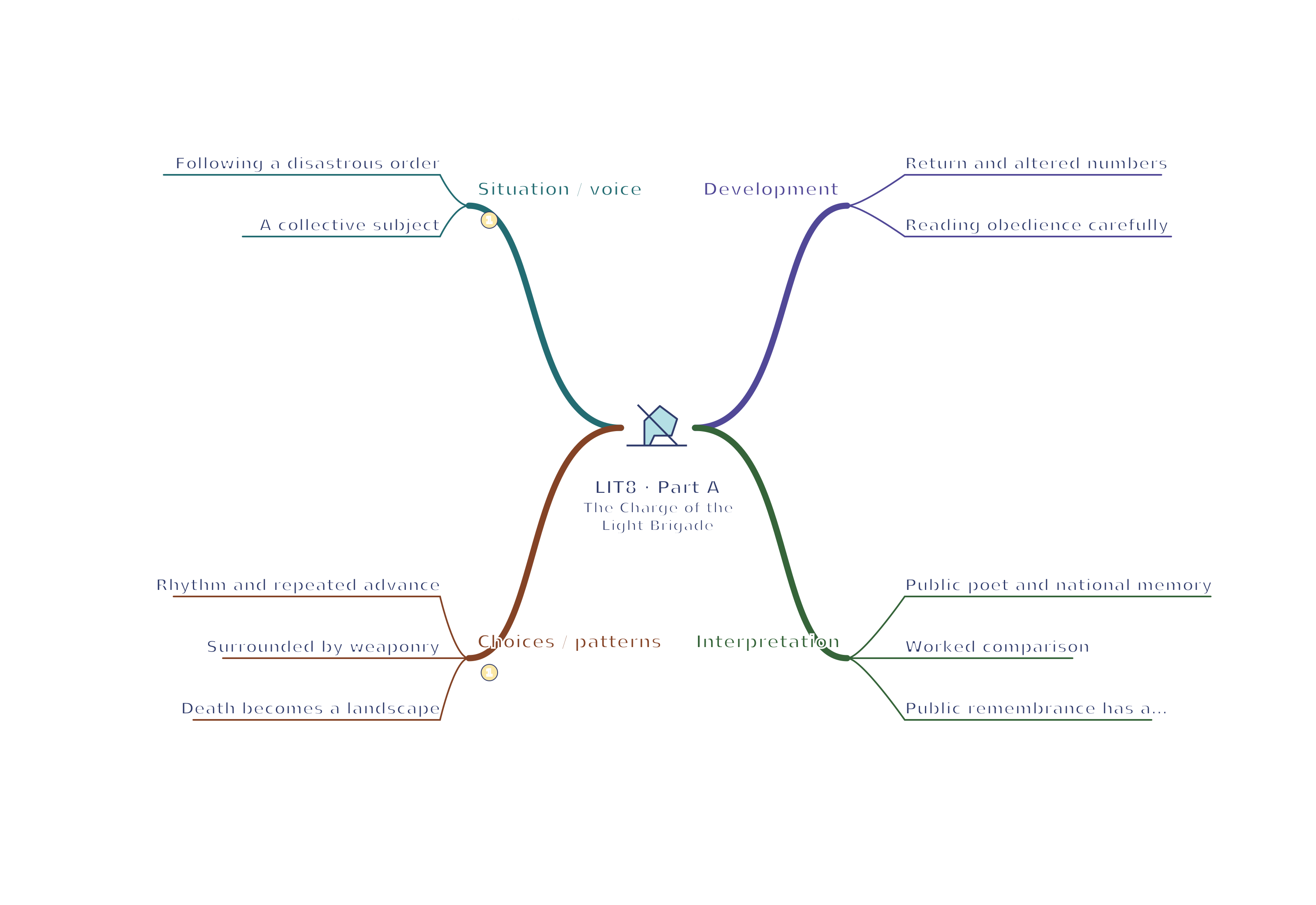
- Following a disastrous order — The poem commemorates a cavalry charge (an attack by soldiers on horseback) during the Crimean War in which soldiers advance into intense enemy fire. Their obedience and courage are praised while an error in command is acknowledged. An interpretation needs both elements; celebration of sacrifice does not mean the military decision is presented as flawless.
Quotation to use: “Someone had blunder’d” (second stanza). The indefinite pronoun admits leadership failure without naming its author.
- A collective subject — The soldiers are chiefly presented as a group rather than individual biographies. This collective perspective supports public remembrance and concentrates attention on shared action. It does not establish that all soldiers had identical thoughts or that the poem records private testimony from each rider.
Methods and development
- Rhythm and repeated advance — Strong recurring stresses and repetitions create a driving movement that can suggest the charge. Rhythm varies within that movement, so avoid forcing every line into the same metrical pattern. Connect the repeated momentum to obedience, danger and the pressure of forward action.
- Surrounded by weaponry — Repeated references to cannon on different sides create a spatial impression of encirclement. The arrangement makes danger appear overwhelming and the soldiers' position vulnerable. Explain the relationship between repeated placement and the experience of the group rather than simply labelling repetition as emphasis.
- Death becomes a landscape — Biblical and bodily images frame the advance as entry into a space associated with death. Such imagery elevates danger and sacrifice rather than describing a literal creature. The scale of the figurative threat contrasts with the human group moving through it.
- Return and altered numbers — The structure moves from advance through combat to return, with repeated numerical references acquiring a changed significance after casualties. Repetition therefore develops meaning instead of merely restarting the same event. The conclusion addresses the audience, turning narration into an instruction to remember and honour.
- Reading obedience carefully — The repeated presentation of duty distinguishes carrying out the command from being allowed to question its wisdom. That tension can honour the riders while exposing an institutional separation between decision and consequence. Avoid using bravery as proof that the soldiers approved the mistaken order.
Quotation to use: “Theirs not to reason why” (second stanza). The negative phrasing denies the soldiers a voice in the decision while foregrounding obedience.
Context, interpretation and comparison
- Public poet and national memory — Tennyson wrote as a prominent public poet, responding to an event in the 1854 war. His role helps explain the commemorative address, but context should not flatten the poem into either unquestioning propaganda (persuasion serving a cause) or a wholly anti-war denunciation (condemnation of war). The command error and honouring of soldiers remain in tension.
Quotation to use: “Honour the Light Brigade” (final stanza). The imperative directs readers towards commemoration even though the order itself was mistaken.
- Worked comparison — With Bayonet Charge, contrast collective public honour with an individual soldier's disorientation. Tennyson's organised retrospective voice gives sacrifice meaning; Hughes's immediate viewpoint shows patriotic abstractions, such as ideals of honour and national duty, losing force under terror. Both present danger, but their perspectives and purposes make that danger mean differently.
- Public remembrance has a perspective — The commemorative voice selects a collective story of courage from a complex historical event. A comparison can ask what this public frame makes visible and what individual uncertainty it leaves less developed. This is a judgement about poetic emphasis, not a claim that remembrance has no value.