Mr Kidman's Classroom


Revise the key ideas
Meaning and perspective
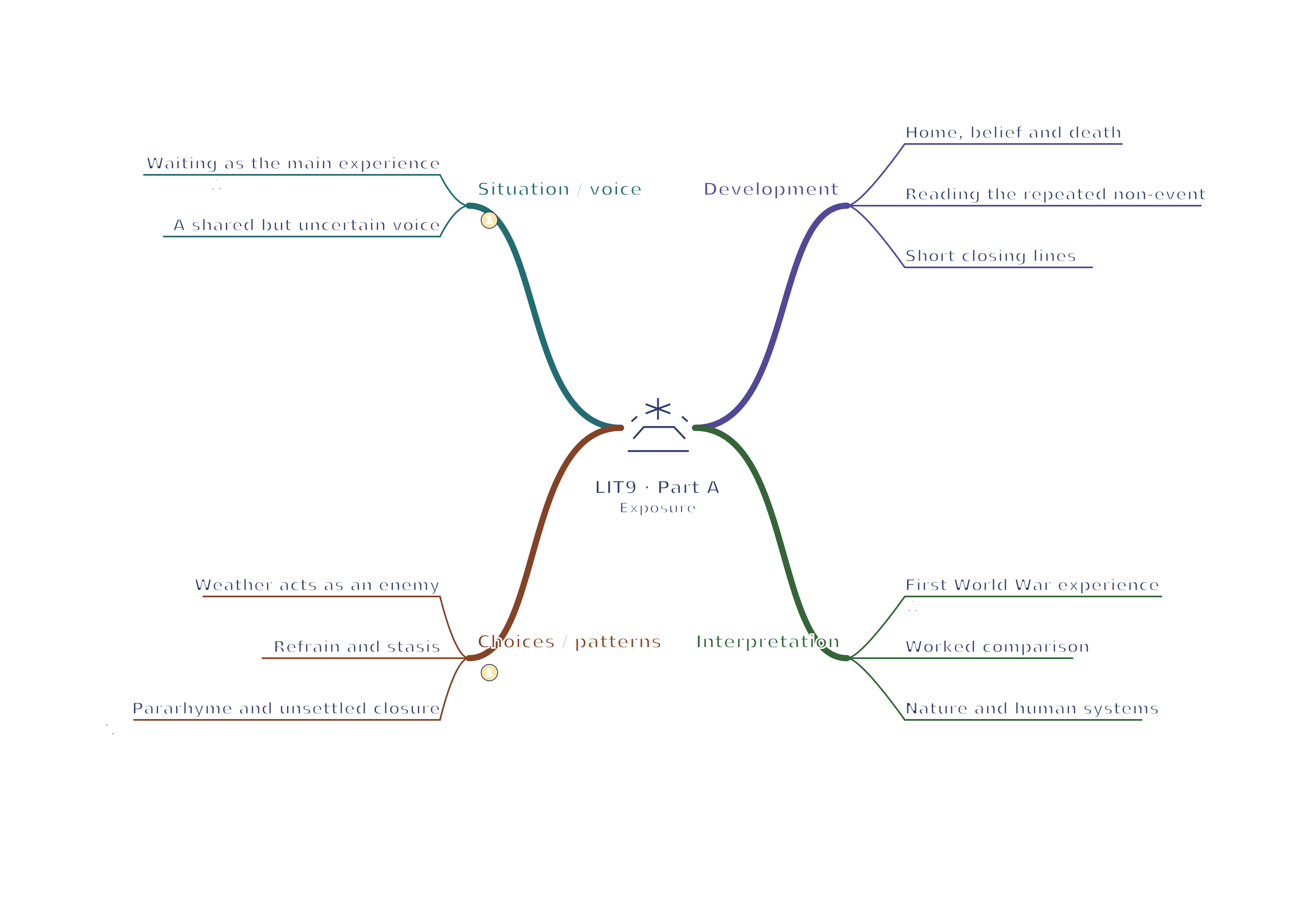
- Waiting as the main experience — The soldiers endure cold, wind and repeated waiting rather than a successful advance or decisive battle. The poem makes apparently inactive time a source of suffering. Its lack of conventional action is deliberate: survival is threatened by exposure and exhaustion as well as enemy weapons.
- A shared but uncertain voice — First-person plural pronouns establish a collective experience, while questions and recurring uncertainty weaken confidence in purpose. The voice is constructed from wartime experience but should not be treated as a transcript of every soldier's thoughts. Its collective perspective allows doubt to spread beyond one speaker.
Methods and development
- Weather acts as an enemy — Personification gives the wind and cold an attacking presence, redistributing the expected threat away from visible combat. Nature is not merely a scenic background. Explain how aggressive descriptions make the environment participate in the soldiers' vulnerability without claiming that weather has literal intentions.
Quotation to use: “merciless iced east winds that knive us” (opening stanza). Personification turns weather into an attacker and makes exposure itself a source of violence.
- Refrain and stasis — The recurring statement of lack of event returns after descriptions of distress, making repeated waiting feel circular. Its apparent denial contrasts with the actual suffering narrated. The effect is not that nothing meaningful occurs: the refrain exposes how pain can continue without the recognised event of battle.
Quotation to use: “But nothing happens.” (recurring refrain). The conjunction frustrates expectation; repeated non-events make waiting an experience of suffering.
- Pararhyme and unsettled closure — Near-matched consonant sounds with different vowels create an incomplete sonic resolution, often described as pararhyme. This can reinforce unease alongside the regular stanza pattern. Identify a genuine sound relationship in the text before making the connection; not every pair of different line endings is pararhyme.
- Home, belief and death — Imagined domestic warmth contrasts with rejection or distance, and questions about divine care complicate earlier assurance. Later images of bodies and burial make the cost of waiting concrete. Follow these shifts to avoid reducing the poem to a single description of cold weather.
Quotation to use: “For love of God seems dying.” (later stanza). The qualification suggests failing belief and abandonment rather than a simple declaration of certainty.
- Reading the repeated non-event — The phrase But nothing happens can sound dismissive when set against attacks of cold and approaching death. The contradiction between the refrain and the stanza's experience exposes what conventional accounts count as action. Analyse that relationship instead of taking the statement as a reliable claim that the men suffer no change.
- Short closing lines — The shorter stanza endings can interrupt the more extended descriptions and leave questions or recurrence hanging. Their effect works with the near-rhyme and repeated waiting, producing incomplete assurance rather than decisive progress. Check each ending's actual content before applying that interpretation mechanically.
Context, interpretation and comparison
- First World War experience — Owen's service informs the poem's challenge to comforting accounts of warfare. Context helps explain trench conditions and the significance of waiting, but an argument still needs the poem's choices. Do not treat every detail as a report of one precisely dated engagement unless the text supplies that information.
- Worked comparison — With The Charge of the Light Brigade, compare how collective soldiers face overwhelming forces. Owen's circular waiting withholds public triumph, while Tennyson's retrospective address gives honour to movement and sacrifice. The comparison can show different constructions of endurance rather than assume all war poetry has one message.
- Nature and human systems — The weather is a severe threat, but the soldiers' presence in exposed conditions is also part of war's human organisation. An argument about nature should not erase that wider responsibility. The poem allows physical suffering and questions about why it is endured to coexist.
Methods and development
- Hear the near-match — In Exposure, the line-ending pair “knive us” and “nervous” keeps a related consonantal frame while changing the main vowel sound; this helps illustrate Owen's unsettling sound relationships. Pararhyme differs from a fully matching rhyme, but the surrounding rhythm and meaning also shape the effect. Read the stanza aloud and compare its longer descriptions with its shorter ending. Explain what remains unresolved in this particular experience rather than simply writing that all imperfect rhyme means fear.