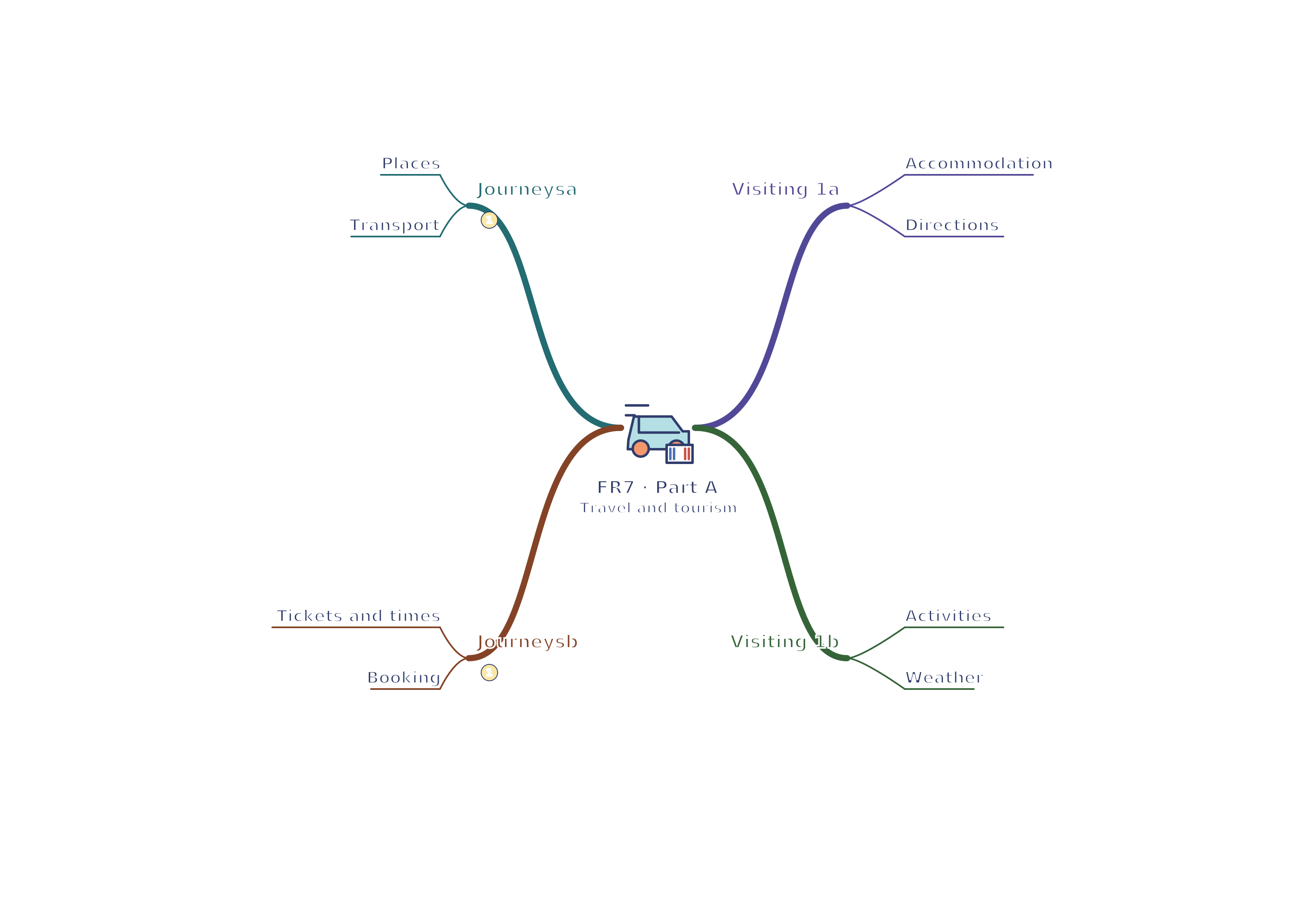
Places — Je vais en France, au Canada, aux États-Unis and à Paris show common country/city patterns. Use en with feminine countries and many masculine countries beginning with a vowel; au with masculine consonant-initial countries; aux for plural countries; à for cities. Learn exceptions with the place name.
Transport — Je voyage en train but je vais à pied or à vélo means I travel by train but go on foot or by bicycle. Do not assume one preposition fits all transport. Partir is leave and arriver arrive; a departure time differs from an arrival time.
Tickets and times — Un aller simple is a single ticket; un aller-retour a return. Le train part à quatorze heures means The train leaves at 14:00. Ask Combien coûte un billet ? for price and De quel quai ? for platform. Check date, route and time together.
Booking — Je voudrais réserver une chambre pour deux nuits means I would like to book a room for two nights. Une chambre double is a double room; avec salle de bains means with a bathroom. Pour indicates intended duration here; confirm number of people as well as nights.
During a visit
Accommodation — Nous logeons dans un hôtel près de la plage means We stay in a hotel near the beach. Dans locates you inside/in a building; près de means near. Une auberge de jeunesse is a youth hostel. Evaluate a specific feature such as location or price.
Directions — Allez tout droit, tournez à gauche, puis traversez la rue means Go straight on, turn left, then cross the road. These are vous imperatives. À droite means to the right; en face de means opposite. Follow the sequence from the stated starting point.
Activities — On visite un musée, on se promène et on prend des photos means We visit a museum, go for a walk and take photos. Visiter takes a place directly; prendre des photos uses prendre, not faire mechanically. Relate the activity to the stated destination.
Weather — Il fait chaud, il pleut and il y a du vent mean It is hot, it is raining and it is windy. Hier, il faisait froid gives past background. Do not translate all weather using il est. Link conditions to a consequence: donc nous restons à l'hôtel.
Requests and problems — La douche ne marche pas means The shower does not work. Pouvez-vous m'aider ? means Can you help me? Explain the actual problem, then request a solution. Polite vous is appropriate with unfamiliar staff. Ne…pas surrounds the conjugated verb.
Recounting and planning
Past travel — Je suis allé/allée en France means I went to France. Aller uses être, and the participle agrees with the subject. Nous avons visité un château uses avoir. Do not choose the auxiliary only because the sentence concerns travel; visiter still uses avoir.
Sequence — D'abord, ensuite, puis and enfin mean first, next, then and finally. Après le déjeuner means after lunch. J'ai perdu mon billet, donc j'ai acheté un autre billet links problem and result. Check that a connective fits the logical order.
Holiday evaluation — L'hôtel était propre, mais la chambre était trop petite means The hotel was clean, but the room was too small. Trop means too/excessively, not simply very. C'était mieux que prévu expresses a positive comparison. Give detail about the feature you evaluate.
Future travel — L'année prochaine, je vais voyager avec mes amis means Next year I am going to travel with my friends. Higher je voyagerai uses the future ending; je voudrais partir expresses a wish. A wish is not a confirmed booking.
Reading and translation — Le départ a été retardé d'une heure means The departure was delayed by one hour. Distinguish the original scheduled time from the actual one. In translation, preserve the delay and direction of change; do not simply copy the first time in the text.
Application — Plan a journey from a fictional timetable, ask for a room, report one problem and recount the trip. Use prices, dates and times consistently. A partner should alter one detail so that you must respond instead of repeating a fixed script.
Checking a reservation — Je voudrais une chambre pour deux personnes du cinq au huit juillet means I would like a room for two people from 5 to 8 July. Le petit déjeuner est compris means Breakfast is included; par personne means per person, par nuit per night. Multiply the correct rate by the actual number of people or nights only when the notice requires it. A quoted price is not automatically the total.
Choosing a place of interest — Une plage, une montagne, un château and un marché are a beach, mountain, castle and market. On peut monter à pied means One can go up on foot. La visite dure une heure means The visit lasts an hour. Compare the activity, time and opening information with the visitor's preferences instead of selecting solely because a place name is familiar.
Shopping and a return — Je voudrais cette taille means I would like this size; c'est trop cher means It is too expensive. J'ai acheté ce pull hier, mais il est trop petit means I bought this jumper yesterday, but it is too small. Je voudrais l'échanger asks to exchange it; un remboursement is a refund. State the product, problem and requested solution in a fictional shop exchange.
Travel disruption — J'ai raté le train means I missed the train; mon train est en retard means My train is late. Le prochain départ est à quinze heures gives the next departure. Un arrêt can mean a stop; une gare is a railway station. Keep the traveller's mistake separate from a delayed service and use the updated departure time when planning onward travel.
Test yourself
30 questions · Random sets of 10. These quick checks support revision; practise longer explanations and justified judgements too.
Mind map
Use the branches to recall the ideas and explain their connections. Check the revision notes for the full detail.
FR7 · 1
View FR7 · 1 mind mapOpen the full-size map to zoom. Use the printable view for A4 landscape or enlarge to A3.
 Mr Kidman's Classroom