 Mr Kidman's Classroom



Revise the key ideas
Nutrition and planning
- A healthy varied diet — A healthy varied diet provides a range of nutrients through different foods over time. The Eatwell Guide groups foods to support balance across the diet, rather than requiring every individual dish to contain exactly the same proportions. Needs and suitable choices differ with age, activity, allergies and other circumstances. Use school-approved nutrition guidance and avoid judging people by body shape or one meal.
- Carbohydrate, protein and fat — Starchy carbohydrates provide energy, protein supports growth and repair and fats provide energy and help several body functions. Foods often supply more than one nutrient: beans contain protein, carbohydrate and fibre. The type and overall balance matter; describing every food as simply 'good' or 'bad' hides quantity, variety and context.
- Vitamins, minerals, fibre and water — Vitamins and minerals support many body processes, fibre supports digestive health and water is needed for normal function. Different foods contribute different combinations, so variety matters. A colourful dish is not proof of complete nutrition, but including varied suitable vegetables and other food groups can broaden contributions. Supplements are not a substitute for learning to prepare balanced food.
- Planning savoury meals — Plan meals that combine suitable starchy foods, vegetables and a protein source, with other components chosen for the overall diet and users. A bean-and-vegetable sauce with pasta can be adapted for taste, cost and availability. Predominantly savoury cooking should form a practical repertoire, not only occasional baking of sweet products. Discuss real dietary requirements through the teacher's arrangements.
- Adapting for users — Consider allergies, intolerances, religious or ethical choices, age, access and preferences before selecting ingredients. A substitute must meet both the user's needs and its job in the recipe, such as helping ingredients hold together. Do not assume a vegetarian ingredient is free from allergens (substances that can trigger an allergic reaction), or that removing a visible garnish removes contamination. Read labels and agree safe arrangements before practical work or tasting.
- Costs, portions and waste — Calculate quantities for the intended number of portions and compare ingredient costs, available equipment and likely waste. A recipe for four using 200 g of an ingredient needs 300 g for six at the same portion size. Scaling does not guarantee identical cooking time, especially if depth or equipment changes. Plan storage and leftovers safely rather than treating unwanted food as automatically reusable.
Sources, seasonality and characteristics
- Where ingredients come from — Ingredients can be grown, reared or caught, then processed and transported. Trace a familiar meal back beyond the shop: flour comes from grain milling, cheese from milk processing and lentils from harvested plants. Processing changes characteristics and storage needs; 'processed' is not one single nutritional category. Use reliable labels and sources instead of guessing origin from a product's brand.
- Seasonality and availability — Seasonality describes when a crop is naturally harvested in a particular place. Imports, protected growing, freezing and storage can extend availability. A strawberry on a winter shelf does not show it was harvested locally outdoors that week. Compare freshness, cost, waste and growing or transport conditions rather than assuming that one label alone establishes the lowest environmental impact.
- Ingredient characteristics — Ingredients contribute flavour, aroma, colour, texture and functional properties. Flour can form structure, a liquid can hydrate (add water to) ingredients and an egg can bind (help them hold together) in suitable recipes. The same ingredient behaves differently with quantities, temperature and method. Choose an ingredient for the dish's purpose and user rather than substituting solely because two foods have a similar colour.
- Reading and adapting recipes — Read the complete method before starting, identify preparation and cooking tasks and check quantities and equipment. Change one relevant feature deliberately, such as adding a suitable vegetable or adjusting seasoning, then evaluate the effect. Record a successful adaptation so it can be repeated. An original recipe still needs safe methods, appropriate ingredients and a practical sequence.
Hygiene and safe organisation
- Personal and kitchen hygiene — Wash hands appropriately, tie back hair and follow the school's clothing and hygiene rules. Clean work areas and equipment before use and after contamination risks. Illness, cuts and other concerns should be reported through the teacher's arrangements. A surface looking clean does not establish that it is free from harmful microorganisms or allergen residues.
- Cross-contamination — Harmful microorganisms or allergens can move through hands, utensils, surfaces or food. Keep raw ingredients needing cooking separate from ready-to-eat foods, using the school's designated equipment and cleaning methods. Washing raw poultry can spread contamination and is not a safety step. Never taste raw mixtures or ingredients simply to check whether contamination is present.
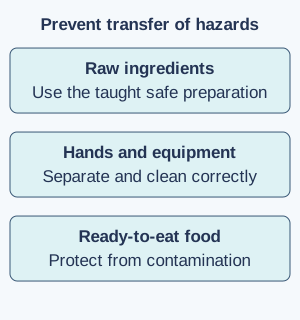
Hands, utensils and surfaces can transfer hazards from raw food to ready-to-eat food. Follow taught separation and cleaning procedures; this diagram is not a complete hygiene protocol. Full-size diagram - Storage and date labels — Follow storage instructions, use-by dates and the school's refrigeration procedures. A use-by date concerns safety, while a best-before date mainly concerns quality; neither removes the need for correct storage. Smell alone cannot establish safety. Food requiring refrigeration should not be left out unnecessarily, and leftovers need the teacher-approved cooling, storage and reheating procedure.
- Knives, heat and equipment — Use knives, hobs, ovens and electrical equipment only with the required instruction and supervision. Secure the chopping board, use the taught safe grip and keep handles and work areas organised. Protect against burns and steam using the correct equipment. Stop and ask if a tool or arrangement is uncertain; a text summary is not a substitute for practical induction.
- Time plans and sequencing — Plan tasks so ingredients, equipment and safe working space are ready when needed. Some processes can occur in parallel, such as a supervised sauce simmering while vegetables are prepared, but attention and hygiene limits matter. Include cleaning and a safe finish, not just cooking time. An efficient plan reduces waiting without encouraging rushed cutting or unattended equipment.
Cooking techniques and a practical repertoire
- Weighing and measuring — Use suitable scales and measuring equipment with the correct units, zeroing or taring when appropriate. Taring resets a scale to zero with the empty container on it, so the container is not counted as ingredient mass. Measure liquids at the relevant level and distinguish mass from volume. A spoon from the cutlery drawer is not automatically an accurate measuring spoon. Precision is important for recipes whose structure depends on ratios, while some savoury seasoning can be adjusted carefully during safe cooking.
Grams measure mass; millilitres measure volume, the space a liquid takes up. They are not interchangeable units for every ingredient.
- Cutting and preparation — Practise teacher-taught methods for peeling, slicing, dicing and preparing suitable ingredients. Similar-sized pieces can cook more evenly, but the desired shape depends on the dish and cooking time. Plan preparation to preserve edible yield and separate waste appropriately. Knife competence is demonstrated in a supervised kitchen, not by correctly naming a cut in a quiz.
- Heat transfer and cooking methods — Boiling and simmering use hot liquid, steaming uses steam, baking or roasting uses hot oven conditions and frying uses a hot pan with suitable fat. Heat reaches food through combinations of conduction, convection and radiation. Choose a method for the ingredient and result; a vigorous boil is not automatically quicker or better for a delicate sauce.
Conduction transfers energy through a material, such as through a pan. Convection carries energy with moving hot liquid or air. Radiation transfers energy by waves, such as infrared from a hot grill element. Actual cooking methods can combine them.
- Checking safe cooking — Follow the recipe, equipment instructions and teacher's food-safety procedure. For suitable foods, official guidance gives a core temperature of 70°C for two minutes or a verified equivalent time-temperature combination. Use a cleaned suitable probe as instructed; appearance or smell alone is not a universal safety test. Different foods and processes need their relevant guidance, so do not invent one visual rule for everything.
- Vegetable soup or sauce — A practical vegetable soup or sauce develops preparation, controlled heating and seasoning. Prepare suitable similar-sized pieces, follow the approved method, manage liquid and heat, and check texture and safe cooking. Blending requires the equipment's safe hot-liquid procedure. Compare a clear recipe goal, such as tenderness and consistency, rather than claiming every soup needs the same texture.
- Pasta, grains and accompaniments — Cooking pasta or a suitable grain develops accurate quantities, controlled heating and safe draining. Follow the particular ingredient's instructions because water needs and times vary. Combine it with an appropriate savoury sauce or protein source to meet the meal plan. Cooked rice needs particular care with cooling and storage; follow the school's specific procedure rather than assuming all leftovers are treated alike.
- Savoury baking and dough — A suitable savoury scone, bread or pastry task develops measuring, mixing, shaping and oven management. The process depends on the recipe: bread dough may develop gluten through kneading, while some pastry needs limited handling. Explain the intended texture and how method affects it. Follow allergy arrangements and cooking instructions; a browned surface does not alone establish every product is safely cooked inside.
Kneading means working a dough. In suitable wheat dough, it can help develop gluten, a stretchy network of proteins. Do not assume every flour, recipe or dietary substitute behaves the same way.
- Protein-containing dishes — A bean dish, egg dish or other suitable protein-based meal can develop combining ingredients and controlling heat. Choose approved recipes that match dietary requirements and available equipment. Raw animal ingredients require their specific hygiene and cooking controls; do not taste partially cooked mixtures. Plant-based alternatives also need safe handling, storage and relevant cooking instructions.
- Seasoning and sensory judgement — Taste, aroma and texture help evaluate food quality when tasting is safe and authorised. Add seasonings in controlled amounts and record changes, considering salt and the user's preferences. Sensory judgement cannot replace safety checks or override an allergy arrangement. A dish can be safe yet too salty, or look appealing yet be unsafe; quality and safety are related but distinct judgements.
Evaluating and developing cooking
- Fair sensory evaluation — Evaluate appearance, aroma, flavour and texture against the intended dish and user needs. Use agreed descriptive terms and record different responses without pressure to taste. When comparing versions, keep relevant serving conditions consistent. 'Nice' is less useful than identifying that a sauce is too thin for its intended use and explaining a possible cause.
- Improving a recipe — Use practical evidence to propose a justified change in ingredient, quantity or method, then test it safely. Adding vegetables may alter water content and cooking time as well as nutrition and flavour. Explain the trade-offs and keep a record of the revised method. One successful dish is a useful step towards a repertoire, not evidence of competence in every cooking technique.


