Reading the play — A Midsummer Night’s Dream is a Shakespeare comedy set in Athens and a nearby forest. Read the complete play with a suitable edition: a summary supports orientation but cannot replace its language, changing relationships and performance possibilities.
The court — Theseus, Duke of Athens, is preparing to marry Hippolyta. The court presents public authority and expectations about marriage. Its apparently orderly setting contrasts with the forest, but the opening also reveals conflict and unequal power.
Hermia's choice — Hermia loves Lysander, but her father Egeus wants her to marry Demetrius. Theseus initially supports Egeus and says that refusing could mean death or a life without marriage in religious seclusion. These threats make her choice dangerous. Her resistance sets personal choice against the obedience demanded by her father and ruler.
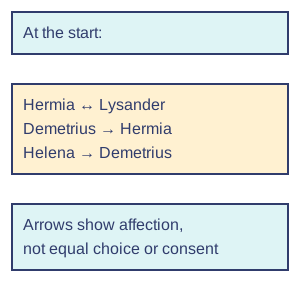
The initial love pattern — Lysander and Hermia love each other. Demetrius also wants Hermia, while Helena loves Demetrius. Keep this starting pattern clear before tracking the magic; otherwise later changes can appear arbitrary.The initial love relationships. Original illustrative model. Full-size diagram
Helena's decision — Helena tells Demetrius about Hermia and Lysander's plan to leave Athens, hoping to gain his favour. Her choice helps bring all four lovers to the forest. Explain her motive without assuming it makes the decision wise.
The mechanicals — A group of tradespeople, often called the mechanicals, prepares Pyramus and Thisbe for the wedding celebrations. Peter Quince organises the play and Bottom takes the role of Pyramus. Their theatrical ambitions create another plot strand.
Fairy conflict — Oberon wants the child in Titania’s care to join his followers, but Titania refuses to give him up. Their quarrel therefore concerns care, loyalty and who has the power to decide. The forest has its own struggles for control; it is not simply a free place outside the court’s rules. Use their speeches to explain each position.
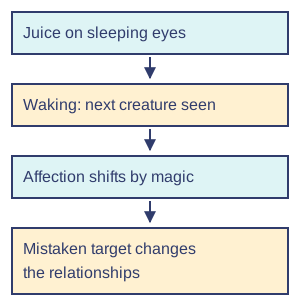
Puck and the flower — Puck, also called Robin Goodfellow, serves Oberon. The flower's juice makes a sleeper love the next creature seen on waking. Track who applies it, to whom, and who is first seen; the same mechanism produces different consequences.A sequence causing mistaken love. Original illustrative model. Full-size diagram
The mistaken Athenian — Puck puts the juice on Lysander's eyes instead of Demetrius's. Lysander wakes and sees Helena, so his affection changes. Helena interprets his declarations as mockery because she does not know the magical cause.
The lovers' quarrel — After Demetrius is enchanted too, both men pursue Helena. She thinks they are conspiring to mock her, while Hermia feels rejected. The scene turns friendship and desire into conflict through misunderstandings and unequal knowledge.
Bottom's transformation — Puck changes Bottom’s head into an ass’s head: an ass is a donkey. Titania, already enchanted, wakes and falls in love with him. The audience sees a mismatch she does not notice, creating comedy. The scene also raises questions about power because Oberon has arranged the enchantment and changed what Titania wants.
Restoring order — Lysander’s enchantment is removed and he loves Hermia again. Demetrius stays enchanted and loves Helena. Theseus allows both couples to marry despite Egeus’s objection. The ending settles the immediate dispute but leaves a question about consent: freely choosing and agreeing. Is Demetrius’s love freely chosen when magic still controls it? Support your view with the play.
The final entertainment — The mechanicals perform Pyramus and Thisbe for the married couples. Their tragedy becomes comic through performance choices, explanations and interruptions. Notice the effort of the players as well as the reactions of the powerful spectators.
Puck's epilogue — Puck addresses the audience and suggests imagining the events as a dream. This crosses the boundary between the fictional world and the actual performance. Consider whether it excuses confusion, invites participation or keeps uncertainty alive.
Language and dramatic form
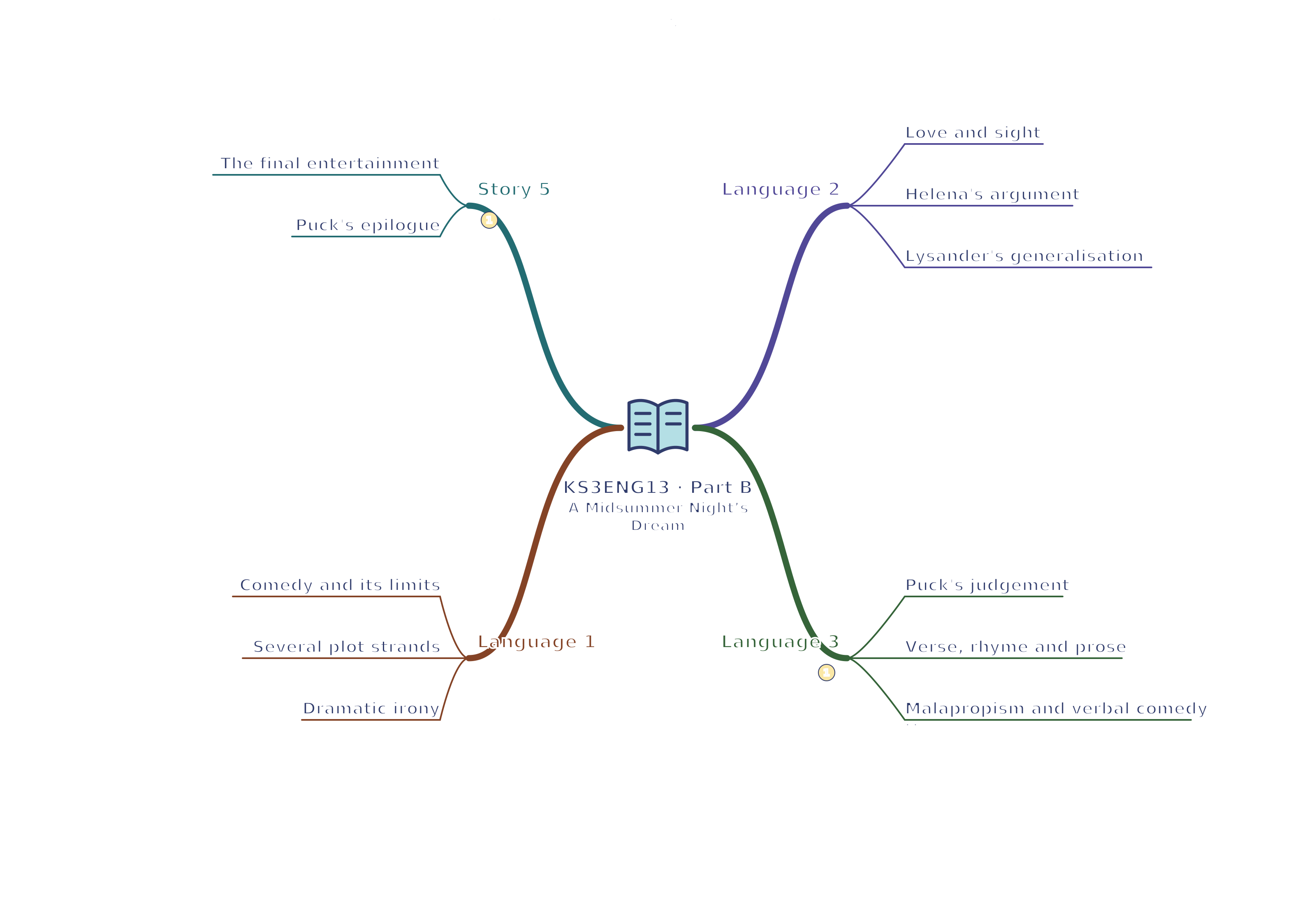
Comedy and its limits — Comedy here includes mistaken identities or intentions, reversals and a marriage ending. It does not mean every moment is harmless or every character is happy throughout. Discuss threats and humiliation alongside the comic resolution.
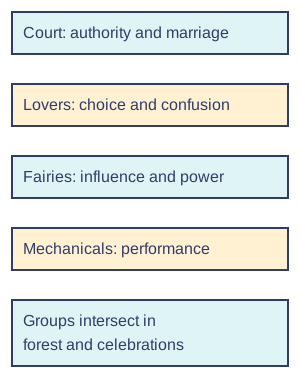
Several plot strands — Court, lovers, fairies and mechanicals begin as distinct groups whose actions intersect. Trace a connection rather than summarising each group separately. The forest allows encounters that disrupt the initial social arrangement.Interacting dramatic groups. Original illustrative model. Full-size diagram
Dramatic irony — The audience knows about the magic while characters often invent other explanations. Helena's belief that declarations of love are insults becomes understandable from her limited knowledge. Explain both the comedy and the potential pain of that gap.
Love and sight — Repeated attention to eyes, seeing and mistaken perception links love with unreliable judgement. Look at how a particular image works in a speech, rather than claiming Shakespeare proves that all love is false.
Helena's argument — In Act 1, scene 1, Helena says, “Love looks not with the eyes but with the mind”. She reflects on love overlooking appearance and sensible judgement while she herself longs for Demetrius. The contrast between eyes and mind helps explain her thinking. Read the whole speech: one line alone cannot capture her disappointment or the argument she develops.
Lysander's generalisation — In Act 1, scene 1, Lysander says “The course of true love never did run smooth”. The image presents love as a difficult route and consoles Hermia. It is a character's generalisation in context, not an objective rule about every relationship.
Puck's judgement — In Act 3, scene 2, Puck calls mortals fools. His comment invites distance from the lovers' confusion, but he has helped create it. Consider the gap between amused observation and responsibility for events.
Verse, rhyme and prose — Verse is arranged in poetic lines and often has a pattern of beats; prose follows ordinary continuous sentences. Shakespeare uses both, and verse need not rhyme. In this play, rhyme can mark spells or patterned exchanges, while prose contributes to the mechanicals’ conversations. Examine the particular speech: social rank alone does not determine which form every character uses.
Malapropism and verbal comedy — A malapropism uses a similar-sounding word where another word is intended. In this invented example, someone says “He is very extinguished” when they mean distinguished, meaning respected or admired: the mistaken grand word undermines the attempt to sound impressive. Look for the same kind of mismatch in the mechanicals’ speech and check the intended word. Unusual wording alone is not a malapropism.
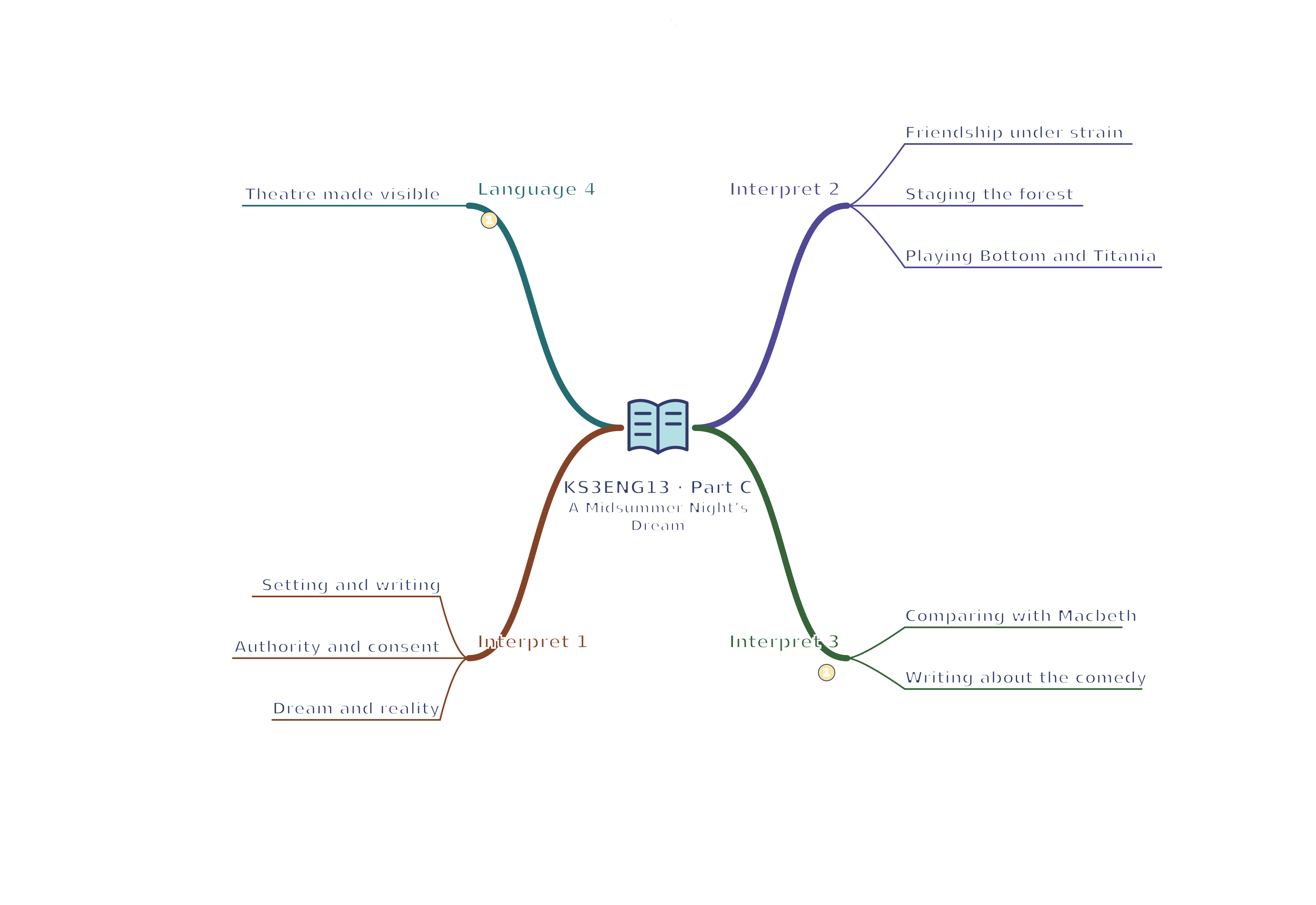
Theatre made visible — In Pyramus and Thisbe, actors play a wall, moonshine and a lion and explain what they represent. The audience can see real performers making a pretend world, which creates comedy when the explanations interrupt the story. Compare this visible play-making with the fairy magic: how does each ask the audience to imagine things that are not really on stage?
Context and interpretation
Setting and writing — The story draws on an imagined classical Athens but was written for an early modern English stage. Distinguish setting, writing context and modern production. Athenian rules within the play are not a complete historical account of real ancient law.
Authority and consent — Compare Egeus's demand, Theseus's changing decision and Oberon's use of enchantment. Ask whose desires count and who can alter another person's choices. A marriage ending does not erase every question about power.
Dream and reality — Characters struggle to explain their forest experiences afterwards. Dreams can frame uncertainty about perception and memory. Do not assume every event literally took place only in one character's dream; the play permits different interpretations.
Friendship under strain — Hermia and Helena's shared history makes their quarrel more painful. Analyse how accusations and remembered closeness interact. Avoid describing their conflict as a natural trait of all women or reducing it to jealousy alone.
Staging the forest — Lighting, sound, movement and spatial levels can distinguish the forest from the court. Choose effects that support the relationships and language. Elaborate scenery is optional; actors' behaviour can establish transformation and uncertainty.
Playing Bottom and Titania — A production can emphasise absurdity, tenderness, domination or a mixture in their encounter. Support choices with words, action and audience knowledge. A comic role still needs a coherent objective rather than random clowning.
Comparing with Macbeth — Both plays involve supernatural influence and uncertain perception, but their genres and outcomes differ. Compare a specific scene or method rather than assuming fairies and witches perform identical roles. Ask how characters respond to influence and what choices follow.
Writing about the comedy — Develop a supported interpretation using brief scene evidence, accurate terminology and explanation of performance possibilities. Plot knowledge helps locate the evidence. Analyse how humour is made and whose perspective it depends on, not simply whether you found it funny.
Test yourself
50 questions · Random sets of 10. These quick checks support revision; practise longer explanations and justified judgements too.
Mind map
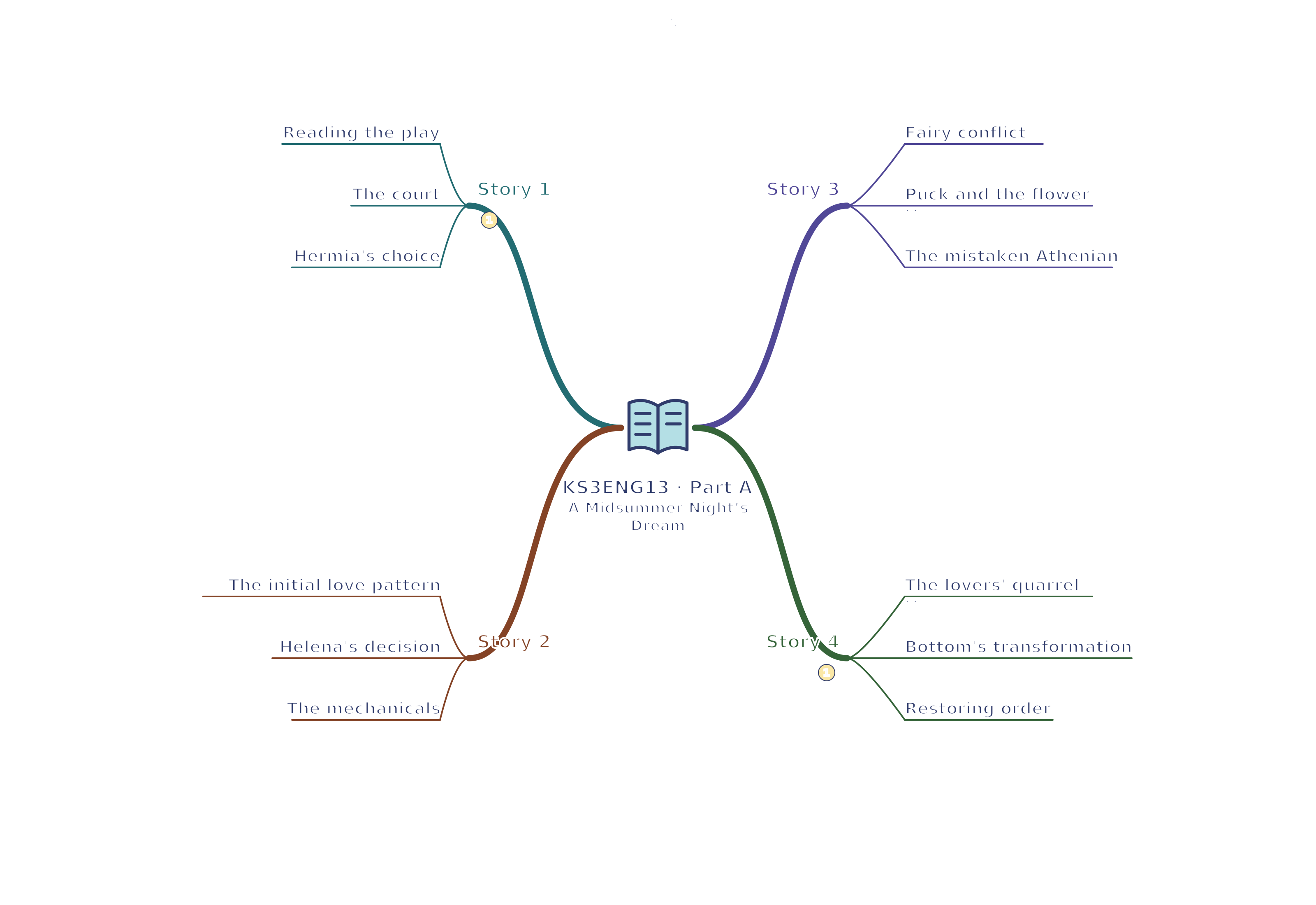
Use the branches to recall the ideas and explain their connections. Check the revision notes for the full detail.
KS3ENG13 · 1
View KS3ENG13 · 1 mind mapOpen the full-size map to zoom. Use the printable view for A4 landscape or enlarge to A3.
 Mr Kidman's Classroom