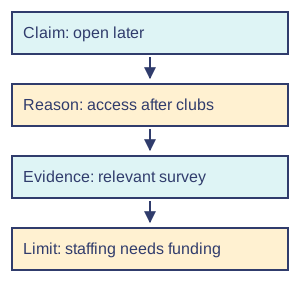
An arguable claim — A claim is a position that needs support, such as whether a school library should open later. Make its scope clear. “Libraries are good” is too broad to organise a focused argument about one practical proposal.
Reasons and evidence — A reason explains why a claim should be accepted; evidence supports the reason. “Later opening helps pupils without quiet study space” is a reason. Relevant survey responses may support it, provided their source and limitations are clear.Reasoning supporting a proposal. Original illustrative model. Full-size diagram
Examples and representativeness — One person’s experience can illustrate a reason but may not show what usually happens. “My friend studies better in the library” is an anecdote: a short account of one experience. Before claiming that most pupils benefit, seek evidence from a wider, fairly chosen group. Explain who was included and who may be missing.
Counterarguments — A counterargument raises a reasonable objection or alternative view. Present it fairly before responding. “Opponents hate reading” attacks people instead of considering a concern such as staffing costs.
Rebuttal and concession — A rebuttal answers an objection with reasons or evidence. A concession accepts a valid part: later opening could help, but staffing must be funded. A qualified conclusion can be more convincing than denying every difficulty.
Persuasive devices — Rhetorical questions, repetition and direct address can emphasise a case, but cannot substitute for sound reasons. Select devices for a specific audience rather than aiming to include every device in a checklist.
Emotive language — Words such as neglected or thriving can encourage a judgement. Use them responsibly and explain the situation. Strong feeling does not establish factual accuracy; manipulative exaggeration can undermine credibility.
Logical connections — Use because for a reason, therefore for a consequence and however for a contrast only when that relationship exists. A connective cannot repair a missing logical step. Read the claim without the connective to test the reasoning.
Exposition and analysis
Expository writing — Expository writing develops an explanation or account of a subject. Establish a clear focus, organise material and explain relevant relationships. It may include different viewpoints without campaigning for one outcome.
Cause and correlation — Correlation means two things show a pattern together; it does not prove one causes the other. In an invented example, ice-cream sales and visits to the park rise on hot days. Buying ice cream need not cause park visits: warm weather may increase both. Look for evidence of how a cause produces an effect before claiming it is proved.
Essay questions — Identify the topic, task word and scope. “How does the writer present conflict in this scene?” asks about methods in a specified passage, not every event in the play. Keep the question visible while planning and drafting.
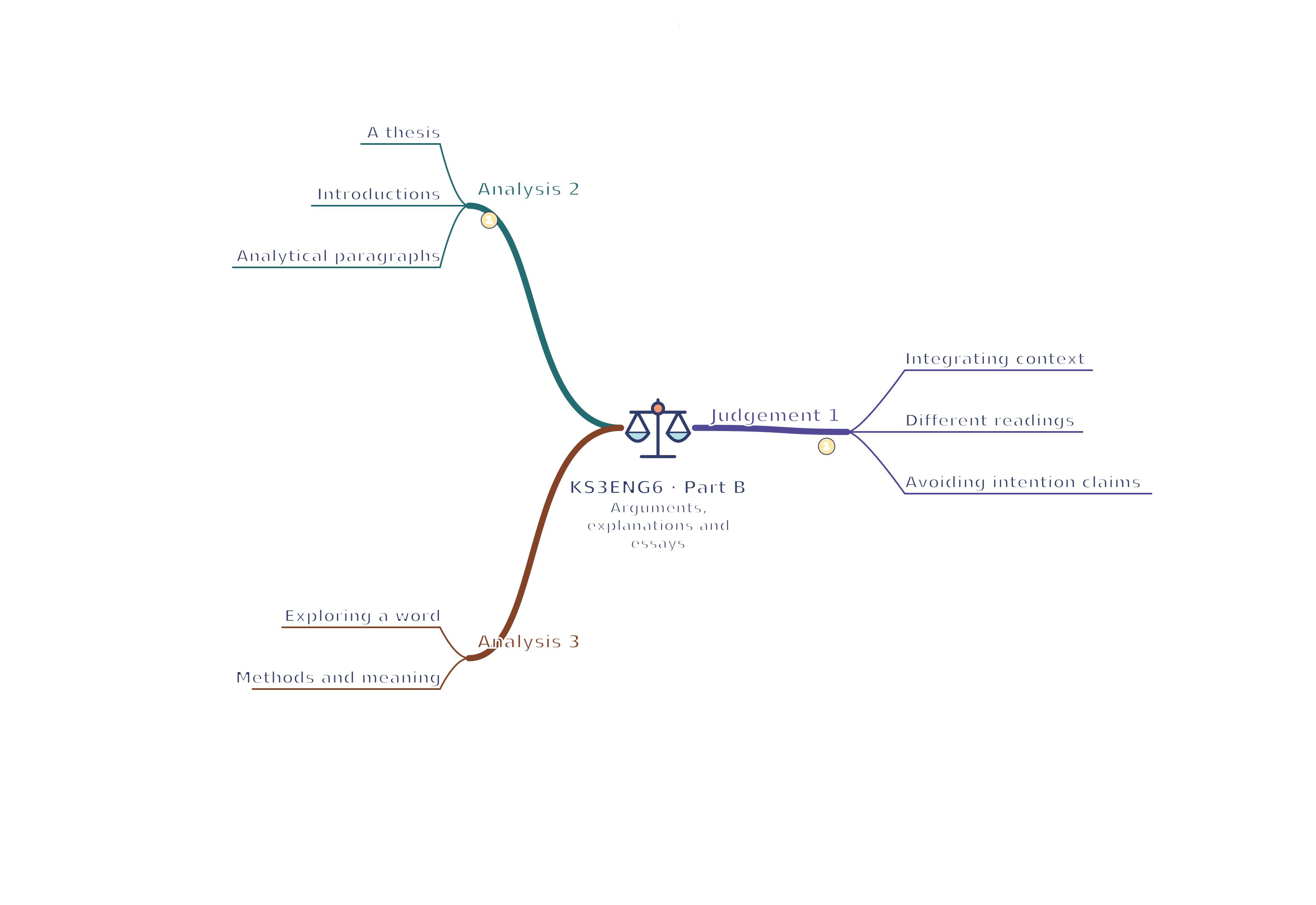
A thesis — A thesis is the central argument or interpretation your essay develops. For example: “Hermia’s conflict is both public and personal: the court supports her father, but she wants to choose whom to marry.” The following paragraphs would need evidence for both parts. Choose a claim that answers the question and can be supported, rather than a broad statement about the whole play.
Introductions — Introduce the focus and direction of the response without retelling the entire plot. A useful introduction gives a reader a reason to follow the argument. Avoid empty promises such as “In this essay I will use many techniques”.
Analytical paragraphs — Develop a point, select evidence and explain how particular choices support the interpretation. Then relate the discussion to the question or wider argument. A paragraph acronym can prompt thinking, but does not guarantee analysis.From evidence to interpretation. Original illustrative model. Full-size diagram
Exploring a word — Select a word central to the point, consider its associations or grammatical role and explain the contribution in context. Avoid listing possible dictionary meanings that do not fit the passage.
Methods and meaning — A method label is useful when accurate, but explanation matters more. Showing how a repeated question reveals uncertainty is stronger than naming “rhetorical question” incorrectly. Technical vocabulary should clarify thinking.
Judgement and development
Integrating context — Contextual knowledge is background that helps explain the text. In A Midsummer Night’s Dream, Hermia’s father wants to choose her husband and the duke initially supports him. That authority helps explain why refusing the marriage is difficult for her. Link the background to words and actions in the scene; unrelated facts about Shakespeare’s life do not explain this conflict.
Different readings — Acknowledge a supported alternative where it sharpens your argument. Explain why your reading fits particular details better or how both can coexist. Qualification is not indecision when the text is complex.
Avoiding intention claims — A text can present an effect without proving what its author privately intended. “The contrast emphasises division” is usually more defensible than “Shakespeare definitely wanted every person to feel…”.
Developing an argument — Order paragraphs so each adds something: establish the conflict, examine its consequences, then evaluate a turning point. Repeating the thesis with a new quotation is not necessarily development.
Worked Macbeth claim — In Macbeth, Act 1, scene 6, Duncan arrives at Macbeth’s castle unaware of the plan to kill him. A possible claim is: “The welcome seems threatening to the audience because we know the hosts are hiding a murder plan, while Duncan trusts them.” This explains dramatic irony: audience and character know different things. Add precise scene evidence to develop the claim.
Conclusions — Return to the question and draw together the reasoning. Explain what the combined evidence shows, with a qualification if necessary. Do not simply repeat the introduction word for word or introduce unexamined evidence.
Editing for reasoning — Check whether every paragraph has a defensible point, appropriate evidence and explanation. Remove unsupported generalisations and make missing steps explicit before correcting surface errors. A polished sentence can still express a weak argument.
Independence and attribution — Use model responses to learn approaches, then select and explain evidence yourself. A memorised paragraph may not answer a new question. Credit borrowed ideas and distinguish an original interpretation from copied wording.
Test yourself
50 questions · Random sets of 10. These quick checks support revision; practise longer explanations and justified judgements too.
Mind map
Use the branches to recall the ideas and explain their connections. Check the revision notes for the full detail.
KS3ENG6 · 1
View KS3ENG6 · 1 mind mapOpen the full-size map to zoom. Use the printable view for A4 landscape or enlarge to A3.
 Mr Kidman's Classroom