Punctuation and meaning — Punctuation marks grammatical relationships and helps a reader interpret a text. It is not simply a record of where a speaker breathes. Start by finding clauses and phrases, then choose marks that show their relationships.
Capital letters — Use capitals for sentence openings, the pronoun I and proper names such as Athens. Do not capitalise every important noun in ordinary prose. Title conventions vary, so follow the task or chosen publication style consistently.
Full stops — A full stop normally closes a statement or command sentence. Check that the sentence is complete rather than a dependent clause: “Although the street was quiet” normally needs a main clause in formal prose.
Comma splices — A comma alone normally cannot join independent main clauses in formal writing: “The door opened, she entered.” Use a full stop, a semicolon or a suitable conjunction. Choose a repair that expresses the intended relationship.Repairing a comma splice. Original illustrative model. Full-size diagram
Commas in lists — Separate items clearly: “pens, paper and folders”. When list items are more complex, additional punctuation may help avoid ambiguity. A comma before the final and can be a style choice; clarity is the priority.
Fronted adverbials — A comma often follows an introductory adverbial, especially a subordinate clause: “When the bell rang, we left.” Short introductory phrases do not always need a comma. Use the construction and clarity rather than a rule that every opening word needs one.
Parenthetical information — Paired commas can enclose extra information: “Puck, who knows the plan, waits.” Removing who knows the plan leaves the main message. Compare “The actor who plays Puck waits”: who plays Puck identifies which actor, so it is not separated by commas. When you open a parenthetical interruption, check that you also close it where needed.
Avoiding stray commas — Do not separate a subject from its verb with a stray comma: “The students beside the door, were waiting.” The long subject still belongs with were. Parenthetical commas work as a pair around an inserted unit, not as random pauses.
Possession and speech
Apostrophes for omission — An apostrophe marks omitted letters in contractions: do not becomes don't; it is becomes it's. Use contractions when they suit the register. An apostrophe does not automatically make a word possessive.
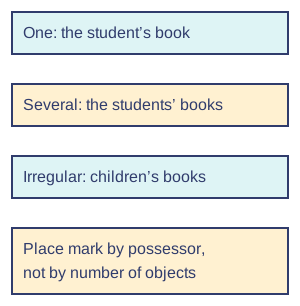
Singular possession — For a singular possessor, normally add apostrophe-s: “the student's book”. Establish who owns or is associated with what before placing the mark. Style choices for names ending in s vary; remain consistent.
Plural possession — A regular plural ending in s takes an apostrophe after the s: “the students' books”. An irregular plural takes apostrophe-s: “the children's books”. The position reflects the possessor, not how many objects are possessed.Apostrophe placement. Original illustrative model. Full-size diagram
Its and it's — Its is possessive: “The theatre changed its programme.” It's means it is or it has: “It's begun.” Expand the contraction to check. Possessive pronouns such as yours and theirs also have no apostrophe.
Plural forms — Ordinary plurals do not take apostrophes: books, tickets, DVDs. An apostrophe is not a general sign that a word ends in s. Distinguish plural number from possession before editing.
Direct speech — Quotation marks enclose a speaker's exact words. In a common style: “Wait here,” she said. Place the comma before the closing quotation mark when the speech leads into a reporting clause. Check your chosen style consistently.Speech and reporting clause. Original illustrative model. Full-size diagram
Questions inside speech — Write “Are you ready?” she asked. The question mark belongs to the spoken question; a second full stop is not added before the closing quotation mark. The reporting clause continues with a lower-case she.
New speakers — Start a new paragraph when the speaker changes in prose dialogue. Separate an action sentence from a reporting clause: “Wait.” She closed the gate. Closed is an action, not a verb meaning said.
Direct and reported speech — Direct speech gives the words as spoken; reported speech represents their content: She said that she was ready. Reported speech normally has no speech marks around the paraphrase. Pronouns and time expressions may need adjustment.
Other punctuation choices
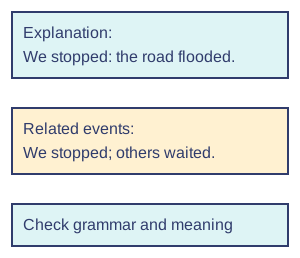
Colons — A colon can introduce an explanation or list after a complete introductory clause: “We needed three things: time, space and trust.” Avoid separating a verb from its object with an unnecessary colon, as in “We needed: time”.
Semicolons — A semicolon can join closely related independent clauses: “The gates were locked; nobody could enter.” Both sides must work as main clauses in this use. It can also separate complex list items that already contain commas.Two different clause relationships. Original illustrative model. Full-size diagram
Dashes and brackets — Paired dashes or brackets can enclose extra information: “Puck — still smiling — left” or “Puck (still smiling) left.” A single dash can add an emphatic ending: “Only one person remained — Puck.” Choose the mark that fits the meaning and style, and keep added information relevant. Check that paired marks close where they should.
Hyphens — Hyphens can join parts of compound expressions and clarify meaning, as in “a well-known story”. Usage varies by expression, so check a dictionary where uncertain. A hyphen joins within an expression; a dash separates larger units.
Ellipses — An ellipsis can show an omission in quotation or a trailing-off voice in creative writing. In quotation, preserve the source's meaning. Repeated ellipses do not automatically create suspense and can obscure sentence boundaries.
Question and exclamation marks — A question mark marks a direct question. Exclamation marks can signal force or feeling, but do not turn any sentence into the grammatical exclamation form. Repeating marks is usually unsuitable for formal writing.
Worked punctuation choice — “Hermia waited: the message had not arrived” uses a colon to explain the situation. “Hermia waited; Puck hurried home” links related events. “Hermia waited, because…” requires a complete reason clause. Choose according to grammar and intended meaning.
Proofreading punctuation — Find sentence boundaries first, then check paired marks, speech and apostrophes. Do not add sophisticated punctuation to every sentence. Accurate simple choices are more useful than a collection of misused marks.
Test yourself
50 questions · Random sets of 10. These quick checks support revision; practise longer explanations and justified judgements too.
Mind map
Use the branches to recall the ideas and explain their connections. Check the revision notes for the full detail.
KS3ENG9 · 1
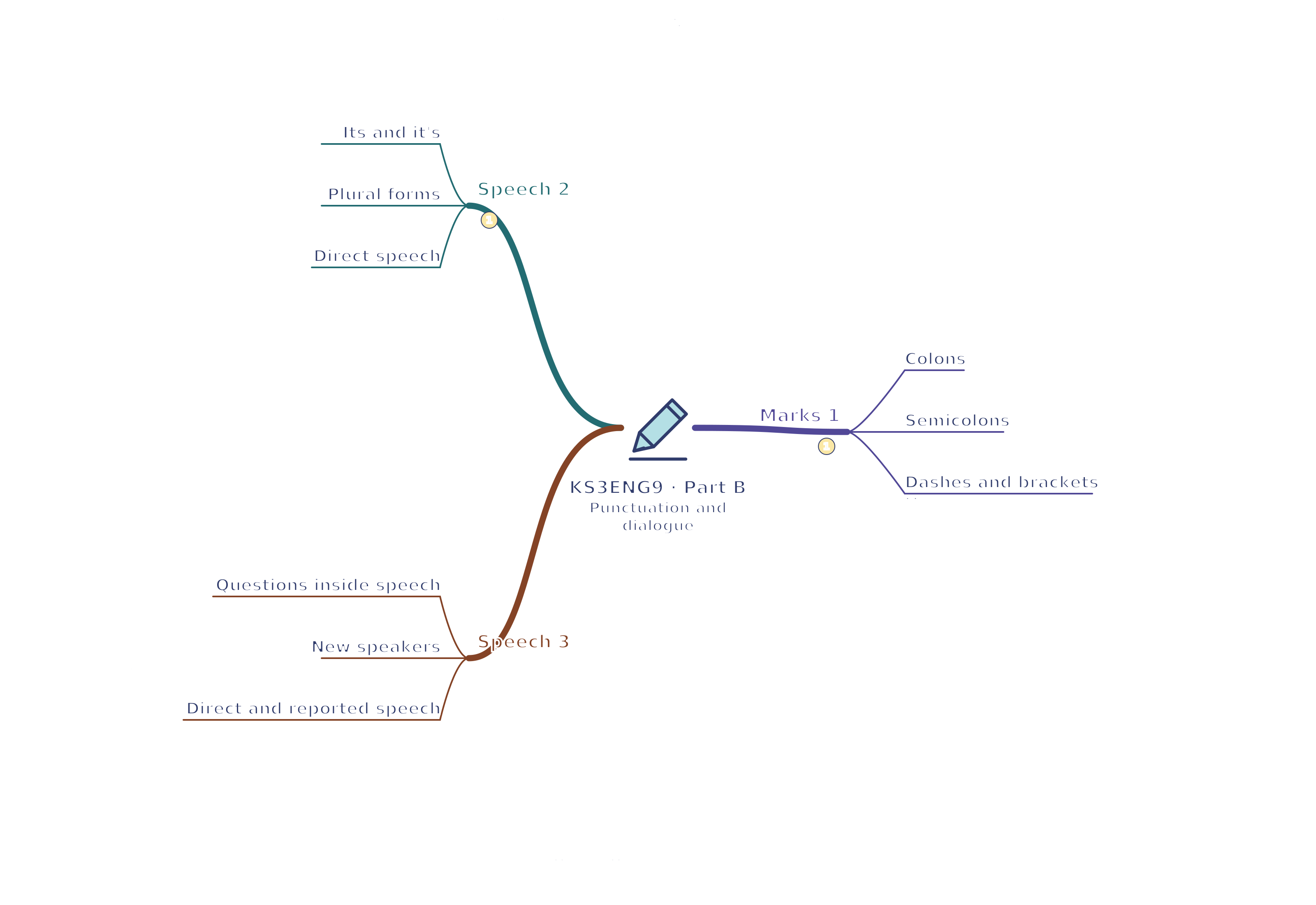
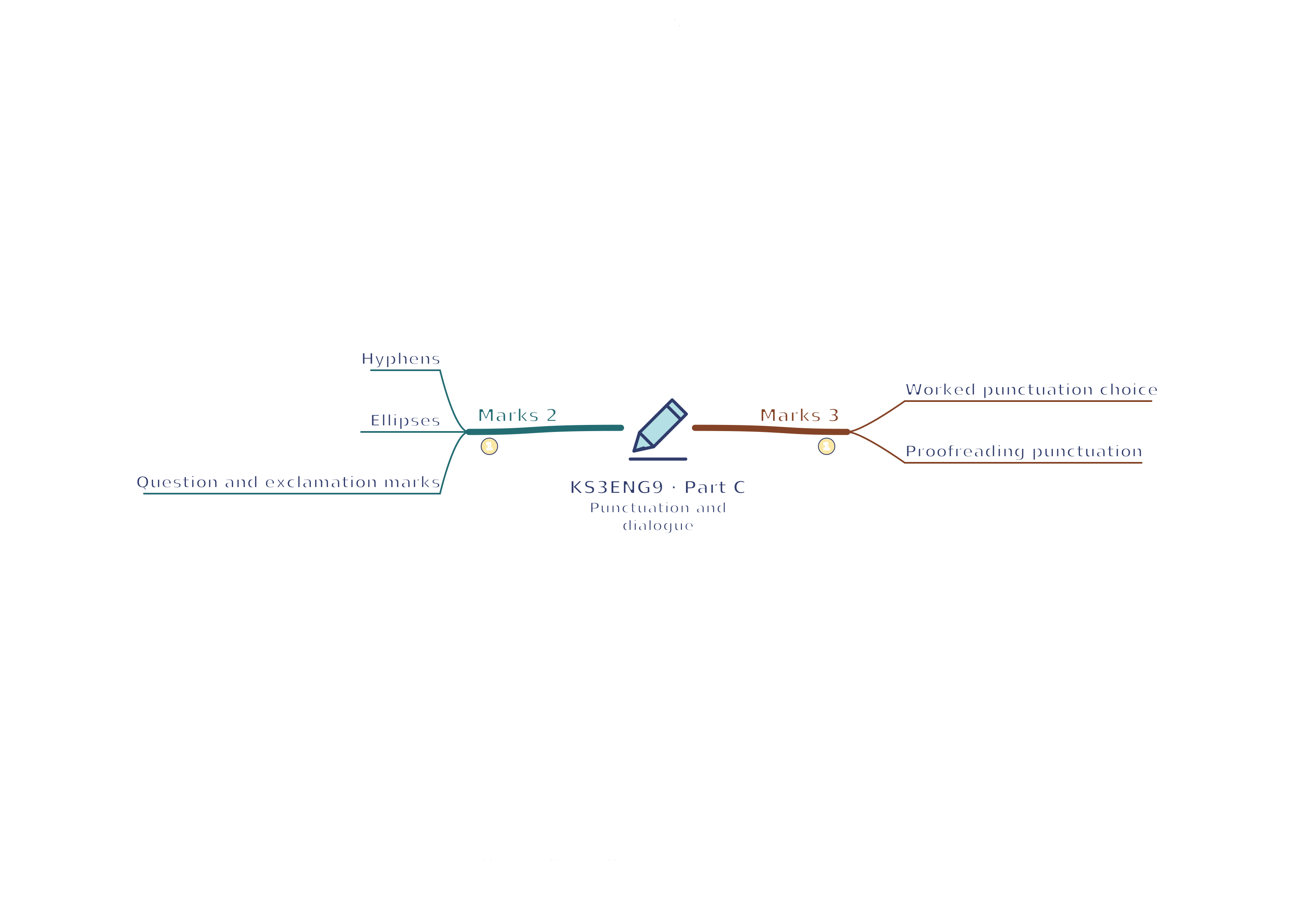
View KS3ENG9 · 1 mind mapOpen the full-size map to zoom. Use the printable view for A4 landscape or enlarge to A3.
 Mr Kidman's Classroom