Development as a varied process — International development concerns changes in people's opportunities and well-being, including income, health, education and security. It is not one fixed ladder followed identically by every society. Countries contain internal inequalities and links to wider systems. Describe a measured dimension and timescale rather than treating 'developed' as a judgement of a person's worth or culture.
Measuring and comparing — Income per person, life expectancy, education and access to services reveal different aspects of development. An average can conceal unequal distribution and missing data. Compare dates, definitions and purchasing conditions, and use several indicators before drawing a conclusion. A country's income category is not a description of every household and can change over time.
Inequality and interdependence — People's opportunities differ within countries as well as between them. Historical relationships, trade, investment, institutions, conflict and physical conditions can interact over time. Avoid explaining a region's outcomes only through climate or individual effort. Follow evidence about particular connections and acknowledge that several causes can contribute without being equally important everywhere.
Development strategies — Education, healthcare, infrastructure, enterprise, fair access and environmental protection can support development in different ways. Aid provides support such as money, equipment or expertise. Trade involves buying and selling goods or services. Investment puts resources into activities such as businesses or infrastructure in the hope of future benefits. They work in different ways and under different conditions. Evaluate effectiveness, local participation, maintenance and possible dependencies rather than assuming every external project helps automatically. A strategy should be judged against stated outcomes and the views of affected people.
Economic sectors and changing work
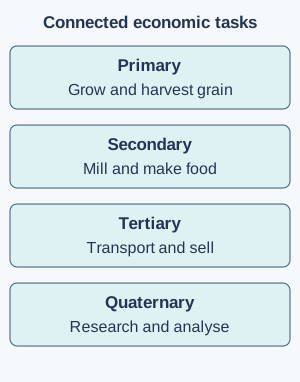
Primary activity — Primary economic activity obtains resources directly from land or sea, including farming, fishing, forestry and mining. These activities depend on natural systems and also alter them. A fishing port may be connected to processing, transport and research elsewhere. Classify the task rather than assuming an entire country belongs to just one sector.
Secondary activity — Secondary activity processes materials or manufactures products, such as milling grain, making clothes or assembling equipment. It relies on energy, labour, inputs and transport, while producing waste and other effects. A factory's location may reflect several historical and economic factors, not just distance from raw materials. Consider working conditions and wider supply chains.
Tertiary and quaternary activity — Tertiary activity provides services such as retail, transport and healthcare. Quaternary activity focuses on knowledge and information services such as research and some data analysis. Boundaries can be blurred, so explain the actual task and classification used. A complex product links all sectors; a designer does not personally extract every material or transport every finished item.
Trade and supply chains — A supply chain links extraction or farming, processing, manufacture, distribution, sale and use across places. Trade can create income and access to goods while exposing workers and communities to changing demand or unequal power. Trace a particular product using reliable evidence and distinguish who receives value at different stages rather than assuming all participants benefit equally.A conceptual grain-to-food chain links resource production, processing, distribution and information work. Real roles and sector boundaries can overlap; benefits are not automatically equally distributed. Full-size diagram
Changing economic patterns — Technology, transport, policy, education and demand can change where work occurs and which skills are needed. Deindustrialisation, a decline in the role of manufacturing industry in an economy, in one place can coincide with manufacturing growth elsewhere. A national sector share does not capture every local experience. Use dated evidence and explain changes at more than one scale, including effects on communities and environments.
Natural resources and systems
Resources, scarcity and access — Resources include water, food, energy, minerals, soils and living systems used to meet needs. Scarcity can concern physical availability or a lack of reliable affordable access through infrastructure and institutions. A place with rainfall can still have unsafe water services. Distinguish supply, demand, distribution and quality when explaining a resource problem.
Renewable and non-renewable resources — Renewable resources can be replenished on relevant timescales if systems are managed appropriately; non-renewable stocks form too slowly to replace current use. Renewable does not mean impact-free or unlimited. A forest can be depleted faster than it regrows, and an energy project can affect habitats and communities even if its energy source is replenished.
Water use and management — Homes, farming and industry require water of suitable quality at the right time. Irrigation, reservoirs, treatment, leakage reduction and demand management offer different benefits and costs. Abstraction means removing water from a river or other source for use. Taking water upstream can leave less for downstream users and ecosystems. Compare a basin's physical processes and social arrangements rather than assuming building one dam solves every water issue.
Food systems and sustainability — Food supply depends on soils, water, climate, biodiversity, skills, labour and transport. Increasing production can involve trade-offs such as fertiliser runoff, habitat loss or water demand. Reducing waste, improving access and protecting soil can complement production changes. A global total does not establish whether a particular household can obtain enough suitable food.
Energy choices — Fossil fuels, nuclear energy and renewable technologies differ in emissions, reliability, land use, cost and other impacts. Compare the whole system and local context, including storage, networks and demand. A low-emission source still has manufacturing and land-use effects, and a cheap unit price alone does not establish an equitable long-term strategy.
Sustainable decisions and evidence — Evaluate a resource choice using effectiveness, fairness, environmental function and long-term maintenance. Identify affected groups, compare alternatives and state assumptions and uncertainty. A locally efficient solution can shift pressures elsewhere through supply chains. Human well-being relies on functioning natural systems, so an economic benefit cannot be assessed independently of water, soil and ecosystem effects.
Test yourself
50 questions · Random sets of 10. These quick checks support revision; practise longer explanations and justified judgements too.
Mind map
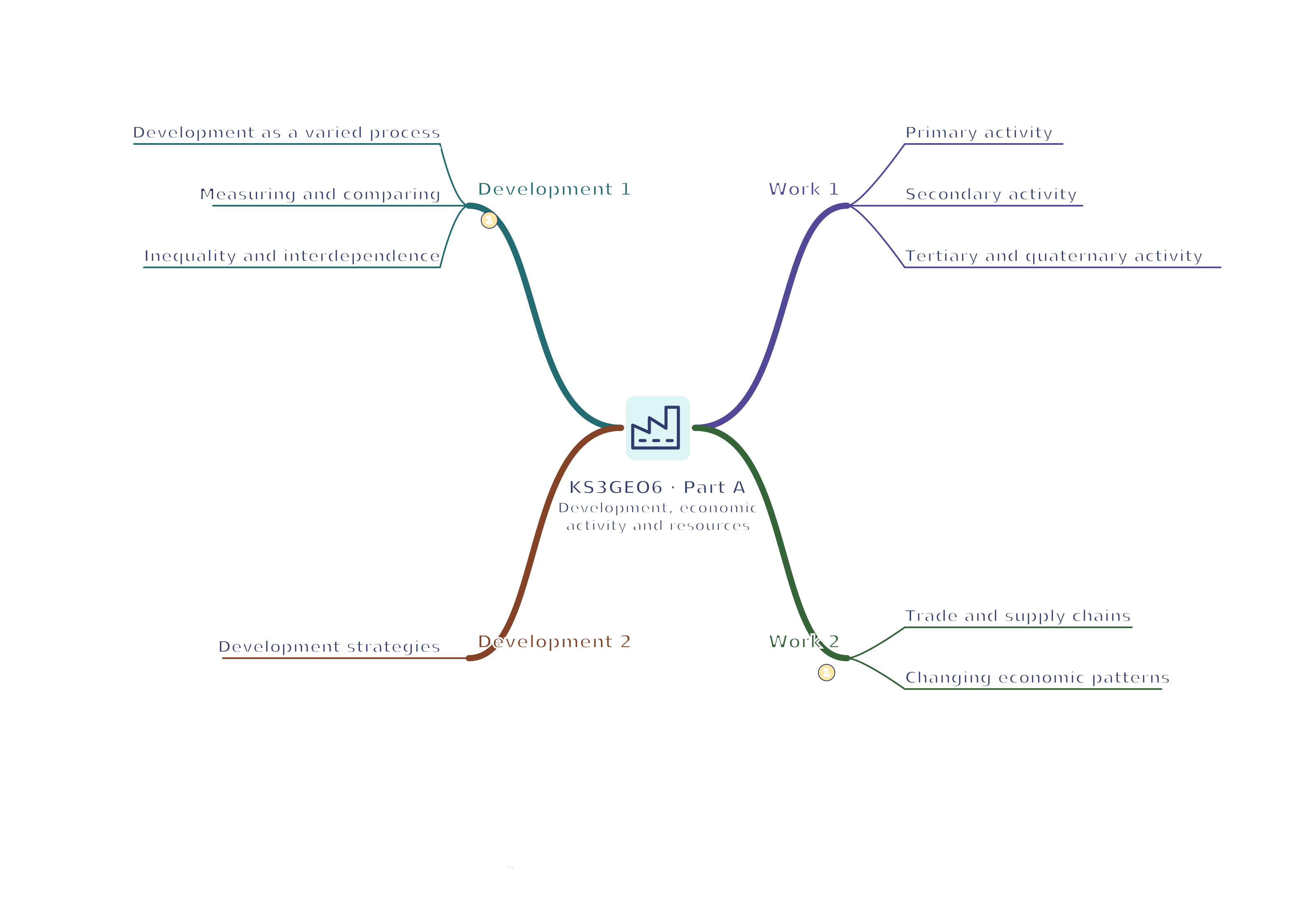
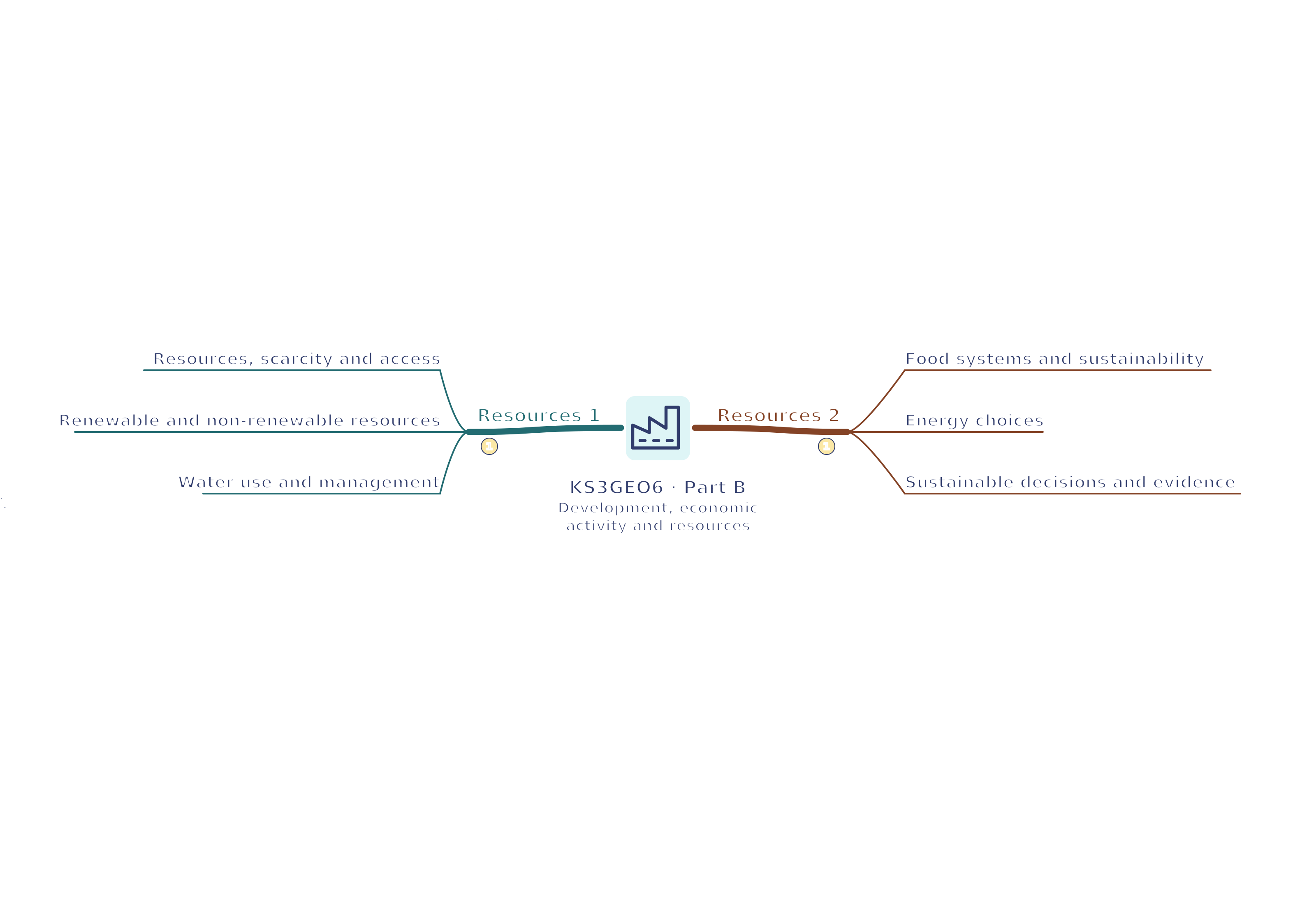
Use the branches to recall the ideas and explain their connections. Check the revision notes for the full detail.
KS3GEO6 · 1
View KS3GEO6 · 1 mind mapOpen the full-size map to zoom. Use the printable view for A4 landscape or enlarge to A3.
 Mr Kidman's Classroom