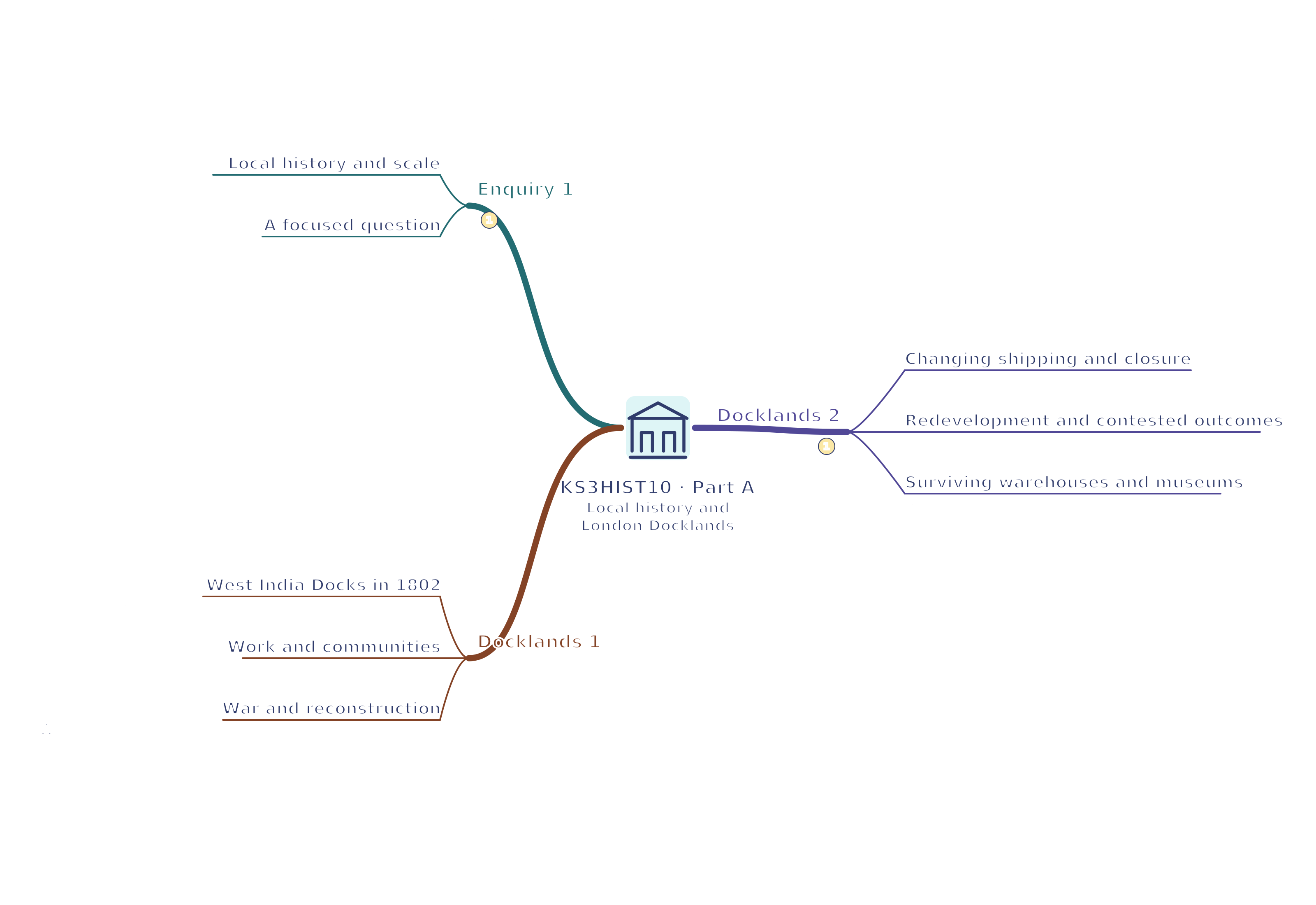
Local history and scale — A local-history study investigates a defined place through evidence of its past, connecting local experiences with wider processes. Select an approved locality relevant to the learner or school. London Docklands is the worked example here, not a claim that it is everyone's local area. Its methods can guide an actual independent study without inventing visits or pupil findings.
A focused question — Ask a question that a place and its surviving evidence can answer, such as 'How did work and land use around West India Docks change after 1802?' Define boundaries and periods before collecting sources. A question about all of London's history is too broad for one small enquiry. Refine the question when evidence reveals a more useful comparison.
Docklands as a real worked example
West India Docks in 1802 — West India Docks opened in 1802 for trade connected with Caribbean plantation economies, including goods produced by enslaved people. Docks provided protected places for ships; warehouses stored goods beside them; routes carried goods onwards. These buildings connect a London site with worldwide trade, labour and coercion. Explain those human relationships as well as the engineering: the docks were not detached from how the goods were produced.
Work and communities — Dock work, shipping, warehousing, manufacturing and associated services shaped local livelihoods and community life. Employment could be insecure and varied, while migration and wider trade connected the area to other places. Use labour records, maps, photographs and attributed memories to investigate particular experiences rather than assuming every resident was a dock worker.
War and reconstruction — Bombing and wartime disruption affected London's docks and surrounding communities, followed by reconstruction and changing commercial conditions. A damaged-building photograph needs a date and location and cannot show every household's experience. Compare it with other evidence to explain change and continuity rather than treating wartime destruction as the sole cause of every later development.
Changing shipping and closure — Containerisation means carrying goods in large standard containers that move between ships, trains and lorries. Along with larger ships and changes in transport and business, it shifted cargo work to other facilities. West India and Millwall Docks stopped general cargo operations in 1980; other sites had different dates. This was not the end of every port activity around London and the Thames.
Redevelopment and contested outcomes — Redevelopment, including Canary Wharf, changed buildings, employment, housing and the area's image. Different residents, workers and institutions judged the effects differently. Compare jobs, access, costs, community change and conservation rather than assuming new buildings benefited everyone equally or that every older activity disappeared without continuity.
Surviving warehouses and museums — Historic warehouses survive, including the building used by London Museum Docklands. Listed-building records explain why a building is legally recognised for its historic or architectural interest and describe features worth protecting. Museum displays connect it with wider histories. A preserved facade, the outside face of a building, cannot reveal every former use. Ask what is original, what changed and whose stories are explained.
Building a source enquiry
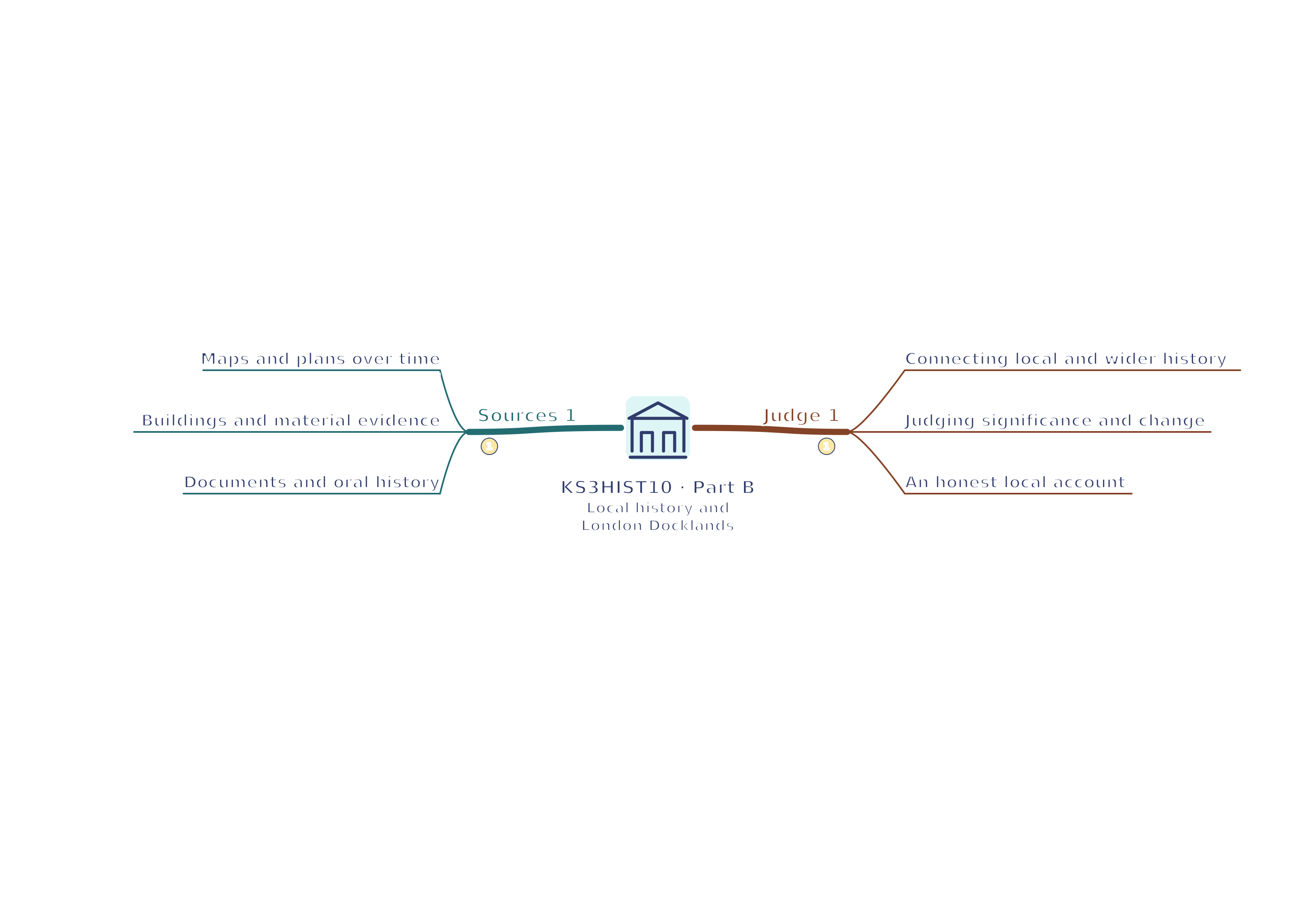
Maps and plans over time — Compare maps of the same area from different dates. Check scale, how map distance represents real distance, and orientation, which way the map faces. Match boundaries and read the keys before claiming a change. A missing building may reflect what a mapmaker chose to show. Separate what you can measure, such as a new road, from your explanation of why it appeared.
Buildings and material evidence — Observe a site only through approved safe arrangements or suitable documented views. Materials, layout, inscriptions and alterations can suggest past functions, but interpretation needs context. A later restoration can resemble an earlier feature without being original. Record what is observed separately from what a guide or historian explains.
Documents and oral history — Directories, employment records, newspapers, planning documents and interviews offer different perspectives and silences. An oral account can reveal personal experience while memory and later events influence its telling. Obtain required consent and avoid unnecessary personal information. Compare accounts without treating disagreement as automatic dishonesty or pretending one voice represents the whole community.
Explanation, significance and responsibility
Connecting local and wider history — Connect a local change to a wider development by showing how the link worked. Dock warehouses stored imported goods, so shipping records and building evidence can connect local employment with overseas trade. Two events happening at the same time is not enough to prove one caused the other. Local evidence can also show people’s actions and differences hidden in national totals.The Docklands worked example connects local buildings and work with wider plantation economies, war and logistics. These connections need specific evidence; the diagram does not imply every local change had the same cause. Full-size diagram
Judging significance and change — Use stated criteria such as impact on work, community, landscape or remembrance. Compare before and after with evidence and identify continuities and uneven effects. A visually dramatic redevelopment is not automatically the most important change for every resident. Explain why another interpretation may emphasise a different group or timescale.
An honest local account — Present a supported answer with a location map, timeline, attributed sources and reasoned paragraphs. State access and evidence limits, distinguish actual observations from the supplied example and explain unanswered questions. Do not fabricate interview quotations, visits, photographs or findings. An independent local study needs real evidence and teacher assessment beyond terminology recall.
Test yourself
50 questions · Random sets of 10. These quick checks support revision; practise longer explanations and justified judgements too.
Mind map
Use the branches to recall the ideas and explain their connections. Check the revision notes for the full detail.
KS3HIST10 · 1
View KS3HIST10 · 1 mind mapOpen the full-size map to zoom. Use the printable view for A4 landscape or enlarge to A3.
 Mr Kidman's Classroom