A long-arc enquiry — Migration means moving to live in another place, whether into Britain, out of it or within it. This enquiry follows movement from before 1066 to the present. Compare reasons, experiences, opportunities and restrictions using the same questions. Set events in time before arguing what changed. Modern country names and identities may not fit people in ancient or medieval societies exactly.
Roman Britain and imperial connections — Roman conquest brought Britain into an empire with military, commercial and administrative connections across Europe, North Africa and western Asia. Soldiers, traders, officials and others moved through those networks under varied conditions, including enslavement. Inscriptions, objects and archaeological context can reveal individual links, but one find does not establish the origins or experiences of an entire population.
Early medieval settlement — After Roman government ended in Britain, people crossed from areas around the North Sea and settled in different places. Groups called Angles, Saxons, Jutes and others were associated with changes in language, settlements and power. Archaeology and written evidence need comparison. Change varied by region; the evidence does not support one simple story of a single pure population replacing everyone else.
Viking-age connections — Scandinavia includes present-day Denmark, Norway and Sweden. People from this region raided, traded, settled and ruled in parts of Britain and Ireland during the Viking age. Objects, place names and texts help investigate these different activities. Date and compare the evidence carefully: an account of one raid cannot represent every settler, and a place name does not tell a whole community’s life story.
Medieval and early modern movement
The Norman Conquest and migration — After 1066, incoming rulers, landholders, clergy and others altered elite power, institutions and language, alongside continuity among much of the population. Conquest and migration were connected but not identical processes. Compare who moved, under what authority and with what consequences instead of assuming every person in Britain became Norman or French-speaking at once.
Jewish communities and exclusion — Medieval Jewish people in England built communities and pursued varied work and relationships while facing restrictions imposed by rulers. Antisemitic violence and the royal expulsion of 1290 harmed them and ordered them to leave. Later Jewish settlement and refuge occurred in different conditions. Separate official policy, people’s actions and hostile accusations: persecution does not make false accusations true. Study community life as well as suffering.
Faith, refuge and skills — Huguenots were French Protestants. Religious persecution and conflict led many to seek refuge elsewhere, including Britain, where communities contributed to crafts, trade and culture. Wealth, family networks and local responses shaped different experiences. Seeking safety could connect with seeking work, but people’s right to be understood as human beings does not depend on one useful skill or on every arrival being welcomed.
Black lives in Tudor evidence — The Westminster Tournament Roll of 1511 depicts John Blanke, a Black royal trumpeter, providing evidence of a named person's presence and role. It does not establish every aspect of his life or make him the only Black person in Tudor England. Use a documented individual to challenge the myth that Black presence began only in the twentieth century while acknowledging gaps.
Industrial, imperial and global movement
Movement within Britain — Industrial and urban change drew people between rural and urban areas and across regions, while families also stayed, returned or moved repeatedly. Work, housing, networks and constraints shaped choices. Internal migration can change a town without crossing a national border. Compare specific records and experiences instead of assuming all industrial workers came from the same place.
Irish migration — Irish people moved to Britain in several periods for work, family and other reasons, with the Great Famine creating devastating pressures in the nineteenth century. Migrants contributed to labour and communities while facing varied conditions and prejudice. The famine's causes and effects involved economic and political circumstances as well as crop failure; movement was not always a freely chosen simple opportunity.
Outward migration and empire — People left Britain for varied reasons, including to settle in colonies overseas. Indigenous peoples were the established communities of those places. Settler expansion could take their land and change who held power: dispossession. Migrants also faced their own ambitions and difficulties. Compare authority and consequences as well as movement; a new start for settlers could mean loss of land and freedom for others.
Refuge in the twentieth century — War, persecution and political upheaval led people to seek refuge, while state policies and public responses limited or enabled entry in different ways. Jewish refugees before and during the Nazi period faced serious barriers; rescue schemes did not admit everyone at risk. Study actual policies and accounts rather than assuming people could always leave danger freely.
Commonwealth migration and Windrush — Post-war migration from the Caribbean, South Asia, Africa and elsewhere developed through imperial connections, work, family and changing citizenship arrangements. Empire Windrush's 1948 arrival symbolises part of this history rather than its beginning or every migrant's experience. Communities shaped Britain while encountering racism and campaigning for fair treatment; individual lives cannot be reduced to one ship or label.
Change, continuity and interpretation
Law, identity and belonging — Rules about nationality, entry and residence changed over time, reflecting political choices and unequal power. A person's legal status, cultural identity and sense of belonging are related but not identical. Historical rules should be described in their period rather than assumed to apply now. For an actual present-day status question, use appropriate qualified support and current official information.
Comparing experiences fairly — Compare at least two periods through reasons for movement, opportunities, restrictions and responses, with evidence about different groups. Similar prejudice does not mean identical laws or circumstances, and contributions do not erase suffering. Recognise agency and human lives while explaining institutional conditions. Avoid a single uninterrupted story of either constant welcome or constant exclusion.
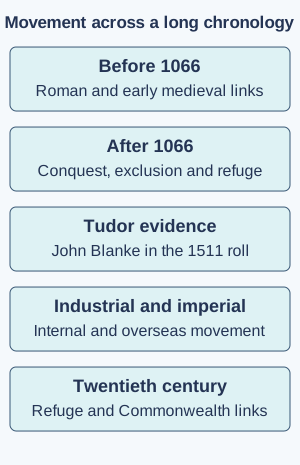
An evidence-based migration history — Combine archaeology, documents, images, oral accounts and suitable statistics, recognising survival and sampling limits. Use named examples within a chronological argument reaching before 1066 and across later periods. Explain how interpretations are constructed and why a current political claim needs historical evidence rather than assuming the past directly dictates one present policy.Selected thematic anchors across unequal intervals, not a complete migration timeline: Roman imperial networks, early medieval settlement, Norman elite movement, Tudor John Blanke evidence, industrial moves and post-war Commonwealth connections. Full-size diagram
Test yourself
50 questions · Random sets of 10. These quick checks support revision; practise longer explanations and justified judgements too.
Mind map
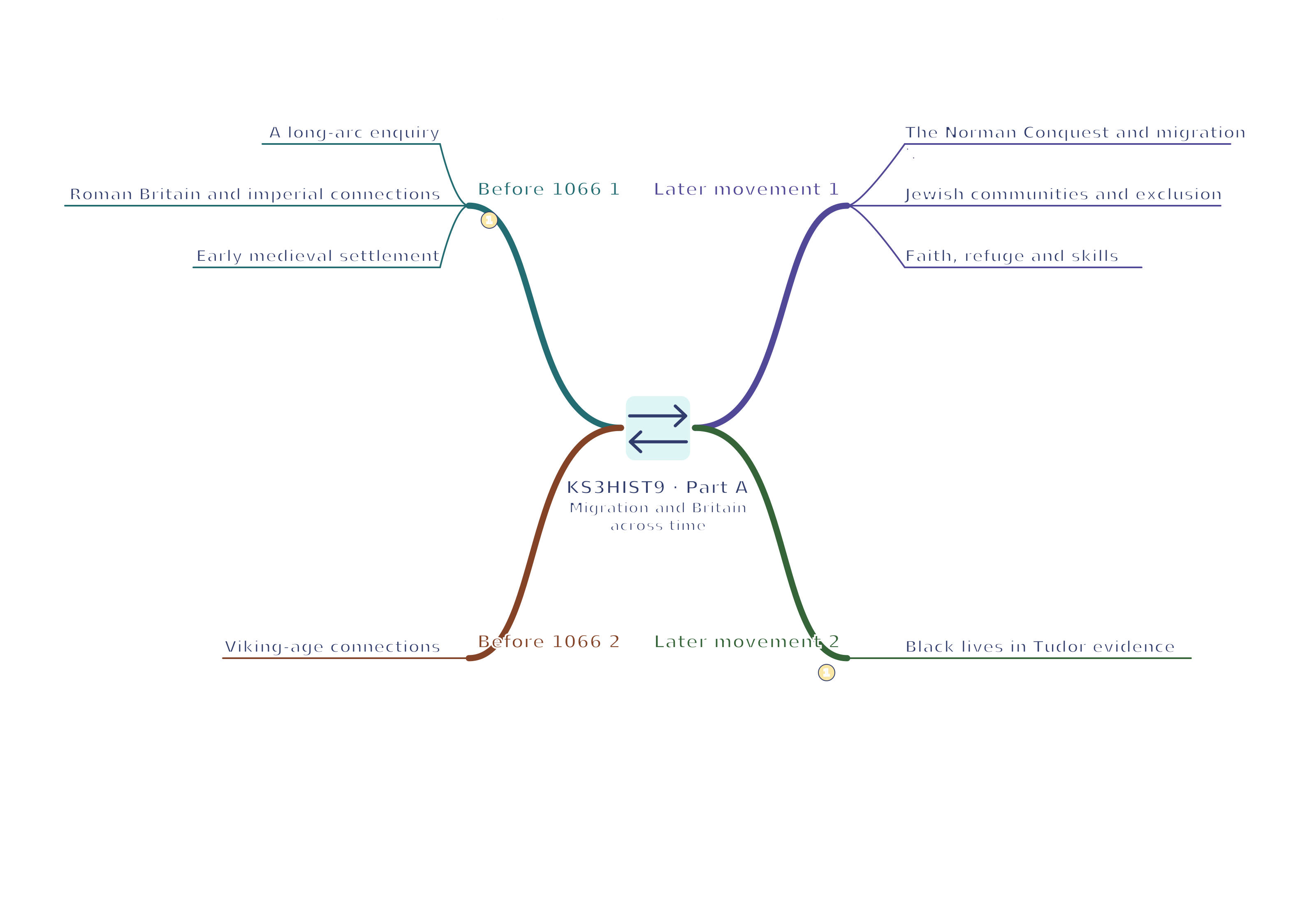
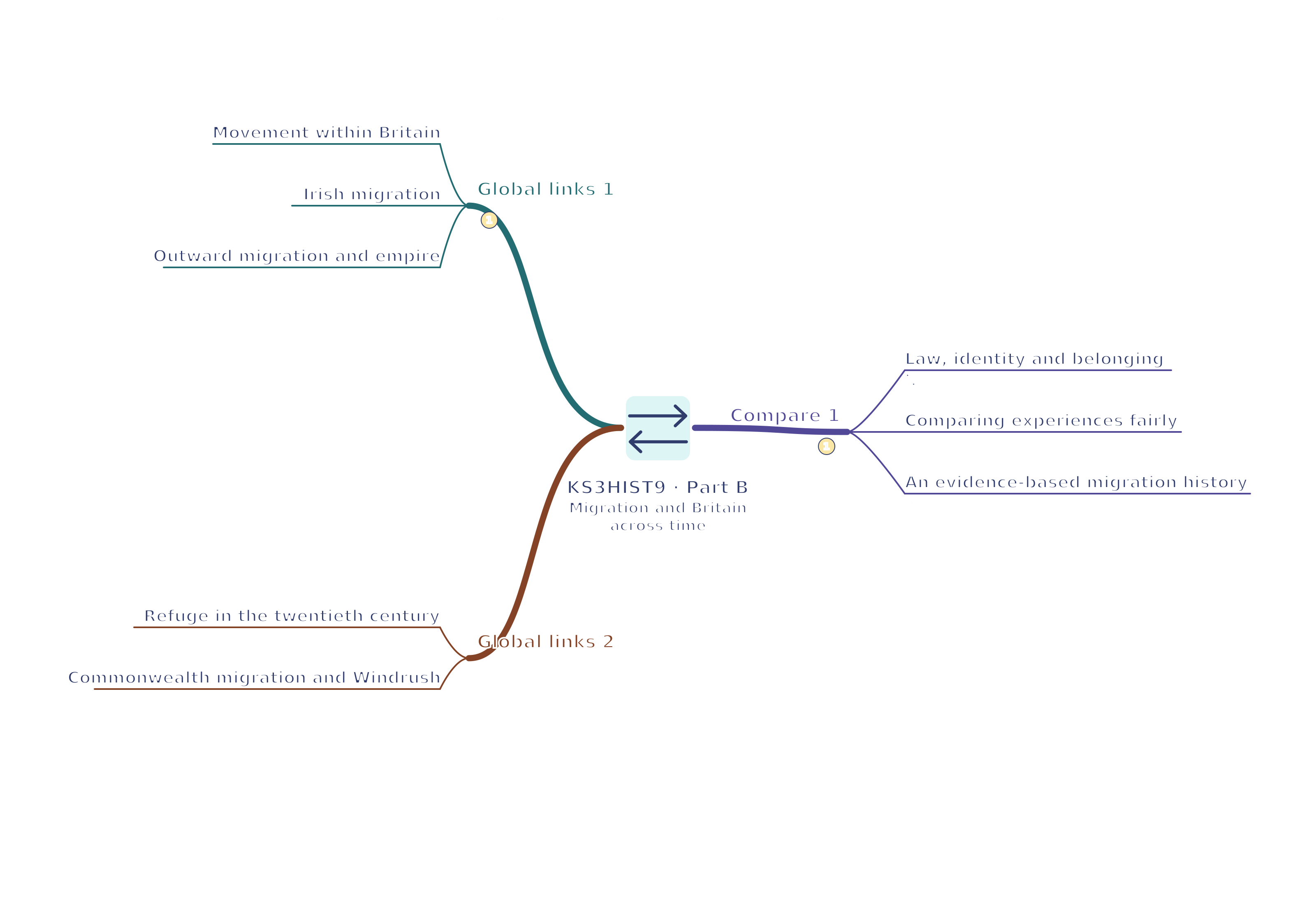
Use the branches to recall the ideas and explain their connections. Check the revision notes for the full detail.
KS3HIST9 · 1
View KS3HIST9 · 1 mind mapOpen the full-size map to zoom. Use the printable view for A4 landscape or enlarge to A3.
 Mr Kidman's Classroom