An interconnected world — By the early twentieth century, Britain was connected through empire, trade, migration, finance and international competition. Unequal political rights and social conditions remained within Britain and across imperial territories. Technological change did not make conflict inevitable or remove poverty. Establish the pre-war context before explaining how particular decisions turned a crisis into war.
Women's suffrage — Women campaigning for the vote used different methods. Some petitioned and lobbied Parliament; some used militant action, including breaking laws to force attention. In 1918 some women meeting age and property conditions gained the parliamentary vote, while men and women gained equal voting terms in 1928. Longer campaigning and wartime change both matter. The 1918 reform did not give every adult woman the same rights as men.
The First World War
Causes and the July crisis — Before 1914, alliances linked states, militarisation expanded armed forces, and nationalism promoted national power and identity. Imperial rivalry added tension. After Franz Ferdinand’s assassination, Austria-Hungary, backed by Germany, made demands on Serbia and then declared war. Russia mobilised, meaning it prepared and moved armed forces for action, in support of Serbia. Germany declared war on Russia and France, then invaded Belgium; Britain entered the war. Explain these choices alongside the background pressures: alliances did not make every step automatic.
A global conflict — The war involved Europe, the Middle East, Africa, oceans and people drawn from empires and other states. Soldiers and labourers from many places contributed under differing circumstances. Britain entered the war in August 1914 in a crisis involving Germany's invasion of Belgium and wider strategic concerns. A Western Front trench image cannot represent every theatre or participant.
Trench warfare and technology — On the Western Front, trenches and other defences protected soldiers while machine guns and artillery made crossing open ground extremely dangerous. Armies also needed supplies, transport and communication: logistics. These problems helped prolong fighting and cause severe losses. Gas, aircraft and later tanks had different roles and limits. Conditions and tactics changed; neither one weapon nor an assumption that commanders had no choices explains the whole war.
Home fronts and society — War affected work, food, state powers, family life and public communication. Women's work and other changes were important but varied and did not erase existing employment or instantly create equality. Propaganda aimed to persuade and needs analysis of audience and purpose. Civilians experienced loss, pressure and disagreement as well as collective action.
Ending the war — An armistice is an agreement to stop fighting; a peace treaty sets formal terms for peace. The November 1918 armistice ended fighting on the Western Front, though related violence continued elsewhere. Military developments, resources, morale, domestic crises and US entry into the war all mattered. A remembrance date marks an important ending, not the instant end of every connected conflict everywhere.
Peace and its consequences — The 1919 Treaty of Versailles set peace terms for Germany, including territorial losses, limits on its armed forces and reparations: payments demanded for war damage. The settlement changed borders and produced different reactions among states and communities. It contributed to later tensions but did not by itself make another world war inevitable. Compare its terms with later economic and political changes rather than using hindsight alone.
Interwar crises and dictatorships
Economic instability — The Great Depression followed the financial crisis of 1929 and affected employment, trade and livelihoods internationally, with uneven severity and policy responses. Earlier economic difficulties also mattered in some places. Unemployment could undermine confidence and increase political conflict, but hardship did not automatically make every society adopt the same form of government.
Democracy and dictatorship — Interwar means between the two world wars. In a democracy, government faces limits and people can choose between political opponents. A dictatorship concentrates power and suppresses opposition, often through censorship, imprisonment and violence. Fascist, Nazi and communist dictatorships differed in beliefs and organisation. Hitler became German chancellor in 1933, after which the Nazis destroyed democratic freedoms. Becoming chancellor did not give the Nazis democratic approval for every later crime, and Germans did not all share the same beliefs or choices.
Aggression and international responses — Nazi Germany, Fascist Italy and imperial Japan expanded power in different regions. Other governments tried diplomacy, sanctions (restrictions intended to put pressure on a state) and rearmament (building armed forces). Appeasement involved concessions intended to avoid conflict. Assess what leaders knew and feared and what their decisions caused. Knowing the later outcome does not prove every alternative then was easy or certain.
The Second World War
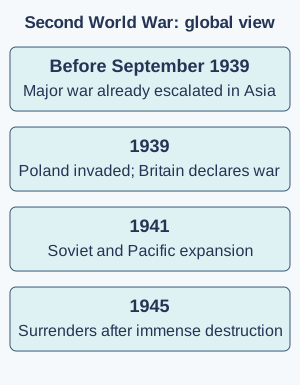
From Europe to a global war — Germany's invasion of Poland in 1939 led Britain and France to declare war. Major warfare in Asia had already escalated, including Japan's war in China, and later developments connected theatres across the world. The German invasion of the Soviet Union and the expansion of war in the Pacific in 1941 transformed the conflict. Starting dates depend partly on the geographical focus being explained.Selected orientation dates with unequal intervals: war in China escalated before the European 1939 outbreak, expansion in 1941 connected major theatres, and main fighting ended in 1945. This is not an exhaustive global timeline. Full-size diagram
Britain in 1940 — In 1940 German victory in France threatened Britain. The Dunkirk evacuation brought many Allied troops away from France; it saved forces but did not win the campaign there. In the Battle of Britain, air fighting was central to resisting German plans. Churchill’s leadership mattered alongside armed forces, production, intelligence, geography, civilians and international and imperial support. Explain how these factors worked together rather than attributing survival to one speech.
War on land, sea and air — The war involved campaigns in Europe, North Africa, Asia and the Pacific, struggles over supply at sea and extensive air operations. The Soviet Union, United States, Britain, China and many other participants made major contributions in different theatres. Assess a particular turning point with evidence and scale rather than claiming one country fought alone throughout.
Occupation and civilian experience — Occupation means control of a place by an enemy power. Civilians could face bombing, forced labour, shortages and displacement: having to leave their homes. Some resisted; some collaborated, helping the occupying authorities; others tried to survive with very limited choices. Experiences and risks differed, so avoid judging every person as if they had complete freedom. The Holocaust needs its own focused explanation within this wartime history.
Victory and destruction — Germany's defeat in 1945 resulted from combined military, economic and political developments across several fronts. War in Asia continued until Japan's surrender after further devastating fighting, Soviet entry against Japan and the US atomic bombings of Hiroshima and Nagasaki. These events caused immense suffering. Analyse decisions and consequences carefully rather than treating destruction as an abstract score or a single inevitable outcome.
Evidence and historical explanation
Investigating wartime sources — Letters, diaries, official orders, photographs, statistics, propaganda and later testimony answer different questions. Check date, audience, censorship, memory and survival while comparing evidence. A recruiting poster can reveal persuasion rather than prove all recruits' motives. Do not invent an authentic-looking soldier's diary and present it as a real source.
Comparing war and society — Compare political power, civilian experience, technology or global participation across the two wars using consistent criteria. Explain both continuities and changes and avoid treating 1914–1945 as uninterrupted identical warfare. A strong account connects individual examples with institutions and wider systems, supports claims and recognises uneven experiences.
Test yourself
50 questions · Random sets of 10. These quick checks support revision; practise longer explanations and justified judgements too.
Mind map
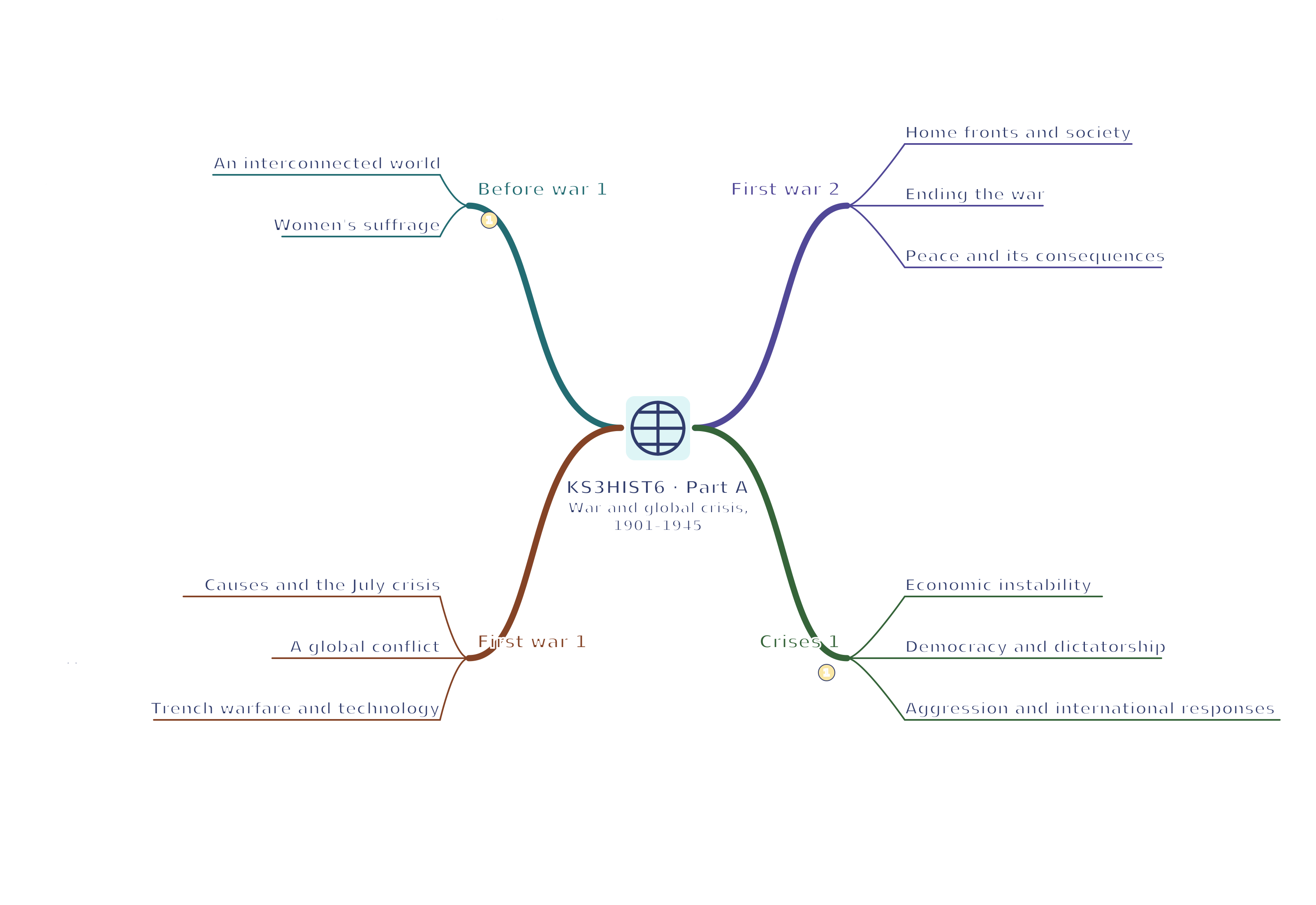
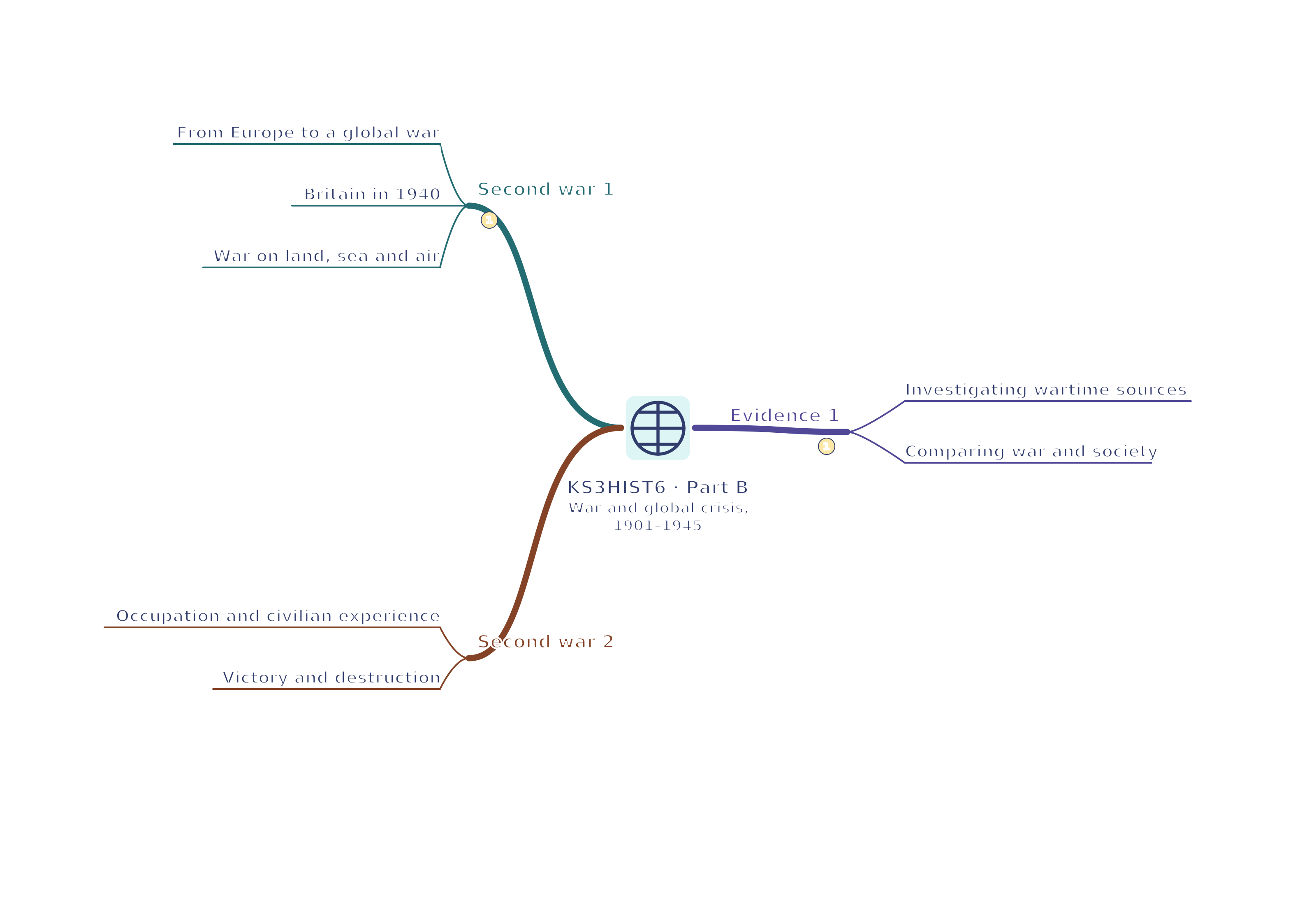
Use the branches to recall the ideas and explain their connections. Check the revision notes for the full detail.
KS3HIST6 · 1
View KS3HIST6 · 1 mind mapOpen the full-size map to zoom. Use the printable view for A4 landscape or enlarge to A3.
 Mr Kidman's Classroom