Measuring — Use a ruler from its zero mark and a protractor centred on the vertex with its baseline on one ray. Choose the scale starting at zero on that ray. State units and accuracy; a construction uses geometric constraints rather than measurement alone.
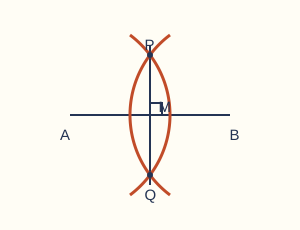
Perpendicular bisector — For segment AB, draw equal-radius arcs centred at A and B with radius more than half AB, crossing above and below. Join the crossings. Both crossing points are equally distant from A and B, so the line cuts AB into two equal lengths at 90°. Cutting into two equal parts is called bisecting.Perpendicular bisector. Original illustrative model. Full-size diagram
Perpendicular at a point — For P on a line, mark equal distances A and B on either side of P. Draw equal arcs from A and B crossing away from the line and join that crossing to P. This is the perpendicular bisector of AB.
Perpendicular from a point — For P off a line, draw an arc centred at P meeting the line at A and B. Draw equal-radius arcs centred at A and B. Choose an intersection Q that is not P; for example, use the intersection on the other side of the line. Q is equidistant from A and B, meaning the two distances are equal. Join Q to P. The perpendicular is the shortest point-to-line distance.
Angle bisector — From vertex V, draw an arc meeting both rays at A and B. With equal radius draw arcs from A and B meeting inside the angle at C. Join V to C. Triangles VAC and VBC have VA = VB, AC = BC, and the shared side VC. They are congruent by SSS (three matching sides), so the two angles at V are equal. VC bisects the angle, meaning it divides it into two equal angles.
Congruence and similarity
Congruent triangles — Congruent figures have the same shape and size. Triangle tests are SSS (three matching sides), SAS (two matching sides and the angle between them), ASA (two matching angles and the side between them), and RHS (a right angle, equal hypotenuses and one other matching side). AAA (three matching angles) proves the same shape, or similarity, but does not guarantee the same size.
Construct a triangle — For sides 5, 6 and 7 cm, draw the 7 cm base; arcs of radii 5 and 6 cm from opposite ends locate the third vertex. Two reflected positions are congruent. The sum of any two sides must exceed the third.
Similarity — Similar figures have equal corresponding angles and all corresponding lengths in one ratio. For triangles, matching angles establishes the shape. A scale factor of 2.5 changes lengths but preserves angles.
Transformations
Translation — A translation moves every point by the same displacement. “3 right, 2 down” maps (x, y) to (x + 3, y − 2). It preserves length, angle and orientation. A direction without distance is incomplete.
Reflection — A reflection flips across a stated mirror line. Perpendicular distances from each point and its image to the line are equal. Across the y-axis, (x, y) maps to (−x, y); points on the mirror stay fixed.
Rotation — Specify centre, angle and direction. About the origin, a 90° anticlockwise rotation sends (x, y) to (−y, x); for example (3, 1) becomes (−1, 3). Every point keeps its distance from the centre.
Enlargement — Specify centre and scale factor. From O, an image point lies along the same ray at k times the original distance for positive k. With centre (0,0) and k = 3, (2,1) maps to (6,3). A factor 0.5 reduces lengths.Scale distances from the centre. Original illustrative model. Full-size diagram
Invariants — Translation, reflection and rotation preserve lengths and angles, producing congruent images. Enlargement preserves angles and length ratios but changes size unless the positive factor is 1. Under reflection, the order of labelled vertices around a figure reverses: clockwise becomes anticlockwise. This is a change of orientation.
Without a grid — Use ruler/compass distances, perpendiculars and rays to transform a figure on plain paper. Check each vertex and join in the original order; counting squares is only one construction method.
Reasoning
Why SSA fails — SSA means two sides and an angle that is not between those sides. These measurements can allow two different triangles: when locating the third vertex, an arc can meet the required ray at two positions. The angle must be included for SAS, or the special right-angle conditions for RHS must apply. A plausible diagram alone does not establish uniqueness.
Proving shape facts — A diagonal in a parallelogram creates triangles with equal alternate angles and a shared side, so ASA establishes congruence. Matching corresponding sides then proves opposite sides equal.
Test yourself
50 questions · Random sets of 10. These quick checks support revision; practise longer explanations and justified judgements too.
Mind map
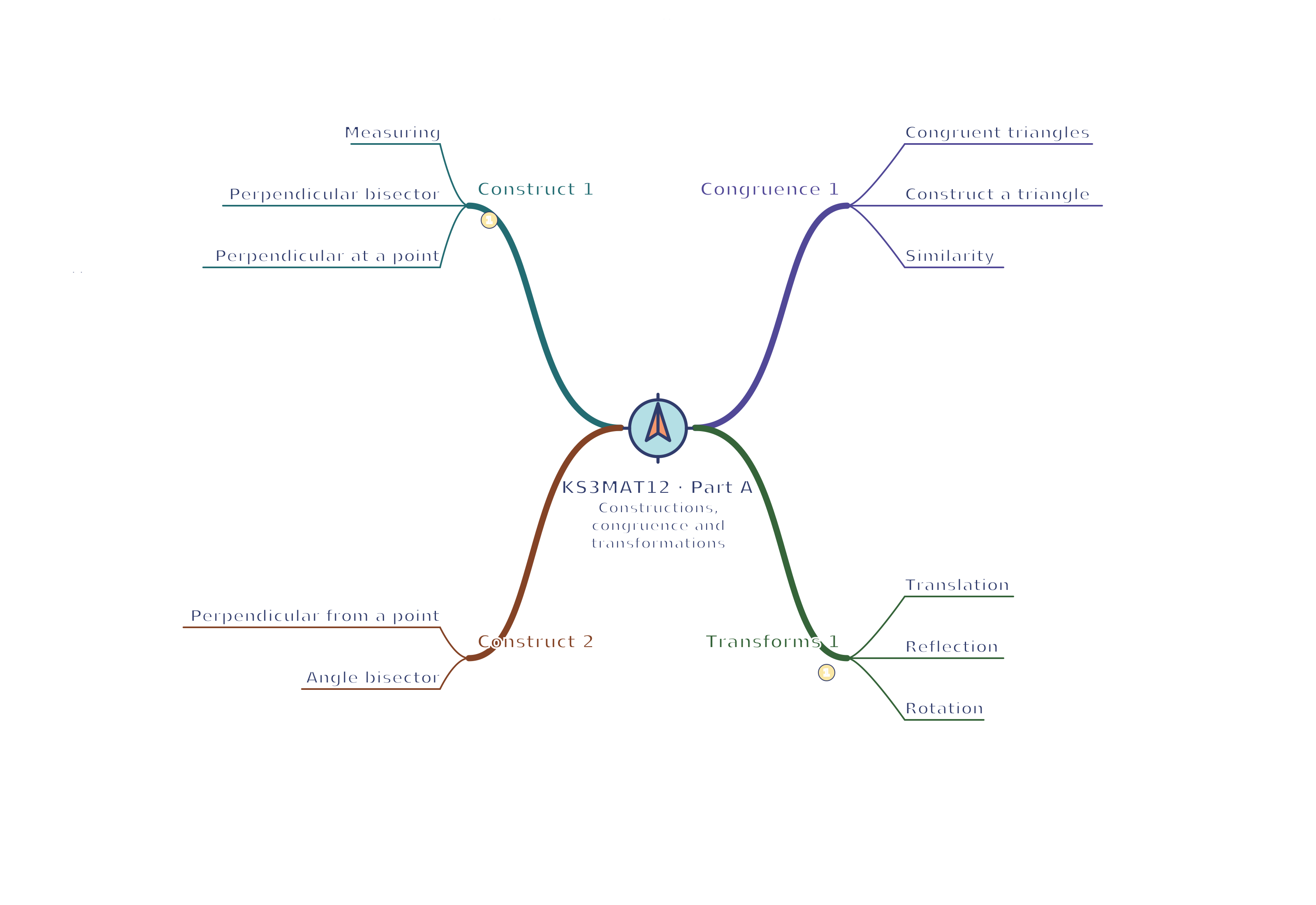
Use the branches to recall the ideas and explain their connections. Check the revision notes for the full detail.
KS3MAT12 · 1
View KS3MAT12 · 1 mind mapOpen the full-size map to zoom. Use the printable view for A4 landscape or enlarge to A3.
 Mr Kidman's Classroom