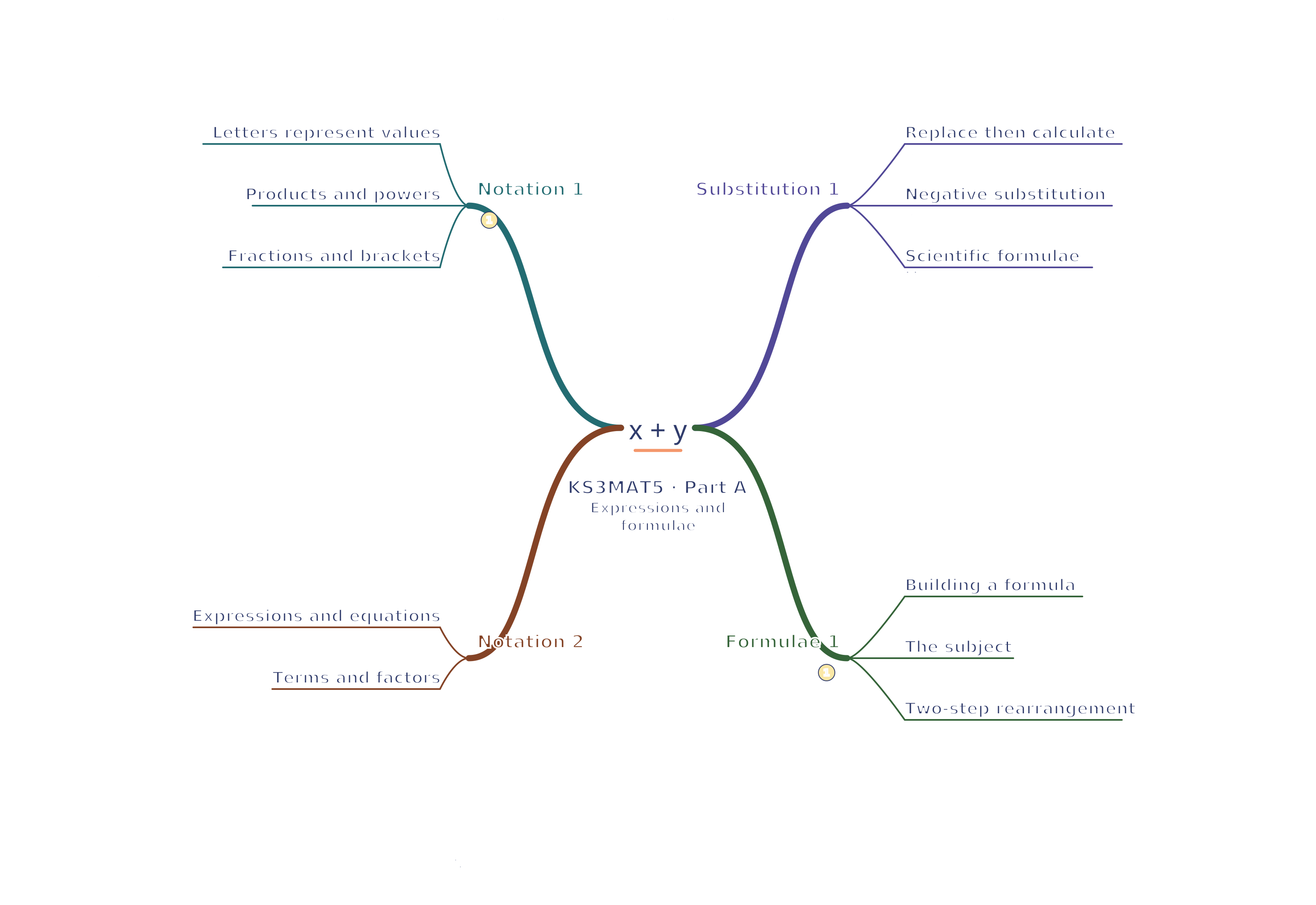
Letters represent values — A variable may take different values; an unknown is a value being sought; a constant stays fixed in the stated model. For tickets costing £4 each plus a fixed £3 booking fee, C = 4n + 3, where n is the number of tickets and C is total cost in pounds. The numbers 4 and 3 are constants in this model.
Products and powers — 3y means 3 × y, ab means a × b and a²b means a × a × b. Writing the letters together means multiply their values, not join their digits: when a = 2 and b = 5, ab = 10, not 25. Write coefficients before letters.
Fractions and brackets — x/4 means x ÷ 4, and (1/2)x is an exact fractional coefficient. 3(x + 2) multiplies the entire bracket. In (a + b)/c the whole numerator is divided by c.
Expressions and equations — An expression such as 4x + 1 does not state that two things are equal. An equation such as 4x + 1 = 9 states two expressions are equal. An inequality compares values, for example x > 2.
Terms and factors — Terms are separated by addition or subtraction at the outer level; 3x + 2y has two terms. Factors multiply: 3 and x are factors of 3x. A coefficient is the numerical factor of a term.
Substitution
Replace then calculate — For 3x² − 2y with x = 4 and y = 5, substitute to get 3 × 4² − 2 × 5 = 48 − 10 = 38. The index applies to x, not automatically to its coefficient.
Negative substitution — For x² + 3x with x = −2, write (−2)² + 3(−2) = 4 − 6 = −2. Brackets prevent a negative input from being mistaken for an unbracketed minus before a square.
Scientific formulae — For density ρ = m/V, m = 84 g and V = 12 cm³ give ρ = 7 g/cm³. The formula expresses a relationship; units must match before substitution.
Formulae
Building a formula — A taxi model charging £3 plus £2 per kilometre is C = 3 + 2d, for distance d km. It assumes the charge depends only on distance, with no waiting fee. Define the variables and their allowed values.
The subject — In A = bh, A is the subject because it appears alone on one side. To find h, divide both sides by b: h = A/b, provided b ≠ 0. Rearrangement preserves the relationship.
Two-step rearrangement — From v = u + at, subtract u to get v − u = at, then divide by t to obtain a = (v − u)/t, with t ≠ 0. The whole difference belongs in the numerator.
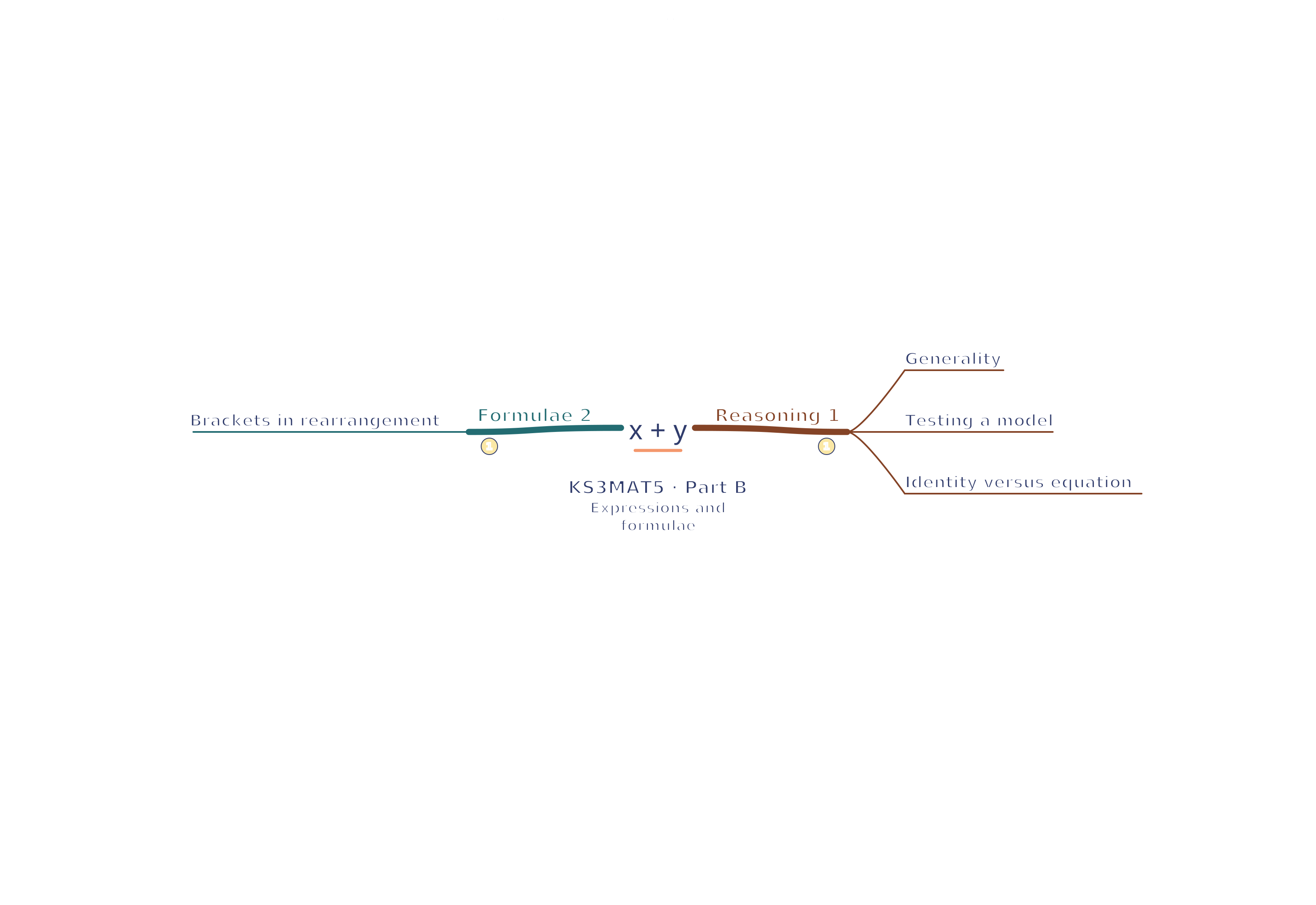
Brackets in rearrangement — For P = 2(l + w), divide by 2 first, then subtract w: l = P/2 − w. Dividing only one term of the original equation would break equality.
Reasoning
Generality — The perimeter of a rectangle is 2l + 2w = 2(l + w). These equivalent expressions describe every rectangle with the stated side lengths, not just a particular measured example.
Testing a model — A formula for a ticket cost may allow n = 2 but not n = −2. Check units, reasonable input values and a known example; a correct calculation can still be inappropriate for the model.
Identity versus equation — 2(x + 3) = 2x + 6 is true for every x and can be written with ≡. The equation 2x + 6 = 10 is true only for its solutions. Checking several numbers cannot prove an identity for every real input. Here the distributive law proves it: multiplying both x and 3 by 2 gives 2x + 6 for any x.
Test yourself
50 questions · Random sets of 10. These quick checks support revision; practise longer explanations and justified judgements too.
Mind map
Use the branches to recall the ideas and explain their connections. Check the revision notes for the full detail.
KS3MAT5 · 1
View KS3MAT5 · 1 mind mapOpen the full-size map to zoom. Use the printable view for A4 landscape or enlarge to A3.
 Mr Kidman's Classroom