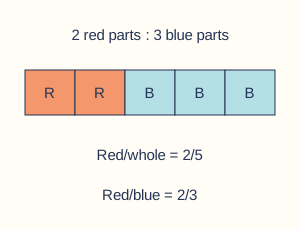
Comparing parts — A red:blue ratio of 2:3 means two equal-sized red parts for every three equal-sized blue parts. It does not say there are only five counters. Equivalent ratios 4:6 and 10:15 have the same relationship.Red:blue = 2:3. Original illustrative model. Full-size diagram
Simplifying ratios — Divide every part by the same non-zero factor: 18:24 = 3:4 after dividing by 6. Convert units first: 1 m:25 cm = 100:25 = 4:1. Subtracting the same number does not preserve a ratio.
Part and whole — For red:blue = 2:3, there are 5 total parts. The red fraction of the whole is 2/5; red compared with blue is 2/3. A part:whole ratio 2:5 therefore describes the same red proportion.
Sharing a total — Share £84 in ratio 3:4. Seven parts make £84, so each part is £12; shares are £36 and £48. Check both that they sum to £84 and that 36:48 simplifies to 3:4.
Given one part — If red:blue = 2:5 and there are 14 red counters, one part is 7 and blue is 35. The total is 49. Do not divide 14 by 7: 14 represents only the red two parts.
Expressing a split — A £50 total split into £20 and £30 gives a part:part ratio 20:30 = 2:3 and first-part:whole ratio 20:50 = 2:5. Explain which comparison the notation represents.
Fractions above one — If A = 12 cm and B = 8 cm, A/B = 3/2 and A:B = 3:2. Fractions used to compare quantities may be greater than 1; 3/2 means A is 1.5 times B.
Direct proportion
Scaling a recipe — A recipe for 4 portions uses 300 g rice. For 10 portions, scale by 10/4 = 2.5 to get 750 g. This assumes the amount per portion remains fixed; adding 6 g because there are 6 more portions is not proportional reasoning.
Unitary method — If 6 identical pens cost £4.50, one costs £0.75 and ten cost £7.50. Find a unit rate, then scale. A fixed delivery charge would mean the total cost is not directly proportional to pen count.
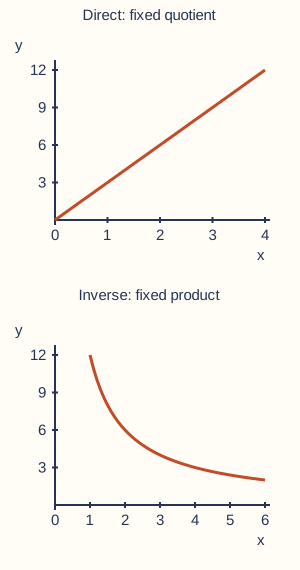
Algebra and graph — Direct proportion has y = kx with fixed k, called the constant of proportionality. Doubling x doubles y; multiplying x by any factor multiplies y by the same factor. For y = 3x, the ratio y/x is 3 when x ≠ 0 and the graph is a straight line through the origin. y = 3x + 2 is linear but not directly proportional.Direct and inverse relationships. Original illustrative model. Full-size diagram
Additive or multiplicative — If one child is 3 years older than another, the difference stays 3; their age ratio changes. If a map always uses 2 cm per kilometre, the quotient, found by dividing map length by real distance in consistent units, stays fixed. Choose the relation from the situation.
Inverse proportion
Constant product — For a fixed 120 km journey, time t = 120/v hours. Doubling speed from 30 to 60 km/h halves time from 4 to 2 h. The product vt stays 120; the graph is a curve, not a descending straight line.
Working with inverse proportion — Six identical pumps empty a tank in 10 hours, so the model requires 60 pump-hours. Ten pumps take 60/10 = 6 hours. This assumes equal constant rates, simultaneous operation and no interference.
Recognising the relationship — For x values 1, 2, 4 and y values 12, 6, 3, xy stays 12. A decrease alone does not prove inverse proportion; check the product or the model's structure.
Scale
Scale drawings — At scale 1:200, 1 cm on paper represents 200 cm = 2 m in reality. A 6 cm wall represents 12 m. Keep length units consistent and use the stated scale, not a resized screenshot's appearance.
Enlargement and similarity — A length scale factor of 3 multiplies all corresponding lengths by 3 and preserves angles. Areas multiply by 9 and volumes by 27 because they involve two and three dimensions. For area, each of two perpendicular lengths is multiplied by 3, giving 3 × 3 = 9. For volume, three lengths give 3 × 3 × 3 = 27. These are supporting connections to geometric scaling.
Problem solving
Compare methods — For 8 drinks using 600 ml concentrate, 14 use 1050 ml. Either multiply by 14/8 or find 75 ml per drink first. Explain why both methods use the same constant ratio.
Interpreting a model — A workforce model may predict 2.5 people, which cannot be hired literally. Real workers may have different rates and limited workspace. State assumptions and interpret or revise the model instead of accepting an impossible count.
Test yourself
50 questions · Random sets of 10. These quick checks support revision; practise longer explanations and justified judgements too.
Mind map
Use the branches to recall the ideas and explain their connections. Check the revision notes for the full detail.
KS3MAT9 · 1
View KS3MAT9 · 1 mind mapOpen the full-size map to zoom. Use the printable view for A4 landscape or enlarge to A3.
 Mr Kidman's Classroom