Term and position — A sequence is an ordered list. The first term has position n = 1 unless stated otherwise. A term-to-term rule uses earlier terms; a position-to-term rule gives a term directly from its position.
Generating terms — Starting at 4 and adding 3 gives 4, 7, 10, 13, … . For the rule 3n + 1, substitute n = 1, 2, 3, 4 to obtain the same list. The starting value is needed with a term-to-term rule.
Arithmetic sequences — An arithmetic sequence has a constant difference. For 8, 13, 18, 23 the difference is 5. Compare with 5n = 5, 10, 15, 20; each is 3 smaller, giving nth term 5n + 3.
General linear rule — For first term a and constant difference d, term n is a + (n − 1)d. There are n − 1 steps after the first term. This explains the rule, rather than guessing from a few values.
Descending terms — For 12, 8, 4, 0, … the difference is −4 and the nth term is 16 − 4n. Substitute n = 1 to check the starting value; descending patterns still use positive integer positions.
Membership — For 3n + 2, ask whether 35 occurs: 3n + 2 = 35 gives n = 11, a positive integer, so yes. For 36, n = 34/3 is not an integer, so no.
Other patterns
Geometric sequences — A geometric sequence has a constant multiplier: 3, 6, 12, 24 doubles each time. Starting at a and multiplying by r each time gives term n = a × rⁿ⁻¹. For a = 3 and r = 2, the fourth term is 3 × 2³ = 24: there are three multiplications after the first term. A multiplier between 0 and 1 produces decreasing positive terms.
Alternating patterns — The sequence 2, −6, 18, −54 has ratio −3. The signs alternate while magnitudes grow. Do not assume every decreasing step has a negative term-to-term difference that stays constant.
Square and cube sequences — Square numbers n² begin 1, 4, 9, 16; cube numbers n³ begin 1, 8, 27, 64. Square-number first differences are 3, 5, 7, …, so squares are not an arithmetic sequence.
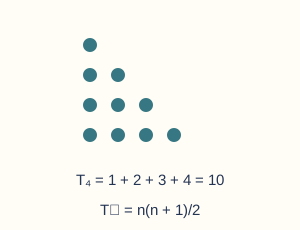
Triangular numbers — 1, 3, 6, 10, 15 add the next counting number each time. Let Tₙ mean the nth triangular number. Two copies of the dot triangle fit together to make a rectangle with n rows and n + 1 columns. It has n(n + 1) dots, so one triangle has half: Tₙ = n(n + 1)/2. For n = 4 this gives 4 × 5 ÷ 2 = 10.A triangular number. Original illustrative model. Full-size diagram
Fibonacci-type rules — Starting with 1, 1 and adding the previous two terms gives 1, 1, 2, 3, 5, 8. Both starting terms matter; changing them produces a different sequence with the same recurrence, meaning the rule that uses previous terms to make the next term.
Reasoning
Visual patterns — A row of n joined squares made from matchsticks needs 3n + 1 sticks: the first square needs 4 and every new square shares one side, adding 3. Explain the shared structure as well as listing totals.
Ambiguous continuation — The first few terms alone do not determine a unique infinite sequence. State the intended rule and test it against every supplied term; a plausible continuation is not proof of uniqueness.
Comparing rules — 3n + 1 and 2n + 7 give equal terms at the same position when n = 6. This connects sequence patterns to equations. Compare their growth rates as well as individual terms.
Test yourself
50 questions · Random sets of 10. These quick checks support revision; practise longer explanations and justified judgements too.
Mind map
Use the branches to recall the ideas and explain their connections. Check the revision notes for the full detail.
KS3MAT7 · 1
View KS3MAT7 · 1 mind mapOpen the full-size map to zoom. Use the printable view for A4 landscape or enlarge to A3.
 Mr Kidman's Classroom