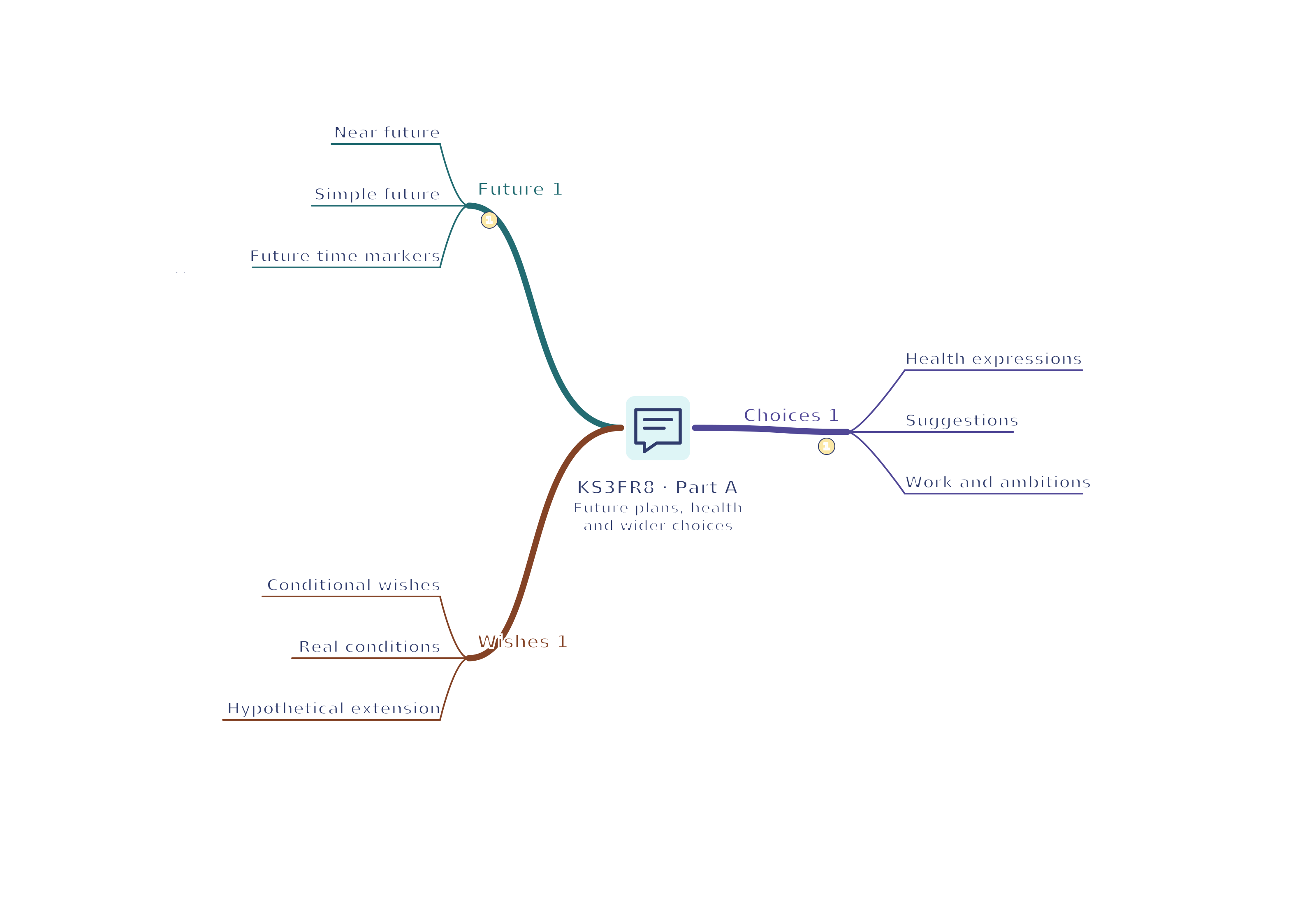
Near future — Use the present of aller plus an infinitive: je vais étudier, tu vas travailler, elle va voyager, nous allons jouer, vous allez lire, ils vont partir. Je vais aller au cinéma means I am going to go to the cinema. The second verb remains an infinitive.
Simple future — Many verbs keep the infinitive and add an ending matched to the subject: je -ai, tu -as, il/elle/on -a, nous -ons, vous -ez, ils/elles -ont. Je parlerai means I will speak; nous finirons means we will finish. Re verbs lose the final e: vendre → je vendrai. Useful irregular stems include ser- for être, aur- for avoir, ir- for aller and fer- for faire.
Future time markers — Demain, la semaine prochaine and l’année prochaine mean tomorrow, next week and next year. Plus tard means later. A present form can also convey a scheduled future with context, as in je pars demain. Learn how a sentence conveys time rather than treating a time word as a substitute for accurate grammar.
Wishes and conditions
Conditional wishes — Je voudrais means I would like; j’aimerais means I would like/love. Je voudrais devenir médecin expresses a career wish. The conditional often uses a future stem with imperfect endings. For example, voyager- + -ais gives je voyagerais (I would travel), while voyager- + -ions gives nous voyagerions (we would travel). Distinguish a wish from a statement that the event will certainly happen.
Real conditions — Si j’ai le temps, je jouerai au tennis means if I have time, I will play tennis. In this pattern si takes the present, not the future: si j’aurai is not the required form. Use a plausible condition and consequence rather than joining unrelated ideas.
Hypothetical extension — Si j’avais plus de temps, je lirais davantage means if I had more time, I would read more. The imperfect after si pairs here with the conditional result. This supporting pattern extends discussion; master present, past and future accounts before trying to include every structure in every paragraph.
Wellbeing and work
Health expressions — J’ai mal à la tête and j’ai mal au ventre mean my head hurts and my stomach hurts. Je suis fatigué/fatiguée describes feeling tired. These are language-learning examples, not a diagnosis or treatment plan; communicate an actual concern clearly to an appropriate adult or professional.
Suggestions — Il faut dormir suffisamment, manger varié et bouger régulièrement offers general language about sleep, varied food and movement. Tu pourrais te reposer means you could rest. Pour rester en forme gives a purpose. Avoid turning a language exercise into personalised medical advice.
Work and ambitions — Je voudrais travailler avec des enfants, devenir ingénieur/ingénieure or aider les autres gives varied ambitions. After devenir and être, occupations commonly appear without an indefinite article: je voudrais devenir médecin. Describe interests and skills without implying jobs belong to one gender.
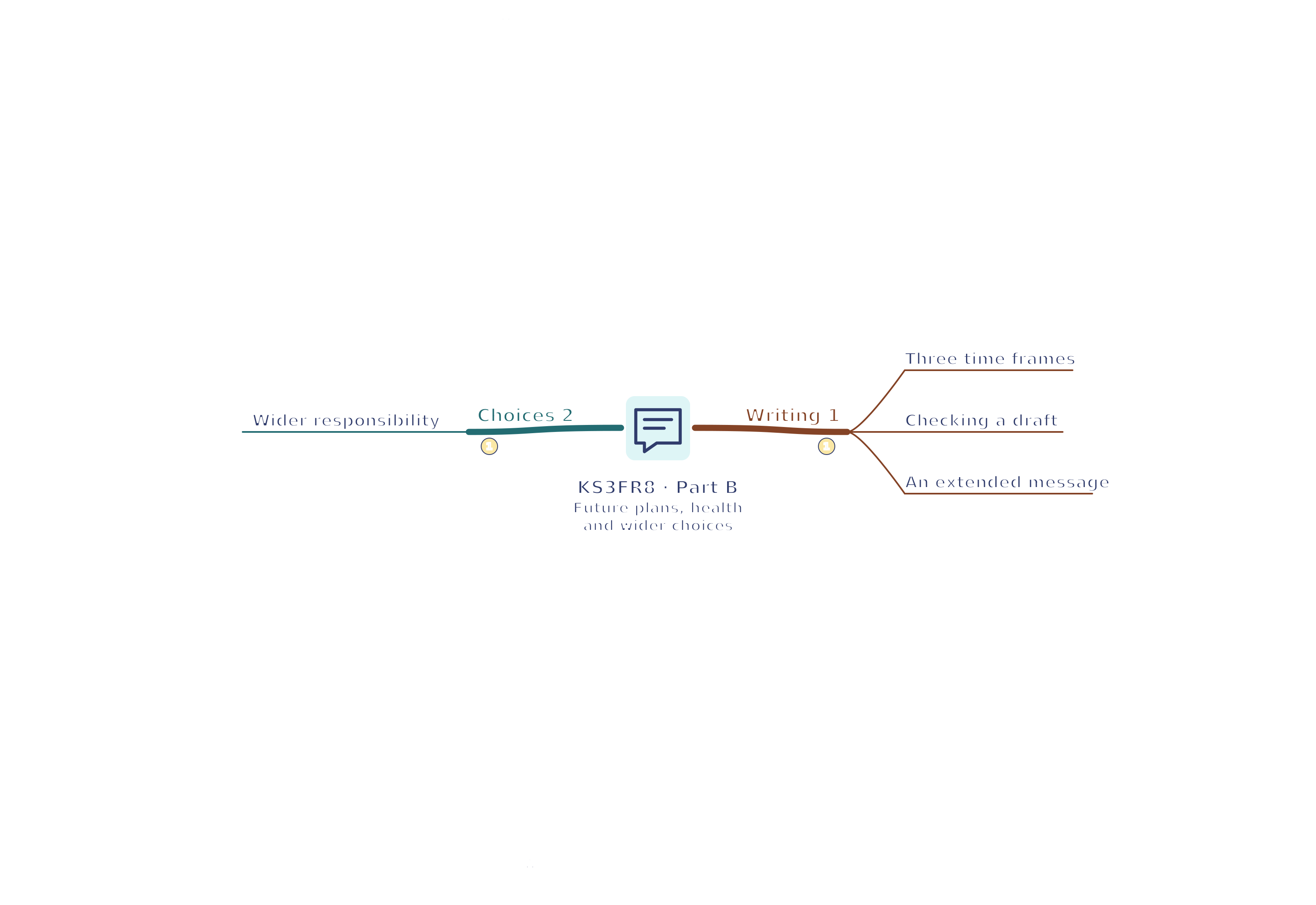
Wider responsibility — À l’avenir, on devra protéger l’environnement means in the future we will have to protect the environment. Je ferai du bénévolat means I will volunteer. Develop a reason, a possible obstacle and an action; this uses language beyond immediate personal preferences.
Connected writing
Three time frames — Le week-end, je joue au basket. Samedi dernier, j’ai joué avec mes amis. Samedi prochain, je vais regarder un match. Each sentence has a clear time and verb pattern. Use several time frames where the purpose needs them, not as an artificial checklist that makes the meaning incoherent.Present routine, completed past event and near-future plan each have a meaningful time expression and verb structure. Full-size diagram
Checking a draft — Underline the subject and conjugated verb in each clause. Check the time intended, endings, articles, adjective agreement, negatives, accents and word order. Read it aloud for sense, then revise one unclear idea. A longer paragraph with repeated errors is not automatically more effective communication.
An extended message — Write to a suitable fictional exchange partner about a past event, a present interest and a future plan. Include a reasoned view and a question that invites a response. Use a dictionary to verify unfamiliar words and grammatical information, then explain your choices without copying a machine-generated paragraph.
Test yourself
50 questions · Random sets of 10. These quick checks support revision; practise longer explanations and justified judgements too.
Mind map
Use the branches to recall the ideas and explain their connections. Check the revision notes for the full detail.
KS3FR8 · 1
View KS3FR8 · 1 mind mapOpen the full-size map to zoom. Use the printable view for A4 landscape or enlarge to A3.
 Mr Kidman's Classroom