Mr Kidman's Classroom



Revise the key ideas
Sound and spelling
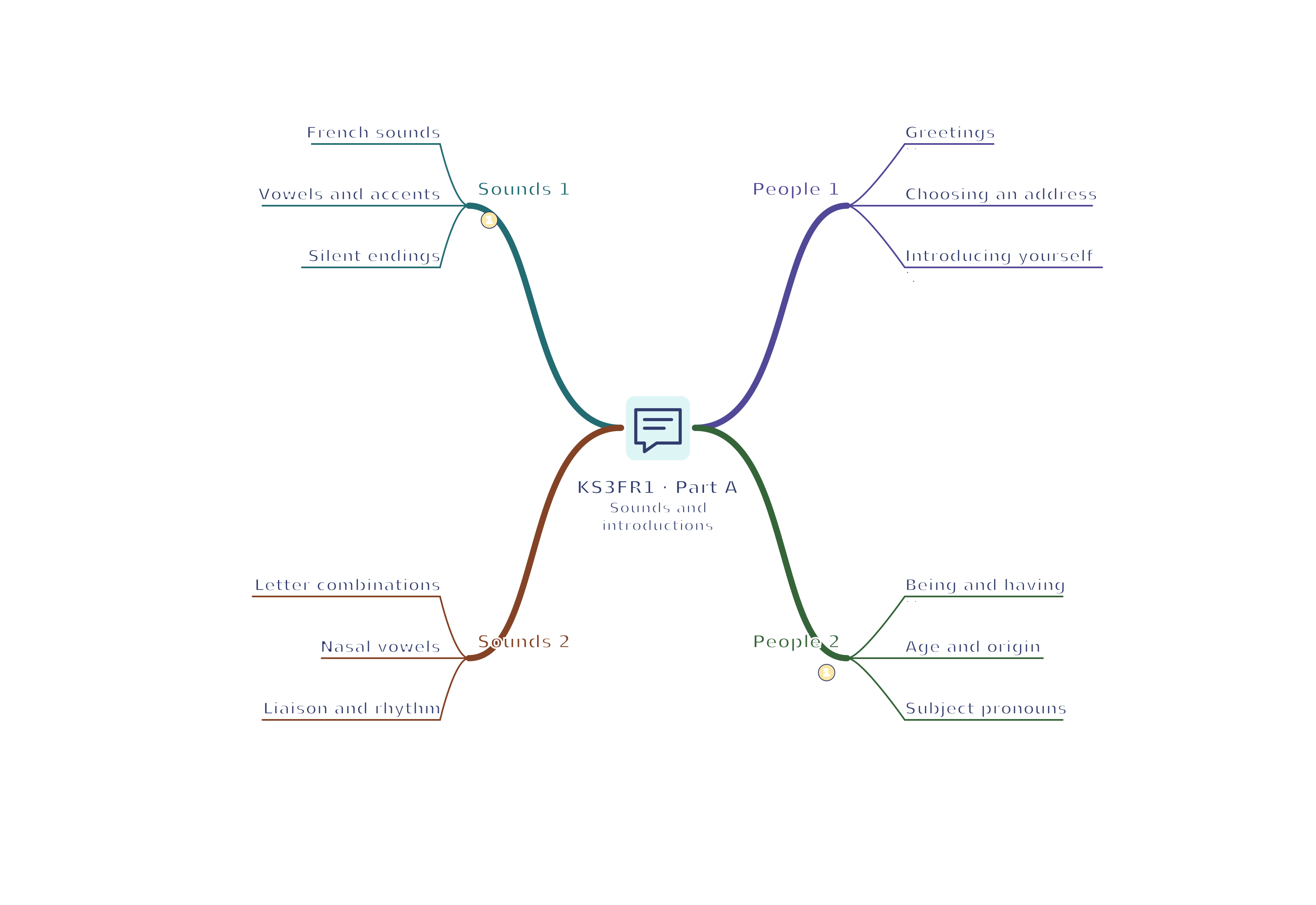
- French sounds — Read French with French sound patterns, rather than giving every letter its English sound. Listen to a model, repeat a short phrase, then record and compare it. Written guides are approximate: a teacher or clear recording helps distinguish sounds that English spelling cannot show reliably.
- Vowels and accents — In café, é usually represents a close e sound; è and ê often have a more open sound. Here close and open describe how open the mouth is for the vowel, not how loudly it is spoken. Listen to a clear model of café and père and repeat each vowel; the written labels alone cannot show the contrast. An accent is part of spelling, not decoration. Compare a, meaning has, with à, meaning to or at. Capitals can carry accents too: Élodie.
Close é and more open è · Original synthetic French practice, not an authentic conversation or exam extract. Listen to the vowel in café and then père. Repeat each word, then compare the vowel rather than the first consonant.
Read the sound-model words
café; père; café; père
- Silent endings — Many final consonants are silent: petit ends with a vowel sound in isolation. The final s of petits normally does not make an extra syllable. Do not apply this as an absolute rule: avec has an audible final consonant and pronunciation depends on the word and context.
- Letter combinations — In chat, ch has the sound heard at the start of English shop. In bonjour, j has the sound heard in the middle of English measure. In vous, ou is a rounded vowel; it differs from u in tu. Tu means you; tout can mean all/everything. Listen to a checked model of tu and tout, repeat each separately, then identify which one you hear without seeing the word. Their vowels differ even though both use rounded lips.
French u and ou · Original synthetic French practice, not an authentic conversation or exam extract. Listen to tu and tout in order, repeat them separately and compare the two rounded vowels.
Read the sound-model words
tu; tout; tu; tout
- Nasal vowels — In bon, the vowel is normally nasal: air passes through both the nose and mouth and the final n is not pronounced as a separate English n. In bonne, the n is heard. Contrast bon and bonne with a model; do not simply add an English n to every written on.
Nasal vowel and pronounced n · Original synthetic French practice, not an authentic conversation or exam extract. Listen to bon, then bonne. In bon there is no separate final n; in bonne the n is heard. Repeat the contrast.
Read the sound-model words
bon; bonne; bon; bonne
- Liaison and rhythm — In vous avez, the normally silent s can link to the following vowel with a z sound. Liaison is required in some combinations, optional in others and forbidden in others: do not link every final consonant. French rhythm groups words into meaningful phrases; stress is not placed on each word as in English.
Meeting people
- Greetings — Bonjour is a polite daytime greeting; bonsoir is used in the evening. Salut is informal and can mean hi or bye. Au revoir means goodbye. Merci and s’il vous plaît help an exchange sound courteous rather than just grammatically correct.
- Choosing an address — Tu addresses one familiar person; vous addresses more than one person or one person formally. Comment vous appelez-vous ? means What is your name? Use it when a formal introduction is appropriate. Follow your setting’s conventions rather than assuming everyone uses tu with strangers.
- Introducing yourself — Je m’appelle Léa means my name is Léa. Tu t’appelles comment ? is a common spoken question. The apostrophe in m’appelle replaces the missing e of me before a vowel; it is not an English possessive apostrophe.
- Being: être — Être means to be. Je suis = I am; tu es = you are (familiar singular); il/elle/on est = he/she is or we are with on; nous sommes = we are; vous êtes = you are (formal singular or plural); ils/elles sont = they are.
- Having: avoir — Avoir means to have. J’ai = I have; tu as = you have; il/elle/on a = he/she has or we have with on; nous avons = we have; vous avez = you have; ils/elles ont = they have. Learn forms with their subject, not as unrelated translations.
- Age and origin — J’ai douze ans means I am twelve years old: French uses avoir for age. Je suis britannique means I am British. J’habite à Leeds means I live in Leeds. Do not translate English word by word as je suis douze or je suis habite.
- Subject pronouns — Subject pronouns stand in for the person or group doing or being something: je = I, tu = you (one familiar person), il = he/it, elle = she/it, nous = we, vous = you (formal singular or plural), and ils/elles = they. On often means we in everyday conversation but takes a singular verb: on est, on a. Ils can refer to a mixed group; elles refers to an all-feminine group. Use language respectfully when referring to actual people.
Numbers and questions
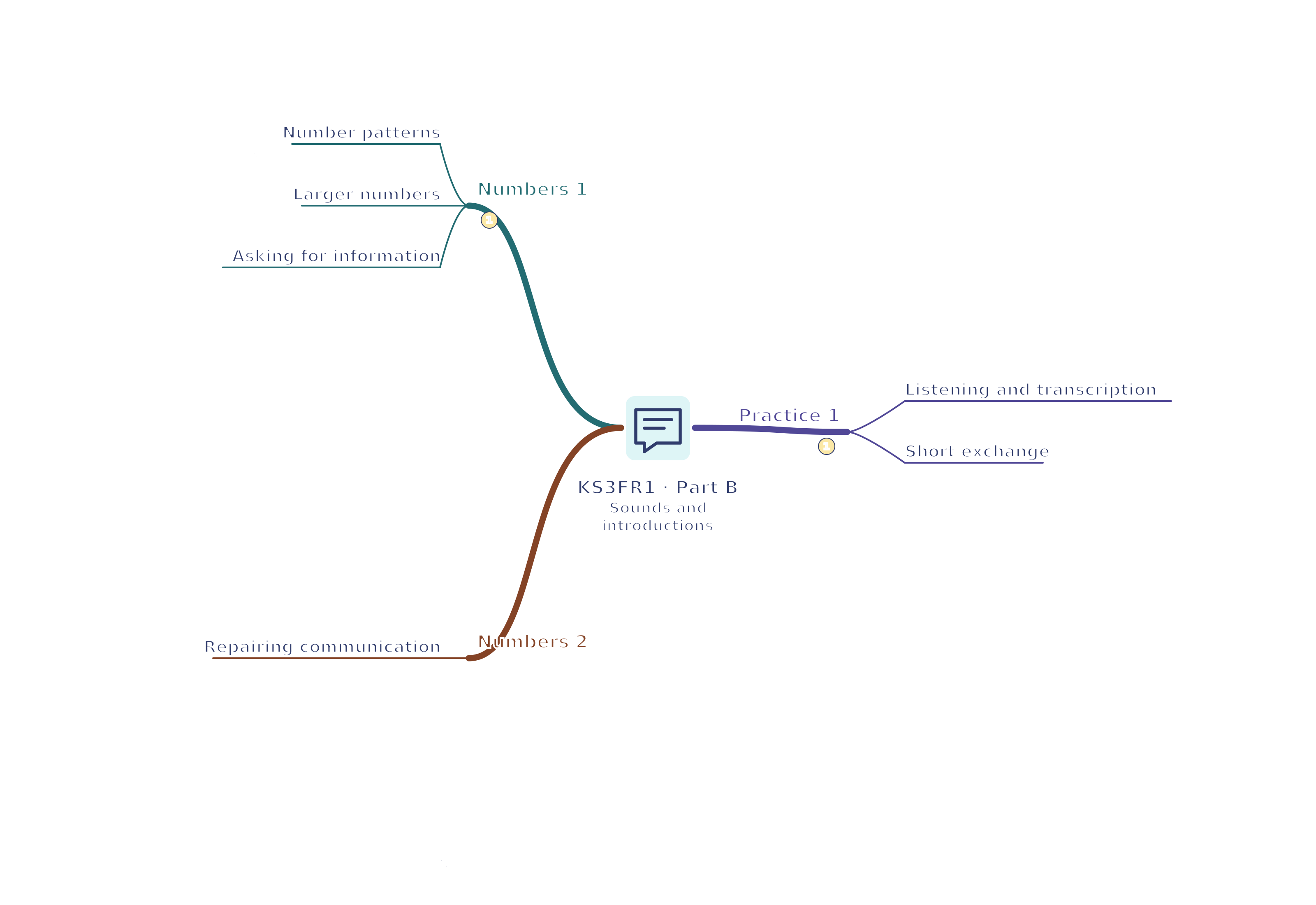
- Number patterns — Learn zéro, un, deux, trois, quatre, cinq, six, sept, huit, neuf, dix, onze, douze, treize, quatorze, quinze and seize. Then combine dix-sept, dix-huit and dix-neuf. Vingt means twenty. Vingt et un means twenty-one and contains et; vingt-deux means twenty-two and does not. The words zéro to seize listed here mean the numbers 0 to 16 in order; dix-sept, dix-huit and dix-neuf mean 17, 18 and 19. Say numbers aloud as well as recognising their written form.
- Larger numbers — Trente, quarante, cinquante and soixante mean thirty to sixty. In standard French as used in France, soixante-dix is seventy, quatre-vingts is eighty and quatre-vingt-dix is ninety. Quatre-vingt-un loses the final s of quatre-vingts. Regional French varieties can use different number words; they are not inherently incorrect.
- Asking for information — Comment means how, où means where, quand means when and pourquoi means why. Quel âge as-tu ? asks age; Où habites-tu ? asks where someone lives. In speech, Tu habites où ? is common. Intonation means the rise and fall of the voice. Est-ce que introduces a question without swapping the subject and verb. Inversion swaps their order, as in habites-tu instead of tu habites. These provide different ways to form questions.
- Repairing communication — Pardon ? and Vous pouvez répéter, s’il vous plaît ? request repetition. Plus lentement, s’il vous plaît asks for slower speech. Comment dit-on … en français ? asks for a word. These phrases let a conversation continue when a response is unexpected.
Independent practice
- Listening and transcription — First listen for the speaker and overall situation, then for details such as name, age and place. To transcribe, listen again to a short section and write the French actually heard. Check accents, apostrophes and silent endings against the grammar; do not replace an unfamiliar word with an English guess.
Introduction · Original synthetic practice speech, not an authentic recording or exam extract. Before opening the transcript, identify the name, age, town and interest. Replay and transcribe the final question.
Read the practice transcript
Bonjour ! Je m’appelle Inès. J’ai quatorze ans et j’habite à Lille. J’aime la musique. Et toi, où habites-tu ?
- Short exchange — Model: Bonjour ! Je m’appelle Sami. J’ai treize ans et j’habite à York. Et toi ? Reply with your own or a fictional identity and ask a follow-up question. Change the age and location so that the exchange uses language rather than memorising only one script.